Helmut Kolle (Helmut Vom Hügel)
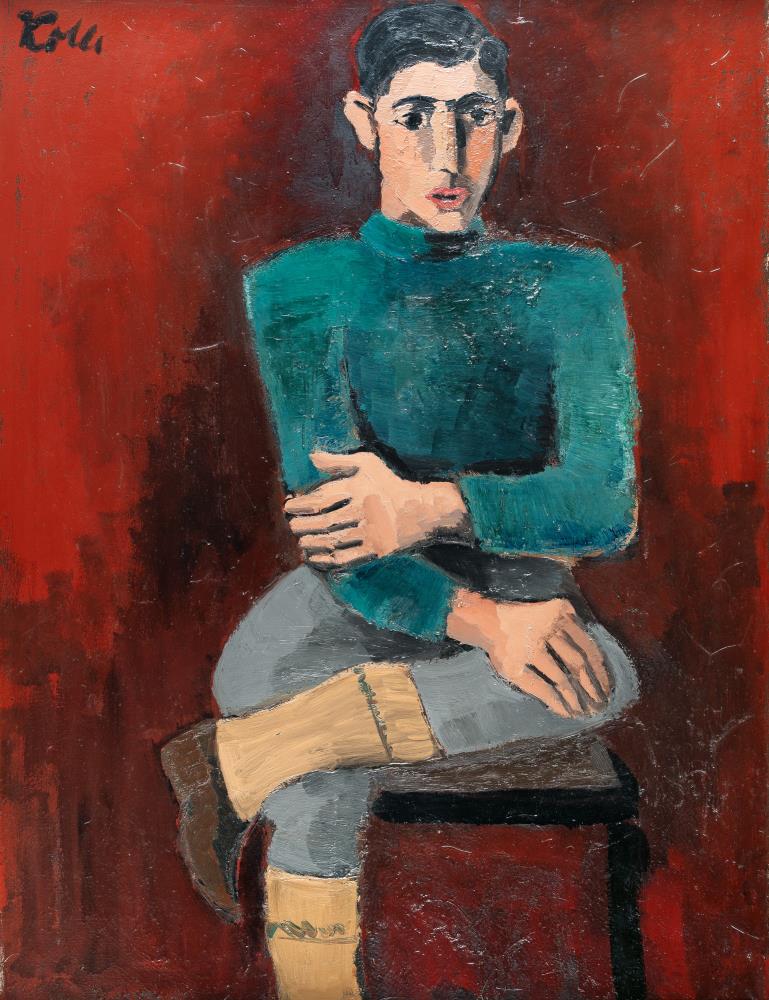
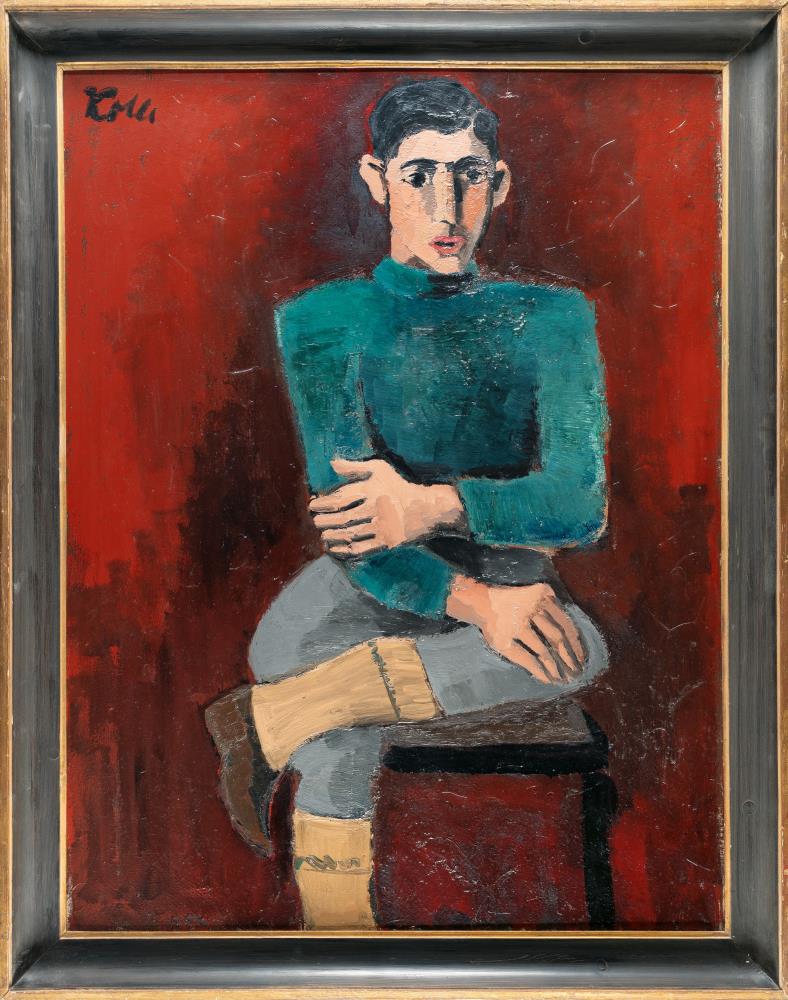
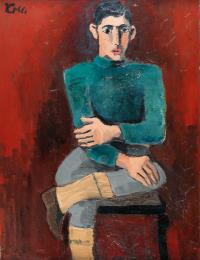
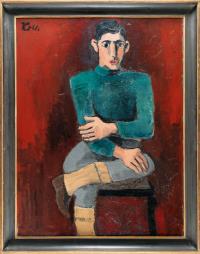
Young man seated in riding breeches
Artist
Helmut Kolle (Helmut Vom Hügel)
1899 Berlin - Chantilly 1931
Further information
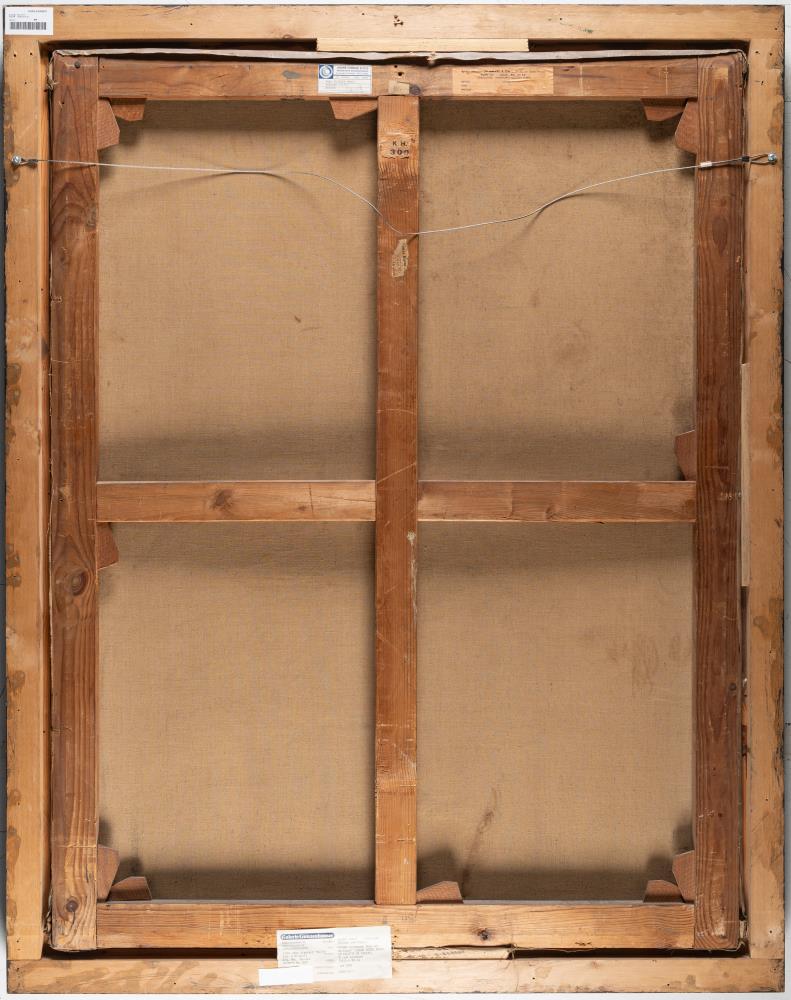
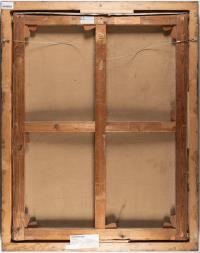
Verso auf dem Keilrahmen mit kleinen Etiketten "6." (handschriftlich) und "K.H. 300", einem Etikettfragment der Spedition "Gustav Knauer" mit gestempelter Nummer "7500" sowie zwei neueren französischen Speditionsetiketten, eines mit dem typografischen Vermerk "Karl Flinker".
Chabert 250.
Chabert 250.
Exhibition
Helmut Kolle (1899–1931): Der Frühvollendete, Galerie Gunzenhauser, München 1996.
Provenance
A. Michelis Collection, Paris;
Mme Jakimov Collection, Paris;
Karl Flinker Gallery/Collection (1923–1991), Paris;
Galerie Gunzenhauser, Munich, with the label on the reverse;
Private collection, Bavaria, acquired from the aforementioned in C. 2005.
Mme Jakimov Collection, Paris;
Karl Flinker Gallery/Collection (1923–1991), Paris;
Galerie Gunzenhauser, Munich, with the label on the reverse;
Private collection, Bavaria, acquired from the aforementioned in C. 2005.
Share


Description
• A colour-rich work by the sensitive Helmut Kolle
• Helmut Kolle was championed by Wilhelm Uhde and introduced to the French art scene
• Works of quiet grandeur and intellectual intensity, found in many public collections
During his lifetime in Germany, Helmut Kolle was derided as an ‘eroticising Frenchman’. But what is erotic about the image of a young man, lonely and barely fitting within the frame of the canvas, forced onto a chair in a void of furious red, thoughtfully embracing himself? Is Kolle not rather depicting here the isolation of young men, trapped in toxic expectations and self-imposed demands?
Helmut Kolle was born in Berlin in 1899. In 1917/18, he met Wilhelm Uhde, who was 20 years his senior. Uhde became not only his life partner but also his patron. He took Kolle under his wing and brought him to France. Uhde, the art dealer and patron, introduced Kolle to art circles – including Alfred Flechtheim, who was also homosexual. Kolle’s partner works successfully to position his work. His paintings, often depictions – or even portraits? – of young men, are stereotypes of male-male desire, homosexual projection surfaces such as boxers, sailors or horsemen. Yet they are more than mere decals. They are more than studies of male isolation. They are psychograms of the painter, indeed of an entire world: Helmut Kolle’s paintings deal neither solely with desire nor merely with toxic expectations. They are situated at the point where the disorientation of young men meets the loneliness of queer adolescence. In doing so, Kolle creates a style entirely his own. References to New Objectivity forms, at once sensual and intimate; rough forms and meticulous balances blend effortlessly together.
When Kolle, who had been ill for a long time, died in 1931, just one year after the painting offered here was created, his life’s work was completed too soon. Yet even during his lifetime, the artist’s work was so highly regarded and well-known that he was subjected to the dubious ‘pleasure’ of ridicule. Today, this has faded; his works can be found in major museum collections: in Munich at the Lenbachhaus as well as the Pinakothek der Moderne, and internationally at the Musée National d’Art Moderne in Paris, for example.
• Helmut Kolle was championed by Wilhelm Uhde and introduced to the French art scene
• Works of quiet grandeur and intellectual intensity, found in many public collections
During his lifetime in Germany, Helmut Kolle was derided as an ‘eroticising Frenchman’. But what is erotic about the image of a young man, lonely and barely fitting within the frame of the canvas, forced onto a chair in a void of furious red, thoughtfully embracing himself? Is Kolle not rather depicting here the isolation of young men, trapped in toxic expectations and self-imposed demands?
Helmut Kolle was born in Berlin in 1899. In 1917/18, he met Wilhelm Uhde, who was 20 years his senior. Uhde became not only his life partner but also his patron. He took Kolle under his wing and brought him to France. Uhde, the art dealer and patron, introduced Kolle to art circles – including Alfred Flechtheim, who was also homosexual. Kolle’s partner works successfully to position his work. His paintings, often depictions – or even portraits? – of young men, are stereotypes of male-male desire, homosexual projection surfaces such as boxers, sailors or horsemen. Yet they are more than mere decals. They are more than studies of male isolation. They are psychograms of the painter, indeed of an entire world: Helmut Kolle’s paintings deal neither solely with desire nor merely with toxic expectations. They are situated at the point where the disorientation of young men meets the loneliness of queer adolescence. In doing so, Kolle creates a style entirely his own. References to New Objectivity forms, at once sensual and intimate; rough forms and meticulous balances blend effortlessly together.
When Kolle, who had been ill for a long time, died in 1931, just one year after the painting offered here was created, his life’s work was completed too soon. Yet even during his lifetime, the artist’s work was so highly regarded and well-known that he was subjected to the dubious ‘pleasure’ of ridicule. Today, this has faded; his works can be found in major museum collections: in Munich at the Lenbachhaus as well as the Pinakothek der Moderne, and internationally at the Musée National d’Art Moderne in Paris, for example.