Amedeo Modigliani
Cariatide



Artist
Amedeo Modigliani
Additional Description
Bleistift und Grafit auf Velin von Canson & Montgolfier. (1913). Ca. 63,5 x 49 cm. Signiert unten rechts.
Period
(1884 Livorno - Paris 1920)
Technique
Works on paper
Ausstellung
FIAC, Grand Palais, Paris 1982 ; Modigliani. Aquarelles/Dessins, Le Point Galerie d'Art Moderne, Monte-Carlo, 1982, Kat.-Nr. 7, Abb. ; Modigliani, Centre Cultural Caixa des Pensions, Barcelona 1983, S. 114 ; Modigliani, Sala de Exposiciones de la Caja Pensiones, Madrid 1983, Kat.-Nr. 49, S. 122, mit dem Stempel auf der Rahmenabdeckung.
Provenance
Sammlung Udo Aleksander Einsild (1897-1957), Paris und Monte-Carlo; Privatsammlung, Italien; Ketterer, München 2.6.2006, Los 344; Privatsammlung.
Share


Description
• Significant, large-format work from Modigliani's transitional phase between sculpture and drawing
• Drawing from the Caryatids series, a key theme in Modigliani's oeuvre
• Work exhibited internationally several times
Around 1913, Amedeo Modigliani had been living in Paris for several years, in the neighbourhood of Montmartre and Montparnasse. He belonged to the circle around Constantin Brâncuși, Pablo Picasso and Diego Rivera and was searching for his own artistic language between tradition and modernity. After initially exploring Symbolism, he increasingly turned to sculpture. During this time, he worked on a series of stone figures characterised by a strict, rhythmic form and reduced design.
At the same time, he produced numerous drawings in which he translated his sculptural ideas into two-dimensional form. These sheets form the basis for the development of the clear, linear aesthetic that characterises his entire later work.
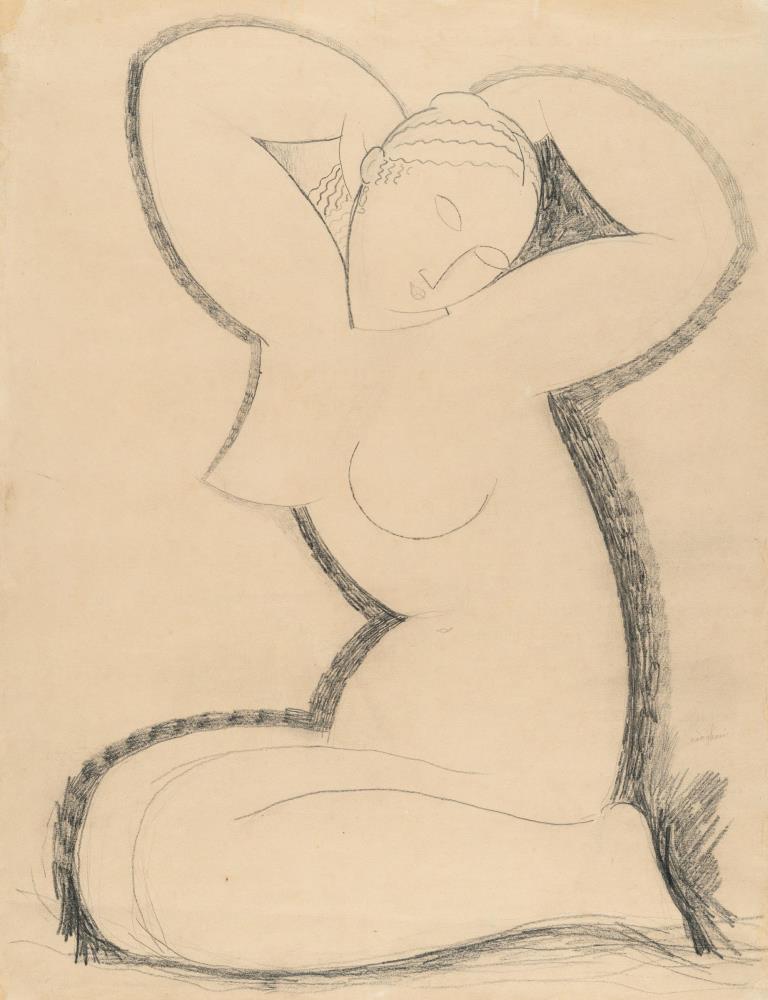
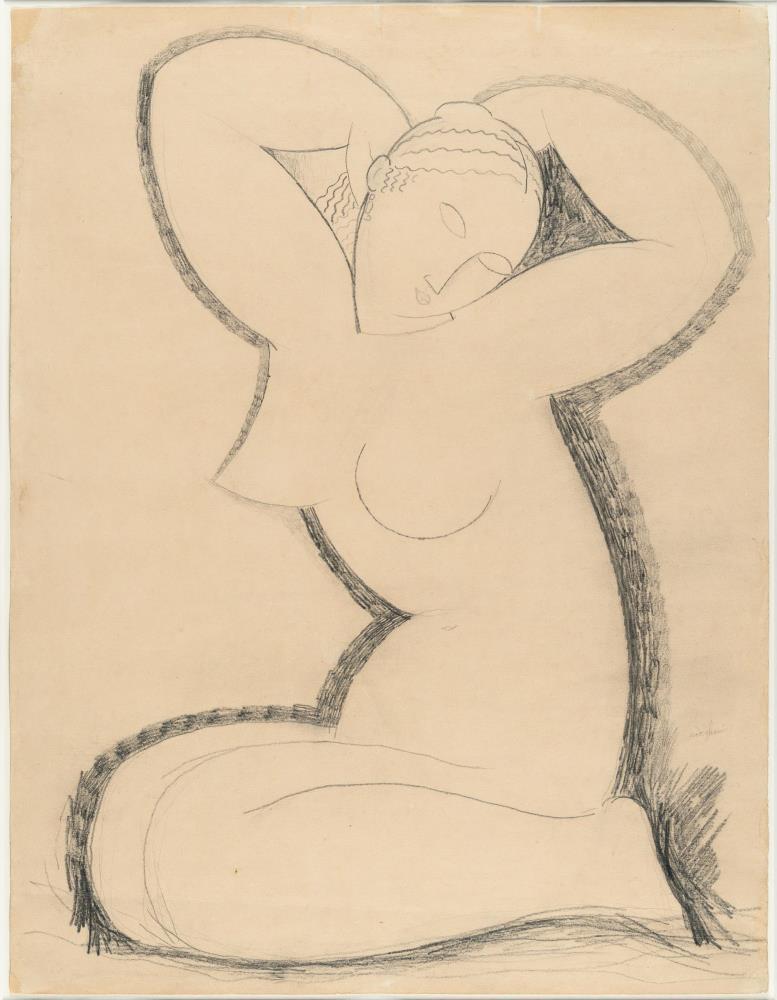
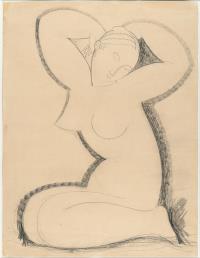
Our drawing Cariatide was created in 1913 during this productive phase. Modigliani translates the motif of the female figure carrying the figure into a modern, abstracted pictorial language and changes the posture in favour of a kneeling position: the figure sits on her lower legs pointing to the left, her upper body turned slightly towards the viewer. The arms are bent and brought together behind the head, the head with the hair combed back into a knot is tilted to the right. The closed eyes of the graceful figure radiate calm and sensuality.
Modigliani uses a few, precise lines to determine proportion, posture and spatial effect;
volume is created solely through the course of the lines and the accentuation of the contours through countless hatchings. The reduced drawing without internal structure with strongly emphasised outlines refers to the artist's sculptural character.
The group of caryatids is closely linked to Modigliani's interest in ancient, African and South-East Asian sculpture, which he studied at the Musée du Trocadéro and the Louvre. These influences lead him to a simplified, rhythmic formal language that combines the classical with the modern. In a balanced relationship between statics and dynamics, closed and open form, Modigliani lends the lines support and shape, thus making reference to the original, supporting function of the ancient column figures.
The Cariatide occupies a key position within Modigliani's oeuvre. It marks the transition from the sculptural to the graphic phase and summarises the central principles of his style: the emphasis on the line, the reduction to the essentials and the harmonious combination of figure and space.
In its clear composition and concentrated calm, our drawing embodies the essence of Modigliani's artistic language – a work that unites the spirit of both antiquity and modernity.
The work was requested by the Institut Restellini. Confirmation was not yet available at the time of going to press. Parisot I 18/13,
with a photographic expertise by Hanka Zborowska, Paris, dated 10.1.1958, also confirmed there by Lunia Czechowska;
with a photographic expertise by Arthur S. Pfannstiel, Hamburg, dated 19.3.1960;
with a photographic expertise by Joseph Lanthemann dated 9.5.1977, confirming that the drawing will be included in the Supplement to the Catalogue raisonné under no. 542b.
With a photo-certificate by Christian Parisot "Modigliani Institut Archives Legales", Paris, dated 16 April 2006.
Exhibition: FIAC, Grand Palais, Paris 1982;
Modigliani. Aquarelles/Dessins, Le Point Galerie d'Art Moderne, Monte-Carlo, 1982, cat. no. 7, illus.;
Modigliani, Centre Cultural Caixa des Pensions, Barcelona 1983, p. 114;
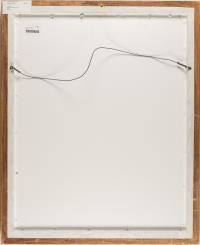
Modigliani, Sala de Exposiciones de la Caja Pensiones, Madrid 1983, cat. no. 49, p. 122, with the stamp on the frame cover.
• Drawing from the Caryatids series, a key theme in Modigliani's oeuvre
• Work exhibited internationally several times
Around 1913, Amedeo Modigliani had been living in Paris for several years, in the neighbourhood of Montmartre and Montparnasse. He belonged to the circle around Constantin Brâncuși, Pablo Picasso and Diego Rivera and was searching for his own artistic language between tradition and modernity. After initially exploring Symbolism, he increasingly turned to sculpture. During this time, he worked on a series of stone figures characterised by a strict, rhythmic form and reduced design.
At the same time, he produced numerous drawings in which he translated his sculptural ideas into two-dimensional form. These sheets form the basis for the development of the clear, linear aesthetic that characterises his entire later work.
Our drawing Cariatide was created in 1913 during this productive phase. Modigliani translates the motif of the female figure carrying the figure into a modern, abstracted pictorial language and changes the posture in favour of a kneeling position: the figure sits on her lower legs pointing to the left, her upper body turned slightly towards the viewer. The arms are bent and brought together behind the head, the head with the hair combed back into a knot is tilted to the right. The closed eyes of the graceful figure radiate calm and sensuality.
Modigliani uses a few, precise lines to determine proportion, posture and spatial effect;
volume is created solely through the course of the lines and the accentuation of the contours through countless hatchings. The reduced drawing without internal structure with strongly emphasised outlines refers to the artist's sculptural character.
The group of caryatids is closely linked to Modigliani's interest in ancient, African and South-East Asian sculpture, which he studied at the Musée du Trocadéro and the Louvre. These influences lead him to a simplified, rhythmic formal language that combines the classical with the modern. In a balanced relationship between statics and dynamics, closed and open form, Modigliani lends the lines support and shape, thus making reference to the original, supporting function of the ancient column figures.
The Cariatide occupies a key position within Modigliani's oeuvre. It marks the transition from the sculptural to the graphic phase and summarises the central principles of his style: the emphasis on the line, the reduction to the essentials and the harmonious combination of figure and space.
In its clear composition and concentrated calm, our drawing embodies the essence of Modigliani's artistic language – a work that unites the spirit of both antiquity and modernity.
The work was requested by the Institut Restellini. Confirmation was not yet available at the time of going to press. Parisot I 18/13,
with a photographic expertise by Hanka Zborowska, Paris, dated 10.1.1958, also confirmed there by Lunia Czechowska;
with a photographic expertise by Arthur S. Pfannstiel, Hamburg, dated 19.3.1960;
with a photographic expertise by Joseph Lanthemann dated 9.5.1977, confirming that the drawing will be included in the Supplement to the Catalogue raisonné under no. 542b.
With a photo-certificate by Christian Parisot "Modigliani Institut Archives Legales", Paris, dated 16 April 2006.
Exhibition: FIAC, Grand Palais, Paris 1982;
Modigliani. Aquarelles/Dessins, Le Point Galerie d'Art Moderne, Monte-Carlo, 1982, cat. no. 7, illus.;
Modigliani, Centre Cultural Caixa des Pensions, Barcelona 1983, p. 114;
Modigliani, Sala de Exposiciones de la Caja Pensiones, Madrid 1983, cat. no. 49, p. 122, with the stamp on the frame cover.