Walter Stöhrer
„Die Ungeduld der Gegenstände, das zu sein, was wir zu tun fürchten“


Artist
Walter Stöhrer
Provenance
Galerie Georg Nothelfer, Berlin; Privatsammlung, Süddeutschland.
Share


Description
- Characteristic large format in the artist's preferred green colors blue, yellow and red
- In the artist's unmistakable furious-gestural signature
- Stöhrer is one of the outstanding German post-war artists beyond the Informel
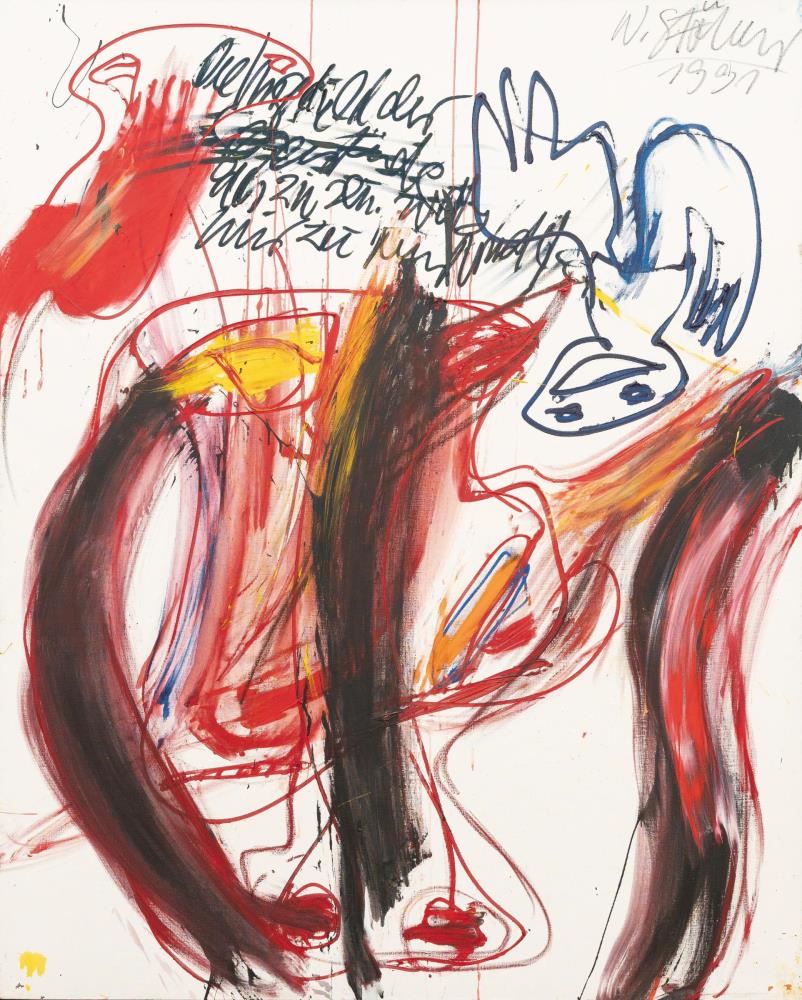
Later works such as "Die Ungeduld der Gegenstände, das zu sein, was wir fürchten zu tun" also display Walter Stöhrer's unmistakable signature. He paints in a gestural-furious manner on large formats, predominantly in the primary colors blue, yellow and red, often leaving the white ground of the canvas. In this case, a further dimension is added, as the title of the work, which is difficult to read, becomes an essential design element. Stöhrer was influenced early on by the American artists Cy Twombly and Jackson Pollock, as well as the figurative representations of Pierre Alechinsky and Asger Jorn. However, the great peculiarity of his eruptive color trails, his very honest painting, is that it takes a convincingly individual and "figurative" path. The expressively gestural and the consistently figurative, which can hardly be united in art after 1945, are brought together by Stöhrer with great painterly power.
Brinkmann/Bose 91.2.
- In the artist's unmistakable furious-gestural signature
- Stöhrer is one of the outstanding German post-war artists beyond the Informel
Later works such as "Die Ungeduld der Gegenstände, das zu sein, was wir fürchten zu tun" also display Walter Stöhrer's unmistakable signature. He paints in a gestural-furious manner on large formats, predominantly in the primary colors blue, yellow and red, often leaving the white ground of the canvas. In this case, a further dimension is added, as the title of the work, which is difficult to read, becomes an essential design element. Stöhrer was influenced early on by the American artists Cy Twombly and Jackson Pollock, as well as the figurative representations of Pierre Alechinsky and Asger Jorn. However, the great peculiarity of his eruptive color trails, his very honest painting, is that it takes a convincingly individual and "figurative" path. The expressively gestural and the consistently figurative, which can hardly be united in art after 1945, are brought together by Stöhrer with great painterly power.
Brinkmann/Bose 91.2.