Gustav Klimt
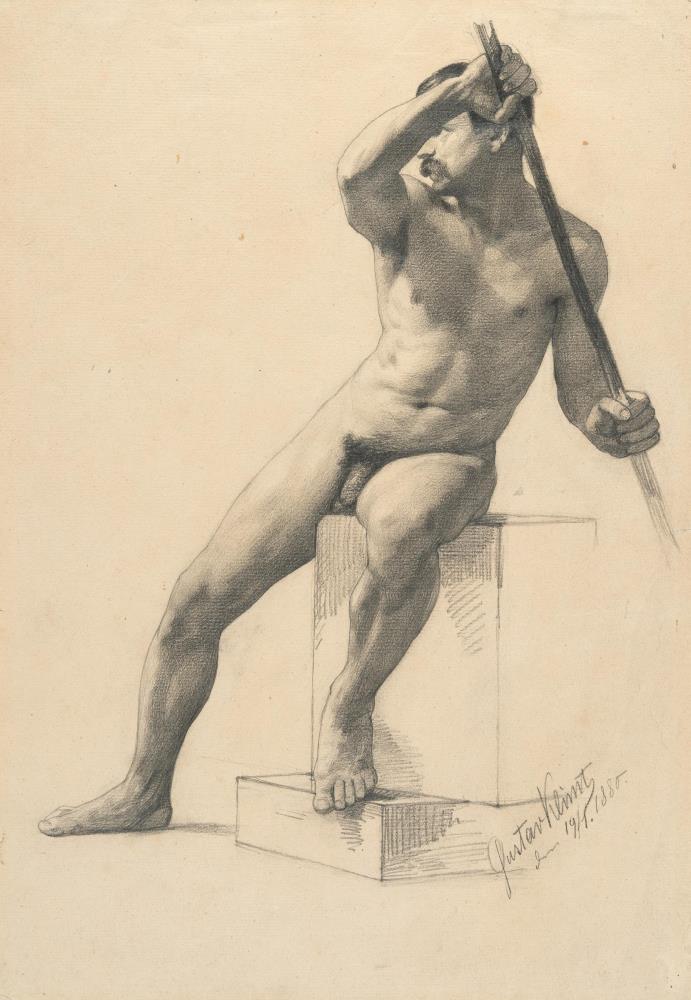
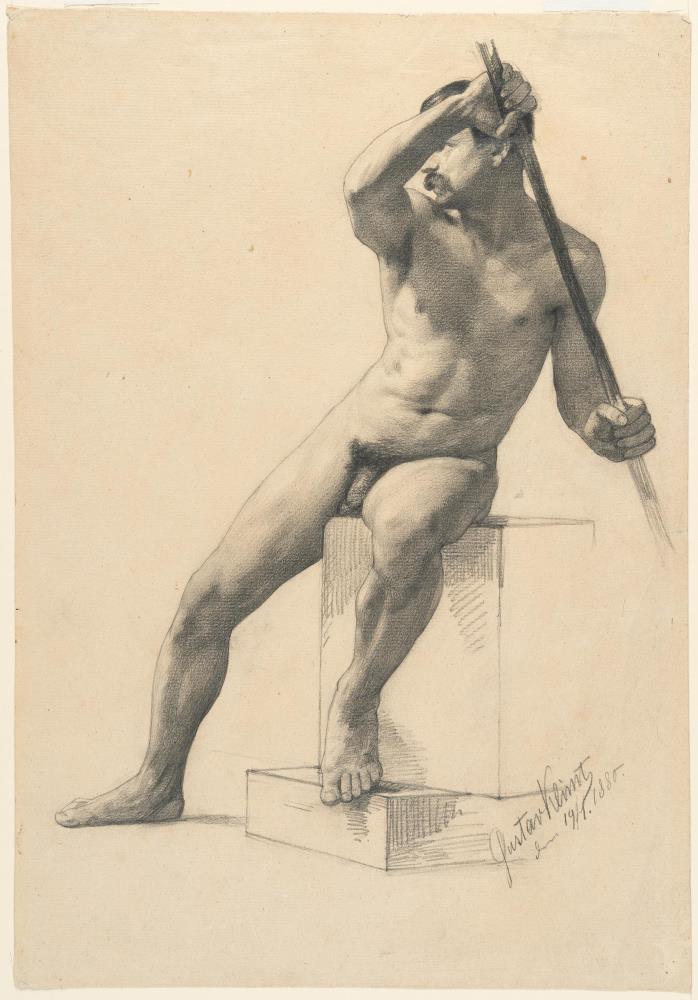
Sitzender Männerakt mit Stab

Artist
Gustav Klimt
Ausstellung
Gustav Klimt, Serge Sabarsky Gallery, New York, 1979, Kat.-Nr. 19, Abb. ;
Gustav Klimt. 100 disegni, Pinacoteca Capitolina, Rom, u.a., 1983–1986, Kat.-Nr. 3, Abb. ;
Gustav Klimt. Zeichnungen aus amerikanischem Privatbesitz ausgewählt von Serge Sabarsky und aus Beständen des Historischen Museums der Stadt Wien, Historisches Museum der Stadt Wien, u.a., 1984–1985, Kat.-Nr. 2, Abb. ;
Gustav Klimt. 100 Zeichnungen, Tiroler Landesmuseum Ferdinandeum, Innsbruck, u.a., 1987–1997, Kat.-Nr. 5, Abb. ;
Gustav Klimt, Nassau County Museum of Art, Roslyn, u.a. 1989-1992 ;
Klimt. Schiele. Kokoschka, Musée des Beaux-Arts de Rouen, Rouen, 1995, Kat.-Nr. 62, Abb. ;
Gustav Klimt. 150th Anniversary Celebration, Neue Galerie, New York, 2012 ;
Klimt Landscapes, Neue Galerie, New York, 2024.
Gustav Klimt. 100 disegni, Pinacoteca Capitolina, Rom, u.a., 1983–1986, Kat.-Nr. 3, Abb. ;
Gustav Klimt. Zeichnungen aus amerikanischem Privatbesitz ausgewählt von Serge Sabarsky und aus Beständen des Historischen Museums der Stadt Wien, Historisches Museum der Stadt Wien, u.a., 1984–1985, Kat.-Nr. 2, Abb. ;
Gustav Klimt. 100 Zeichnungen, Tiroler Landesmuseum Ferdinandeum, Innsbruck, u.a., 1987–1997, Kat.-Nr. 5, Abb. ;
Gustav Klimt, Nassau County Museum of Art, Roslyn, u.a. 1989-1992 ;
Klimt. Schiele. Kokoschka, Musée des Beaux-Arts de Rouen, Rouen, 1995, Kat.-Nr. 62, Abb. ;
Gustav Klimt. 150th Anniversary Celebration, Neue Galerie, New York, 2012 ;
Klimt Landscapes, Neue Galerie, New York, 2024.
Provenance
Erich Lederer, Genf;
Serge Sabarsky Gallery, New York, 1976 bei Vorgenanntem erworben;
Jose Martinez, 1976 bei Vorgenannter erworben;
Serge Sabarsky Gallery, New York, 1979 bei Vorgenanntem erworben;
Sammlung/Nachlass Serge Sabarsky, New York;
Sammlung/Stiftung Vally Sabarsky, New York.
Serge Sabarsky Gallery, New York, 1976 bei Vorgenanntem erworben;
Jose Martinez, 1976 bei Vorgenannter erworben;
Serge Sabarsky Gallery, New York, 1979 bei Vorgenanntem erworben;
Sammlung/Nachlass Serge Sabarsky, New York;
Sammlung/Stiftung Vally Sabarsky, New York.
Share


Description
- From the early phase of Gustav Klimt's work
- The drawing shows the mastery of academic nude drawing in the spirit of tradition
- From the collection of Erich Lederer
At the height of his career, Gustav Klimt rebelled against tradition. He will find a new way of painting, his figures will be unprecedented and unheard of, his colors fresh. He would invent compositions that would offend his clients. And finally, he will achieve world fame with precisely this new style.
However, in 1880, when he was just 18 years old, Gustav Klimt was still following the academic-traditional path. Until 1883, he was enrolled as a student at the Vienna School of Arts and Crafts of the Imperial and Royal Austrian Museum of Art and Industry. There he learned the necessary tools of the trade. At the end of the 19th century, this also included a course in nude drawing. In addition to the anatomy course, in which the students - women were rarely if ever admitted to the art academies in the DACH region at this time - learned about the innermost parts of the human being, they were also taught to depict human movement sequences on a living subject in the nude drawing room. In the youngest semesters, they first learn how to imitate muscle formations and frozen movement, as the ancients formed them, or to transfer them into two-dimensionality, using plaster casts of classical sculpture. In the nude drawing course, living people, almost exclusively men, are then available. These are day laborers and other people with precarious financial conditions who put themselves through the physically difficult work of modeling. The poses, imitations of antique sculpture or challenging contortions, have to be held for hours. On the sheet offered here, for example, we see a muscular male nude - perhaps a worker whose activity worked out the muscles in this way - the staff certainly also serves to support him during the long sitting process.
The present sheet eventually found its way into Erich Lederer's collection. The son of Serena and August Lederer knew his parents' friend well, as he was in and out of the family home. When Erich was 15, Klimt put him in touch with the 19-year-old Egon Schiele, who would paint the adolescent. This led to a long and close relationship between Erich and Egon until Schiele's death. Erich Lederer would not only go on to acquire numerous works by Schiele and thus support him financially, he would also add works by his family friend Klimt to his collection.
Strobl 3178.
- The drawing shows the mastery of academic nude drawing in the spirit of tradition
- From the collection of Erich Lederer
At the height of his career, Gustav Klimt rebelled against tradition. He will find a new way of painting, his figures will be unprecedented and unheard of, his colors fresh. He would invent compositions that would offend his clients. And finally, he will achieve world fame with precisely this new style.
However, in 1880, when he was just 18 years old, Gustav Klimt was still following the academic-traditional path. Until 1883, he was enrolled as a student at the Vienna School of Arts and Crafts of the Imperial and Royal Austrian Museum of Art and Industry. There he learned the necessary tools of the trade. At the end of the 19th century, this also included a course in nude drawing. In addition to the anatomy course, in which the students - women were rarely if ever admitted to the art academies in the DACH region at this time - learned about the innermost parts of the human being, they were also taught to depict human movement sequences on a living subject in the nude drawing room. In the youngest semesters, they first learn how to imitate muscle formations and frozen movement, as the ancients formed them, or to transfer them into two-dimensionality, using plaster casts of classical sculpture. In the nude drawing course, living people, almost exclusively men, are then available. These are day laborers and other people with precarious financial conditions who put themselves through the physically difficult work of modeling. The poses, imitations of antique sculpture or challenging contortions, have to be held for hours. On the sheet offered here, for example, we see a muscular male nude - perhaps a worker whose activity worked out the muscles in this way - the staff certainly also serves to support him during the long sitting process.
The present sheet eventually found its way into Erich Lederer's collection. The son of Serena and August Lederer knew his parents' friend well, as he was in and out of the family home. When Erich was 15, Klimt put him in touch with the 19-year-old Egon Schiele, who would paint the adolescent. This led to a long and close relationship between Erich and Egon until Schiele's death. Erich Lederer would not only go on to acquire numerous works by Schiele and thus support him financially, he would also add works by his family friend Klimt to his collection.
Strobl 3178.