Gustav Klimt
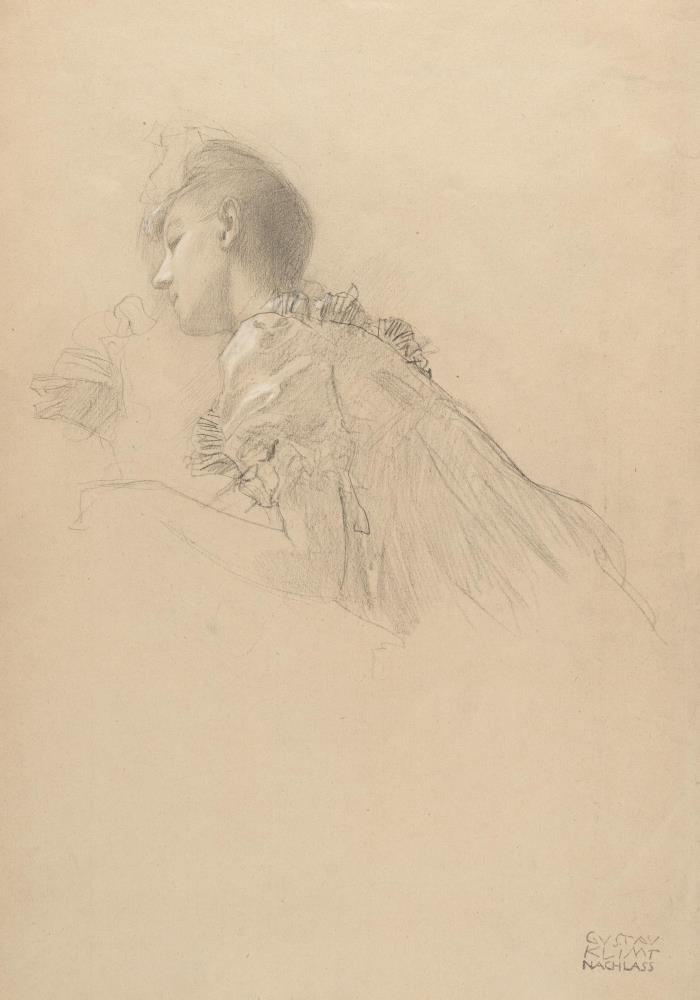
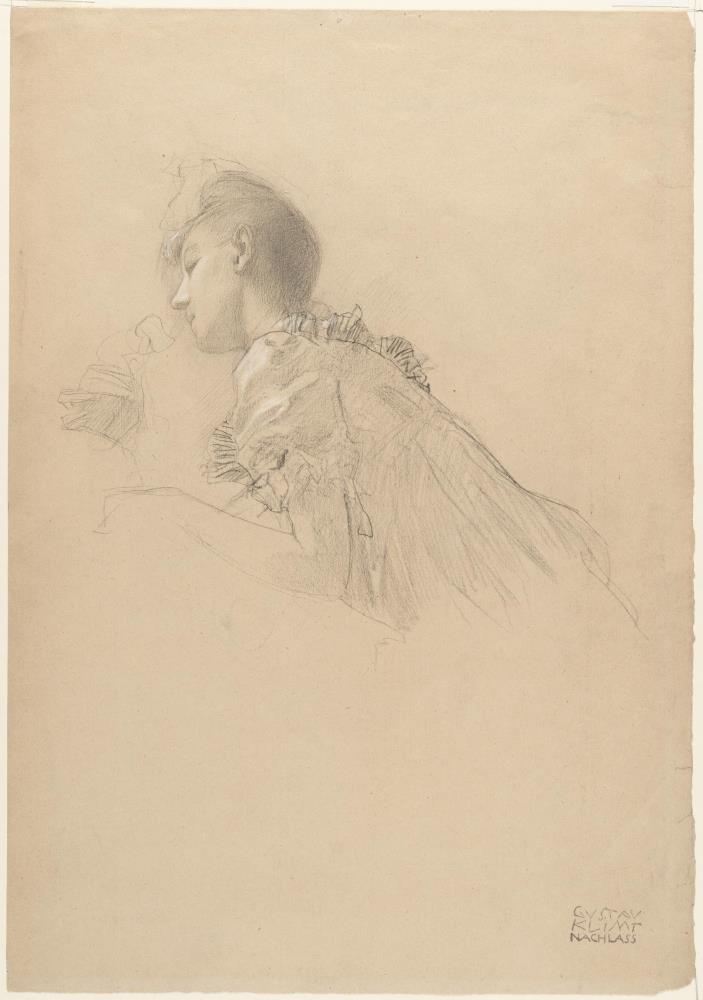
Mädchenstudie im Profil nach links


Artist
Gustav Klimt
Provenance
Nachlass Gustav Klimt, Wien, 1918, unten rechts mit dem Stempel (Lugt 1575);
Sammlung/Nachlass Serge Sabarsky, New York;
Sammlung/Stiftung Vally Sabarsky, New York.
Ausstellung:
Gustav Klimt. The Ronald S. Lauder and Serge Sabarsky Collections, Neue Galerie, New York 2007/08;
Bloom and Doom. Visual Expressions and Reform in Vienna 1900, Middlebury College Museum of Art, Middlebury, Vermont, 2016;
Klimt Landscapes, Neue Galerie Museum, New York 2024.
Sammlung/Nachlass Serge Sabarsky, New York;
Sammlung/Stiftung Vally Sabarsky, New York.
Ausstellung:
Gustav Klimt. The Ronald S. Lauder and Serge Sabarsky Collections, Neue Galerie, New York 2007/08;
Bloom and Doom. Visual Expressions and Reform in Vienna 1900, Middlebury College Museum of Art, Middlebury, Vermont, 2016;
Klimt Landscapes, Neue Galerie Museum, New York 2024.
Share


Description
- Light and airy depiction of a young girl
- Study for a painting in the theater in Karlovy Vary
- Sketchy and yet full of visual power
I wonder what she is doing, this elegantly dressed girl?
Gustav Klimt's hand drawing, which takes us into the master's sketching process, dates from around 1885. We see a young girl in a light Empire dress leaning over an invisible balustrade. Where she is must remain unknown: Is she attending a theater or opera performance? Is she looking down from her window onto the street? And what is the mysterious object in her right hand that evaporates into sketchiness? Klimt's study is particularly delicate, almost in keeping with the subject. In black chalk with reduced white heightening, a fleeting snapshot is created. The girl thus becomes an almost ethereal apparition that begins to manifest itself in the hip area, only to disappear again at the forearms.
The work was created in the context of Klimt's works for the theater in Karlovy Vary. Excessive preparation was a fundamental part of Gustav Klimt's work process; all of his paintings were accompanied by dozens of preliminary studies and sketches. In these, Klimt meticulously records every little detail, practicing seemingly inconspicuous details over and over again, trying things out, discarding and rejecting them. It is therefore quite possible that Klimt is trying to capture a theater spectator in Karlovy Vary society. But perhaps she is also an actress about to perform a balcony scene - think of Shakespeare's Juliet, for example? But it is also possible that he is using a (now nameless) model to dissect a movement.
We would like to thank Dr. Elisabeth Dutz, Albertina Vienna, for her kind help in cataloguing this work.
The work is listed in the Online Catalogue Raisonné under the number GK3968.
- Study for a painting in the theater in Karlovy Vary
- Sketchy and yet full of visual power
I wonder what she is doing, this elegantly dressed girl?
Gustav Klimt's hand drawing, which takes us into the master's sketching process, dates from around 1885. We see a young girl in a light Empire dress leaning over an invisible balustrade. Where she is must remain unknown: Is she attending a theater or opera performance? Is she looking down from her window onto the street? And what is the mysterious object in her right hand that evaporates into sketchiness? Klimt's study is particularly delicate, almost in keeping with the subject. In black chalk with reduced white heightening, a fleeting snapshot is created. The girl thus becomes an almost ethereal apparition that begins to manifest itself in the hip area, only to disappear again at the forearms.
The work was created in the context of Klimt's works for the theater in Karlovy Vary. Excessive preparation was a fundamental part of Gustav Klimt's work process; all of his paintings were accompanied by dozens of preliminary studies and sketches. In these, Klimt meticulously records every little detail, practicing seemingly inconspicuous details over and over again, trying things out, discarding and rejecting them. It is therefore quite possible that Klimt is trying to capture a theater spectator in Karlovy Vary society. But perhaps she is also an actress about to perform a balcony scene - think of Shakespeare's Juliet, for example? But it is also possible that he is using a (now nameless) model to dissect a movement.
We would like to thank Dr. Elisabeth Dutz, Albertina Vienna, for her kind help in cataloguing this work.
The work is listed in the Online Catalogue Raisonné under the number GK3968.