Mikhail Larionov
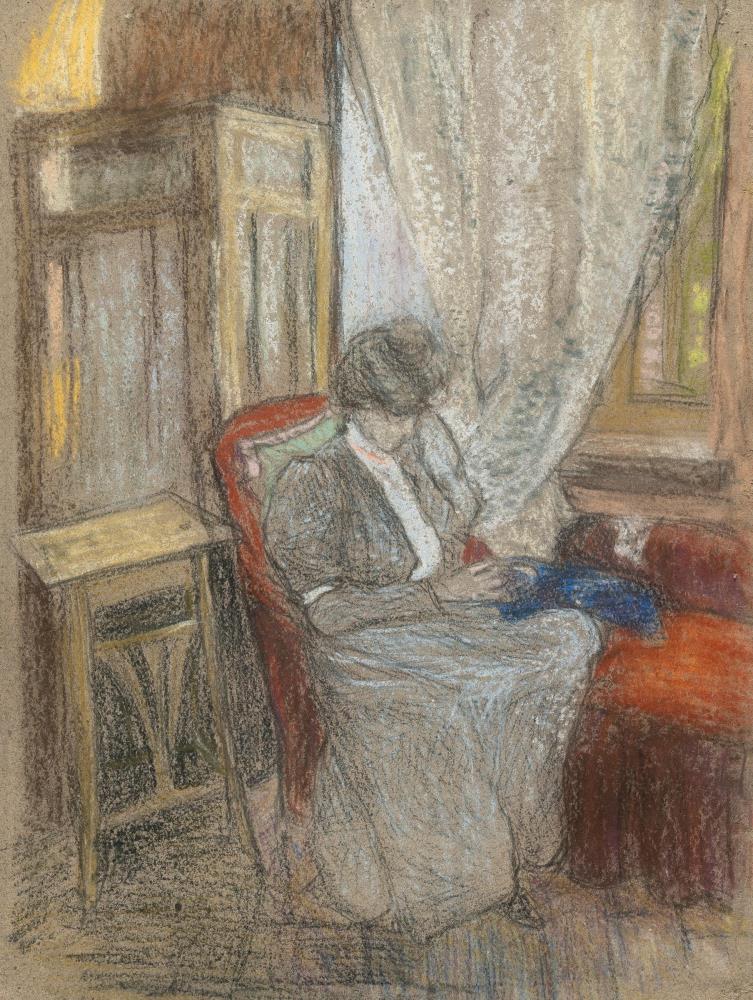
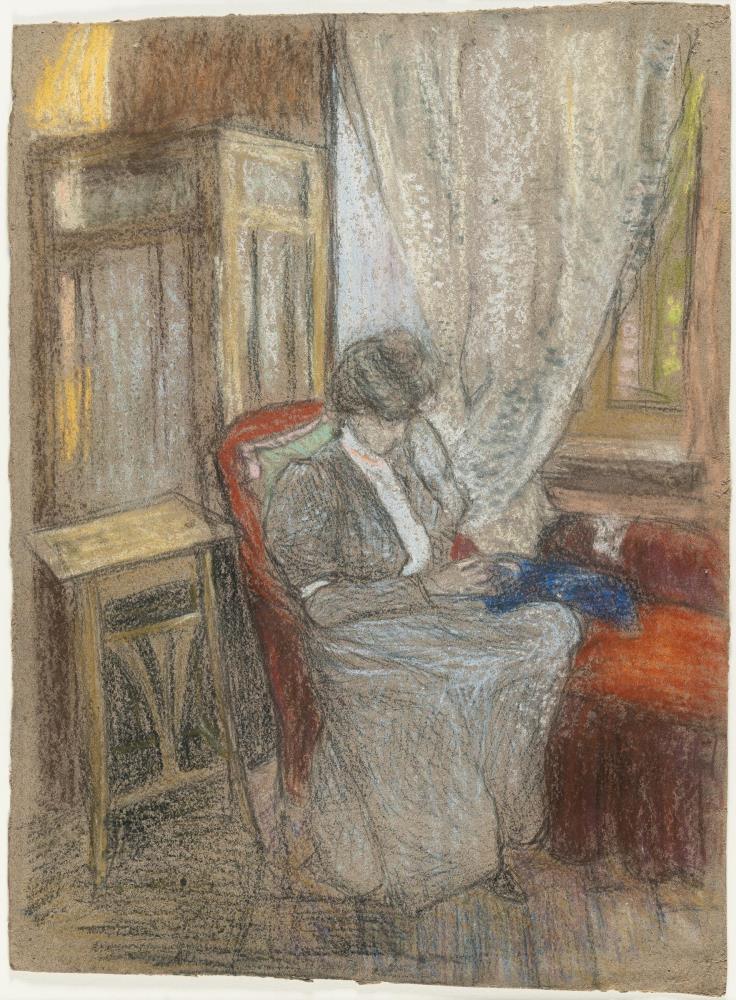
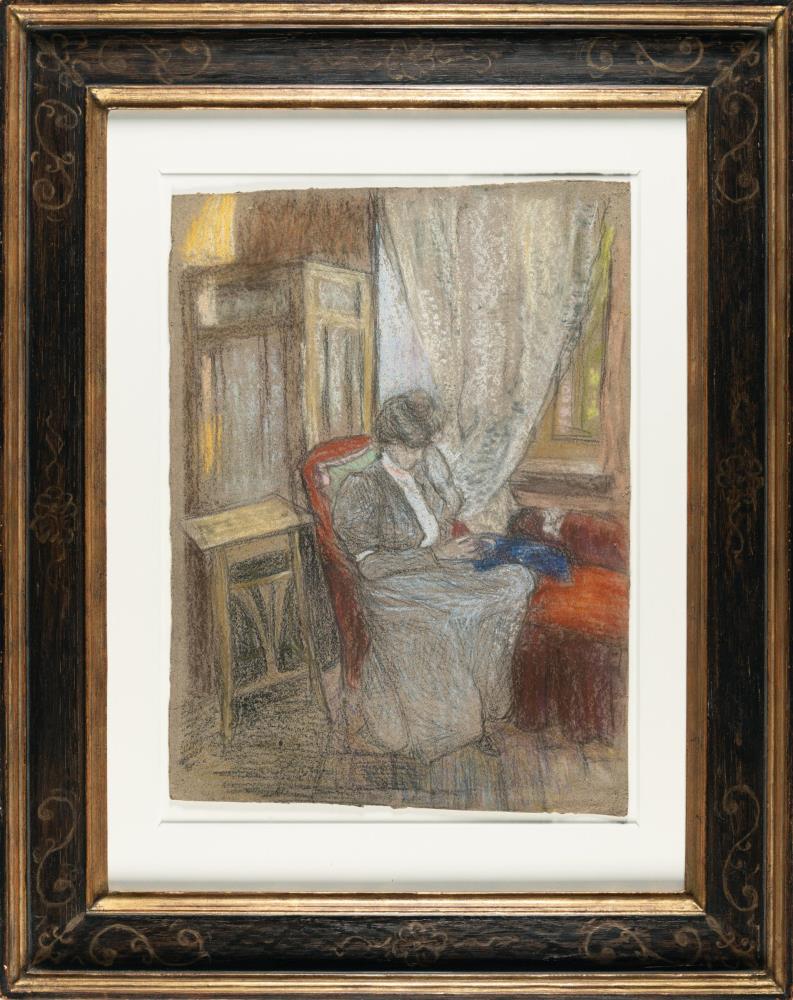
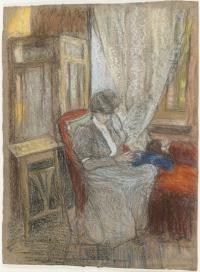
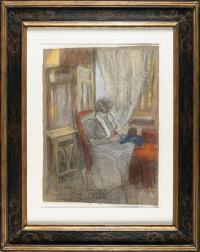
Femme brodant


Artist
Mikhail Larionov
(1881 Tiraspol - Fontenay-aux-Roses bei Paris 1964)
Provenance
Sammlung Alexandra Larionov-Tomilina, der Witwe des Künstlers; Privatsammlung, Schweiz.
Share


Description
- Early work by the founder of Rayonism and co-creator of the Russian avant-garde
- Finely executed pastel with atmospheric depth and vibrant color contrasts
- Significant document of his time as a student at the Moscow Art Academy
Mikhail Larionov was one of the central innovators of Russian art around 1900 and thus one of the most influential artists of Russian modernism. Together with his future partner Natalia Goncharova, he founded the artists' group "Jack of Diamonds" in 1910, whose members turned against academic tradition and opened up Russian painting to the influences of Cézanne, Fauvism and German Expressionism. As early as 1912, Larionov, together with Goncharova, initiated the "Donkey's Tail" (Osliny Khvost) group with more radical positions, in which Marc Chagall and Kazimir Malevich, among others, participated - a circle that was one of the pioneers of the avant-garde through deliberate provocation and the search for an original Russian formal language.
The present work Femme brodant was created around 1898, at the beginning of Larionov's training at the Moscow Academy of Painting, Sculpture and Architecture.
The depiction of a young woman embroidering reveals a sensitive composition that makes both external and internal experience tangible. The subject - a secluded domestic scene - is captured with delicate but definite lines. The bright light blue of the dress and the reddish accentuated facial features stand out effectively against the neutral gray cardboard and create a balanced color tension.
In its delicate execution, the pastel is reminiscent of French models - such as Edgar Degas' depictions of domestic scenes - and is thus exemplary of that phase of Russian art in which Western influences and national characteristics entered into a productive exchange.
Femme brodant is therefore much more than an early work: it documents the moment of artistic self-discovery, the beginning of a work that a few years later would be one of the most innovative contributions of the European avant-garde.
With a certificate of authenticity from François Daulte, executor of Alexandra Tomilina-Larionov's estate, dated December 5, 1996 (copy).
- Finely executed pastel with atmospheric depth and vibrant color contrasts
- Significant document of his time as a student at the Moscow Art Academy
Mikhail Larionov was one of the central innovators of Russian art around 1900 and thus one of the most influential artists of Russian modernism. Together with his future partner Natalia Goncharova, he founded the artists' group "Jack of Diamonds" in 1910, whose members turned against academic tradition and opened up Russian painting to the influences of Cézanne, Fauvism and German Expressionism. As early as 1912, Larionov, together with Goncharova, initiated the "Donkey's Tail" (Osliny Khvost) group with more radical positions, in which Marc Chagall and Kazimir Malevich, among others, participated - a circle that was one of the pioneers of the avant-garde through deliberate provocation and the search for an original Russian formal language.
The present work Femme brodant was created around 1898, at the beginning of Larionov's training at the Moscow Academy of Painting, Sculpture and Architecture.
The depiction of a young woman embroidering reveals a sensitive composition that makes both external and internal experience tangible. The subject - a secluded domestic scene - is captured with delicate but definite lines. The bright light blue of the dress and the reddish accentuated facial features stand out effectively against the neutral gray cardboard and create a balanced color tension.
In its delicate execution, the pastel is reminiscent of French models - such as Edgar Degas' depictions of domestic scenes - and is thus exemplary of that phase of Russian art in which Western influences and national characteristics entered into a productive exchange.
Femme brodant is therefore much more than an early work: it documents the moment of artistic self-discovery, the beginning of a work that a few years later would be one of the most innovative contributions of the European avant-garde.
With a certificate of authenticity from François Daulte, executor of Alexandra Tomilina-Larionov's estate, dated December 5, 1996 (copy).