George Grosz
Sunday morning


Artista
George Grosz
1893 - Berlin - 1959
Ulteriori informazioni
Wohl von fremder Hand betitelt unten links, mit unbekanntem Trockenstempel "G. H." (im Kreis mit Hand und Beil) oben links. Verso nochmals bezeichnet sowie mit französischem Zollstempel.
Vorlage für Blatt 78 der Sammelmappe "Ecce Homo", die 1922/23 im Malik-Verlag, Berlin erscheint (vgl. Dückers S I, 78).
Vorlage für Blatt 78 der Sammelmappe "Ecce Homo", die 1922/23 im Malik-Verlag, Berlin erscheint (vgl. Dückers S I, 78).
Mostra
George Grosz, Galerie Welz, Salzburg 1975, Kat.-Nr. 3;
An Exhibition with Works by George Grosz, Serge Sabarsky Gallery, New York 1975, Kat.-Nr. 3;
George Grosz 1893-1959. Drawings, Watercolors, Photos, Books, organisiert von Dr. Walter Huder (Akademie der Künste, Berlin), Goethe Institut, USA und Kanada, o.J., Kat.-Nr. 50;
Women as Sex Objects, Art Gallery, Edmonton/Kanada 1976;
Drawings and watercolors by George Grosz (1893-1959), Serge Sabarsky Gallery, New York 1980, Kat.-Nr. 17;
George Grosz. Gli anni di Berlino/Die Berliner Jahre/Les années berlinoises/The Berlin Years/Berlinskie lata, Palazzo Reale, Mailand u.a. 1985-1995, Kat.-Nr. 109 bzw. 54, mit Abb.
An Exhibition with Works by George Grosz, Serge Sabarsky Gallery, New York 1975, Kat.-Nr. 3;
George Grosz 1893-1959. Drawings, Watercolors, Photos, Books, organisiert von Dr. Walter Huder (Akademie der Künste, Berlin), Goethe Institut, USA und Kanada, o.J., Kat.-Nr. 50;
Women as Sex Objects, Art Gallery, Edmonton/Kanada 1976;
Drawings and watercolors by George Grosz (1893-1959), Serge Sabarsky Gallery, New York 1980, Kat.-Nr. 17;
George Grosz. Gli anni di Berlino/Die Berliner Jahre/Les années berlinoises/The Berlin Years/Berlinskie lata, Palazzo Reale, Mailand u.a. 1985-1995, Kat.-Nr. 109 bzw. 54, mit Abb.
Provenienza
Galerie Wolfgang Ketterer, Munich, 27 May 1974, lot 697;
Galerie Welz, Salzburg;
Collection/Estate of Serge Sabarsky, New York, probably acquired from the aforementioned in 1975;
Collection/Foundation of Vally Sabarsky, New York.
Galerie Welz, Salzburg;
Collection/Estate of Serge Sabarsky, New York, probably acquired from the aforementioned in 1975;
Collection/Foundation of Vally Sabarsky, New York.
Share


Descrizione
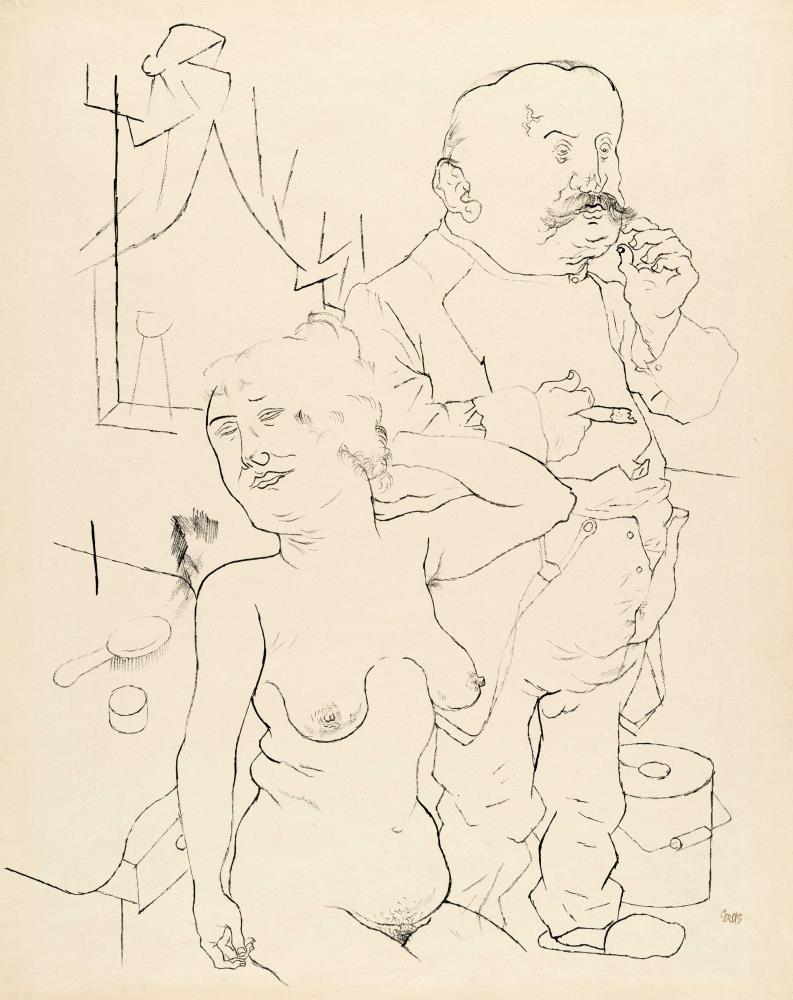
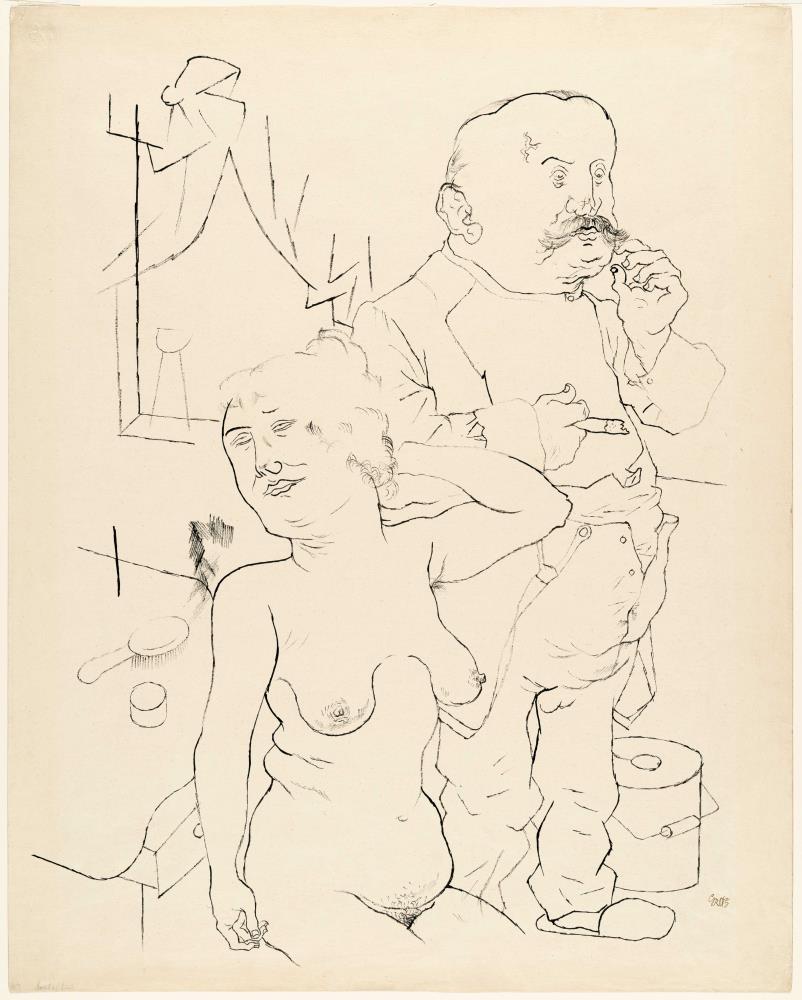
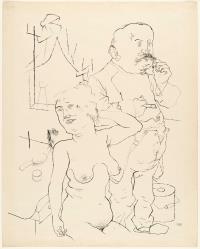
• Large-format preliminary drawing for the sheet of the same name from the important portfolio "Ecce homo"
• The risqué depiction, along with other prints from the folder, caused a scandal
• The print reveals Grosz as a masterful, critical observer of decadence in the Weimar Republic
This large-format drawing served as the model for print 78 of the "Ecce Homo" folder, published in 1922/23 by Malik-Verlag, Berlin. In this folder, Grosz sketches and caricatures the political and social conditions of the Weimar Republic: the metropolis, its seedy underbelly (murder, perversion, violence) and class divisions. In doing so, he mocks the ruling circles of the Weimar Republic, highlights social contrasts and criticises in particular the economy, politics, the military and the clergy. The bald man with a moustache is a caricature typical of Grosz, depicting a lecherous industrialist: cigar in hand, trousers undone, his stiff shirt unbuttoned, he stands in the room, his feet in slippers. Seated before him is a naked woman, her arm raised lasciviously to her head. The contrast between naked and clothed, sitting and standing, reinforces the sense of imbalance between the two protagonists. The title ‘Early Sunday Morning’ leaves room for interpretation: is the man spending his morning with a prostitute instead of in church? Or is he at home after all, given he is in slippers, enjoying his financial and sexual success? Is the couple indulging in the deadly sins of lust—expressed in the woman’s lascivious posture—and gluttony, reflected in the cigar and the pot-bellied figure?
Just a few months after publication, in December 1923, the Public Prosecutor’s Office in Berlin brought charges against Grosz and his publishers Gumperz and Herzfelde for disseminating "obscene images or depictions". In Blatt 78, too, "the manner of their depiction, in particular the emphasis on the genitals" was criticised; according to the indictment, this was "likely to offend the sense of modesty and morality of a person of normal sensibilities in sexual matters." During the trial, Grosz explains that it is his passionate endeavour to expose the weaknesses and vices of the times and of society, and that he believes he can only come close to this goal by ruthlessly revealing the truth. Prominent artists of the time, including Max Liebermann, vouched for Grosz’s moral integrity. Yet the court remained unyielding: the publisher and the artist were each sentenced to a fine of 500 gold marks, and the folder was confiscated.
• The risqué depiction, along with other prints from the folder, caused a scandal
• The print reveals Grosz as a masterful, critical observer of decadence in the Weimar Republic
This large-format drawing served as the model for print 78 of the "Ecce Homo" folder, published in 1922/23 by Malik-Verlag, Berlin. In this folder, Grosz sketches and caricatures the political and social conditions of the Weimar Republic: the metropolis, its seedy underbelly (murder, perversion, violence) and class divisions. In doing so, he mocks the ruling circles of the Weimar Republic, highlights social contrasts and criticises in particular the economy, politics, the military and the clergy. The bald man with a moustache is a caricature typical of Grosz, depicting a lecherous industrialist: cigar in hand, trousers undone, his stiff shirt unbuttoned, he stands in the room, his feet in slippers. Seated before him is a naked woman, her arm raised lasciviously to her head. The contrast between naked and clothed, sitting and standing, reinforces the sense of imbalance between the two protagonists. The title ‘Early Sunday Morning’ leaves room for interpretation: is the man spending his morning with a prostitute instead of in church? Or is he at home after all, given he is in slippers, enjoying his financial and sexual success? Is the couple indulging in the deadly sins of lust—expressed in the woman’s lascivious posture—and gluttony, reflected in the cigar and the pot-bellied figure?
Just a few months after publication, in December 1923, the Public Prosecutor’s Office in Berlin brought charges against Grosz and his publishers Gumperz and Herzfelde for disseminating "obscene images or depictions". In Blatt 78, too, "the manner of their depiction, in particular the emphasis on the genitals" was criticised; according to the indictment, this was "likely to offend the sense of modesty and morality of a person of normal sensibilities in sexual matters." During the trial, Grosz explains that it is his passionate endeavour to expose the weaknesses and vices of the times and of society, and that he believes he can only come close to this goal by ruthlessly revealing the truth. Prominent artists of the time, including Max Liebermann, vouched for Grosz’s moral integrity. Yet the court remained unyielding: the publisher and the artist were each sentenced to a fine of 500 gold marks, and the folder was confiscated.