Günther Förg
"Canto II"
Artista
Günther Förg
1952 Füssen - Freiburg i. Br. 2013
Ulteriori informazioni
Das Werk ist im Archiv Günther Förg unter der Nummer WVF.90.C.0666 registriert. Wir danken Herrn Michael Neff vom Estate Günther Förg für die freundliche Bestätigung der Authentizität dieser Arbeit.
Mostra
Günther Förg - Große Zeichnungen. Galerie Capitain, Köln 1990, farb. Abb. S. 131;
Günther Förg, Museum Fridericianum, Stuttgart 1990, farb. Abb. S. 121.
Günther Förg, Museum Fridericianum, Stuttgart 1990, farb. Abb. S. 121.
Provenienza
Edition Julie Sylvester, New York;
Christie’s, South Kensington: Monday 5 December 2005, Lot 84;
Private collection, USA;
Dallas Auction Gallery, 2 October 2013, Lot 91;
Private collection, Belgium.
Christie’s, South Kensington: Monday 5 December 2005, Lot 84;
Private collection, USA;
Dallas Auction Gallery, 2 October 2013, Lot 91;
Private collection, Belgium.
Share


Descrizione
• Early work from the important series of ‘Grid Paintings’
• Förg is one of the most distinguished artists of our time; his estate is represented by Hauser & Wirth
• Förg is represented with works in numerous international museums, including the Museum of Modern Art, New York, the Stedelijk Museum, Amsterdam, the San Francisco Museum of Art and the Städel, Frankfurt am Main
Günther Förg occupies a central position in German contemporary art. His work draws on the achievements of classical modernism whilst deliberately questioning them. His multifaceted oeuvre encompasses painting, photography and sculpture and is characterised by an unmistakable combination of rigour and sensual openness.
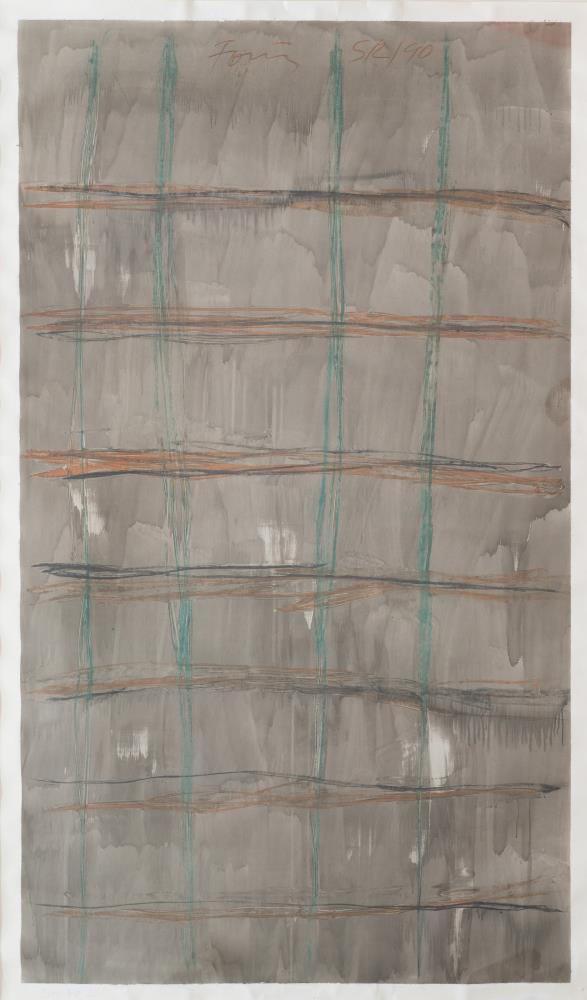
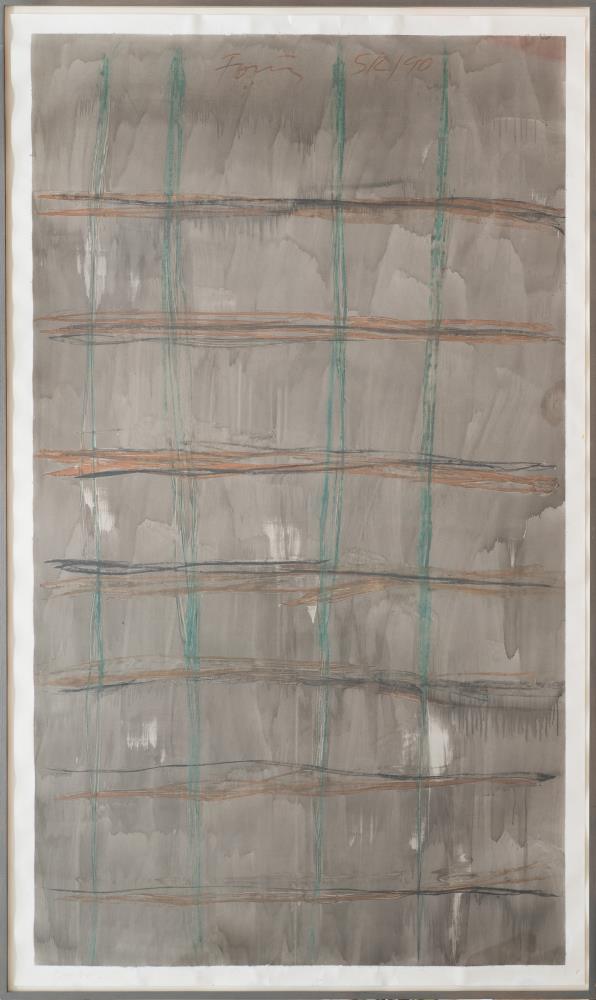
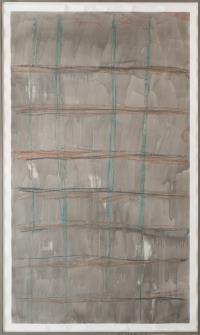
This large-format work on paper from 1990 belongs to the phase of his career in which Förg engaged intensively with linear arrangements and serial structures. An open grid of vertical, greenish lines meets horizontal bands rendered in earthy, dark tones. This seemingly constructive order, however, remains deliberately unstable: lines run off course, overlap and lose precision, creating a dynamic interplay between structure and dissolution.
Förg’s handling of the material is characteristic. The glazed, partly blurred layers of grey allow the paper as a picture support to remain visible and create a vibrating surface. The painterly process remains traceable at all times – a central concern of the artist, who asserts the autonomy of the gesture over strict form.
The special quality of the work lies in this balance between controlled application and deliberately permitted blurring. Here, Förg draws on positions within Minimal Art and post-war European modernism, yet subverts their formal rigour in favour of an immediate, physically perceptible pictorial effect.
The work exemplifies Förg’s ability to develop a dense, atmospherically charged visual language using minimal means – and is thus one of the most compelling examples of his works on paper from the early 1990s.
• Förg is one of the most distinguished artists of our time; his estate is represented by Hauser & Wirth
• Förg is represented with works in numerous international museums, including the Museum of Modern Art, New York, the Stedelijk Museum, Amsterdam, the San Francisco Museum of Art and the Städel, Frankfurt am Main
Günther Förg occupies a central position in German contemporary art. His work draws on the achievements of classical modernism whilst deliberately questioning them. His multifaceted oeuvre encompasses painting, photography and sculpture and is characterised by an unmistakable combination of rigour and sensual openness.
This large-format work on paper from 1990 belongs to the phase of his career in which Förg engaged intensively with linear arrangements and serial structures. An open grid of vertical, greenish lines meets horizontal bands rendered in earthy, dark tones. This seemingly constructive order, however, remains deliberately unstable: lines run off course, overlap and lose precision, creating a dynamic interplay between structure and dissolution.
Förg’s handling of the material is characteristic. The glazed, partly blurred layers of grey allow the paper as a picture support to remain visible and create a vibrating surface. The painterly process remains traceable at all times – a central concern of the artist, who asserts the autonomy of the gesture over strict form.
The special quality of the work lies in this balance between controlled application and deliberately permitted blurring. Here, Förg draws on positions within Minimal Art and post-war European modernism, yet subverts their formal rigour in favour of an immediate, physically perceptible pictorial effect.
The work exemplifies Förg’s ability to develop a dense, atmospherically charged visual language using minimal means – and is thus one of the most compelling examples of his works on paper from the early 1990s.