Tony Cragg
Forminifera
Artista
Tony Cragg
1949 Liverpool
Ulteriori informazioni
Mit einem vom Künstler signierten Fotozertifikat von 2019, Wuppertal.
Provenienza
Deweer Gallery, Zwevegem/Belgium;
Private collection, Belgium.
Private collection, Belgium.
Share


Descrizione
• A rare, museum-quality installation, in private ownership for 30 years
• Cragg is one of the most innovative and versatile sculptors in the international contemporary art scene
• His works are held in museum collections worldwide; Installations from the ‘Foraminifera’ series can be found at the Kunstmuseum Wolfsburg, the MUDAM in Luxembourg, the Museo Nacional de Arte Reina Sofia in Madrid and the MART in Rovereto, amongst others
Quote: ‘Foraminifera’ is an ensemble made of plaster. Plaster, in turn, is a sediment consisting of foraminifera – the oldest mineral tissue on Earth. Some of them have skeletal forms. Even whilst this work was being created, I always spoke of foraminifera. In this case, therefore, there was no act of titling at all." Tony Cragg 2016
In the early 1990s, Tony Cragg’s sculptural language moved away from his early material-based assemblages, which often consisted of found materials and reflected social and ecological issues. With the "Foraminifera" series, he began to develop autonomous, organically appearing forms in space using plaster, a material of great significance to him.
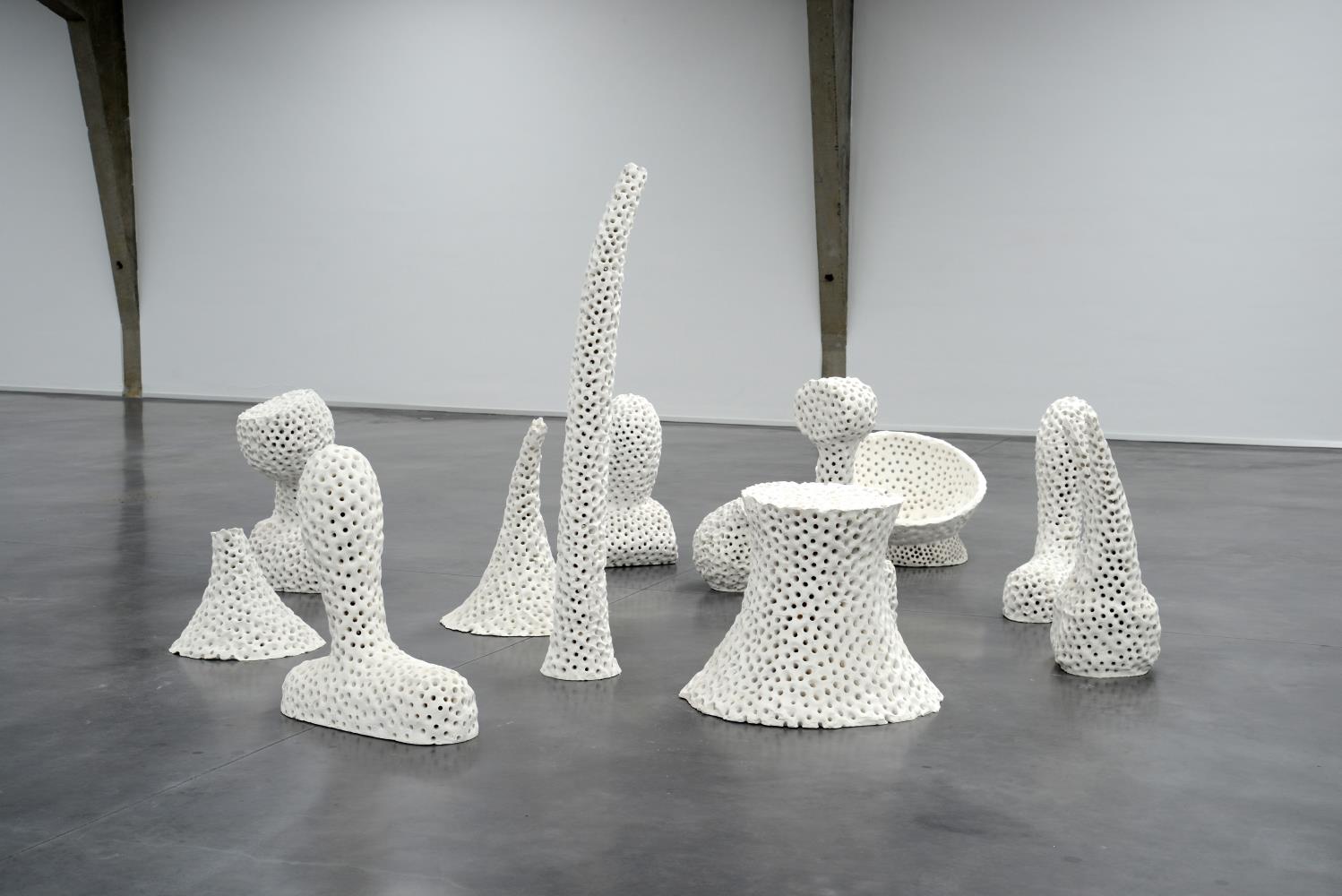
The 12-part museum installation "Foraminifera" presented here is one of the largest and most complex works in the series, which comprises only a few pieces.
A key aspect of Tony Cragg’s work is the connection between art and natural science. His lifelong engagement with fossils and mineral forms shapes his conception of sculpture as a "discovery of form": nature provides him with an inexhaustible reservoir of structures that he can transform artistically. This idea is particularly evident in "Forminifera". The individual forms of the installation appear both familiar and alien: their silhouettes are reminiscent of vessels or archaic objects, whilst their perforated surface, made of sandblasted, hardened plaster, evokes biological structures such as corals or microscopically magnified organisms. This impression is programmatic, for the title refers to foraminifera, a genus of tiny, single-celled marine organisms whose calcareous shells are riddled with countless fine pores. In a sketch defining the arrangement of the individual elements within a three-metre radius, Cragg later inscribed these ‘found’ forms in a free-associative manner as ‘tooth’, ‘stamp’, ‘witch hat’ or ‘cooling tower’, thereby playfully hinting at the connection between microcosm and macrocosm. Characteristic of foraminifera is the precise arrangement of the individual elements, which do not form a closed body but rather a spatial reference system. The 12 sculptures enter into a dialogue with one another; their varying sizes and curvatures generate a dynamic tension, a field of experimentation in which Cragg first tests central principles of his later groups of works with installative clarity. "Forminifera" thus becomes a precursor to works such as Rational Beings, in which Cragg further develops the transformation of vessel and body forms into dynamic, often spiral structures. The idea of morphological metamorphosis inherent in the installation – from simple, cell-like units to complex structures – remains a central motif of his later work.
• Cragg is one of the most innovative and versatile sculptors in the international contemporary art scene
• His works are held in museum collections worldwide; Installations from the ‘Foraminifera’ series can be found at the Kunstmuseum Wolfsburg, the MUDAM in Luxembourg, the Museo Nacional de Arte Reina Sofia in Madrid and the MART in Rovereto, amongst others
Quote: ‘Foraminifera’ is an ensemble made of plaster. Plaster, in turn, is a sediment consisting of foraminifera – the oldest mineral tissue on Earth. Some of them have skeletal forms. Even whilst this work was being created, I always spoke of foraminifera. In this case, therefore, there was no act of titling at all." Tony Cragg 2016
In the early 1990s, Tony Cragg’s sculptural language moved away from his early material-based assemblages, which often consisted of found materials and reflected social and ecological issues. With the "Foraminifera" series, he began to develop autonomous, organically appearing forms in space using plaster, a material of great significance to him.
The 12-part museum installation "Foraminifera" presented here is one of the largest and most complex works in the series, which comprises only a few pieces.
A key aspect of Tony Cragg’s work is the connection between art and natural science. His lifelong engagement with fossils and mineral forms shapes his conception of sculpture as a "discovery of form": nature provides him with an inexhaustible reservoir of structures that he can transform artistically. This idea is particularly evident in "Forminifera". The individual forms of the installation appear both familiar and alien: their silhouettes are reminiscent of vessels or archaic objects, whilst their perforated surface, made of sandblasted, hardened plaster, evokes biological structures such as corals or microscopically magnified organisms. This impression is programmatic, for the title refers to foraminifera, a genus of tiny, single-celled marine organisms whose calcareous shells are riddled with countless fine pores. In a sketch defining the arrangement of the individual elements within a three-metre radius, Cragg later inscribed these ‘found’ forms in a free-associative manner as ‘tooth’, ‘stamp’, ‘witch hat’ or ‘cooling tower’, thereby playfully hinting at the connection between microcosm and macrocosm. Characteristic of foraminifera is the precise arrangement of the individual elements, which do not form a closed body but rather a spatial reference system. The 12 sculptures enter into a dialogue with one another; their varying sizes and curvatures generate a dynamic tension, a field of experimentation in which Cragg first tests central principles of his later groups of works with installative clarity. "Forminifera" thus becomes a precursor to works such as Rational Beings, in which Cragg further develops the transformation of vessel and body forms into dynamic, often spiral structures. The idea of morphological metamorphosis inherent in the installation – from simple, cell-like units to complex structures – remains a central motif of his later work.