Joseph Maria Olbrich
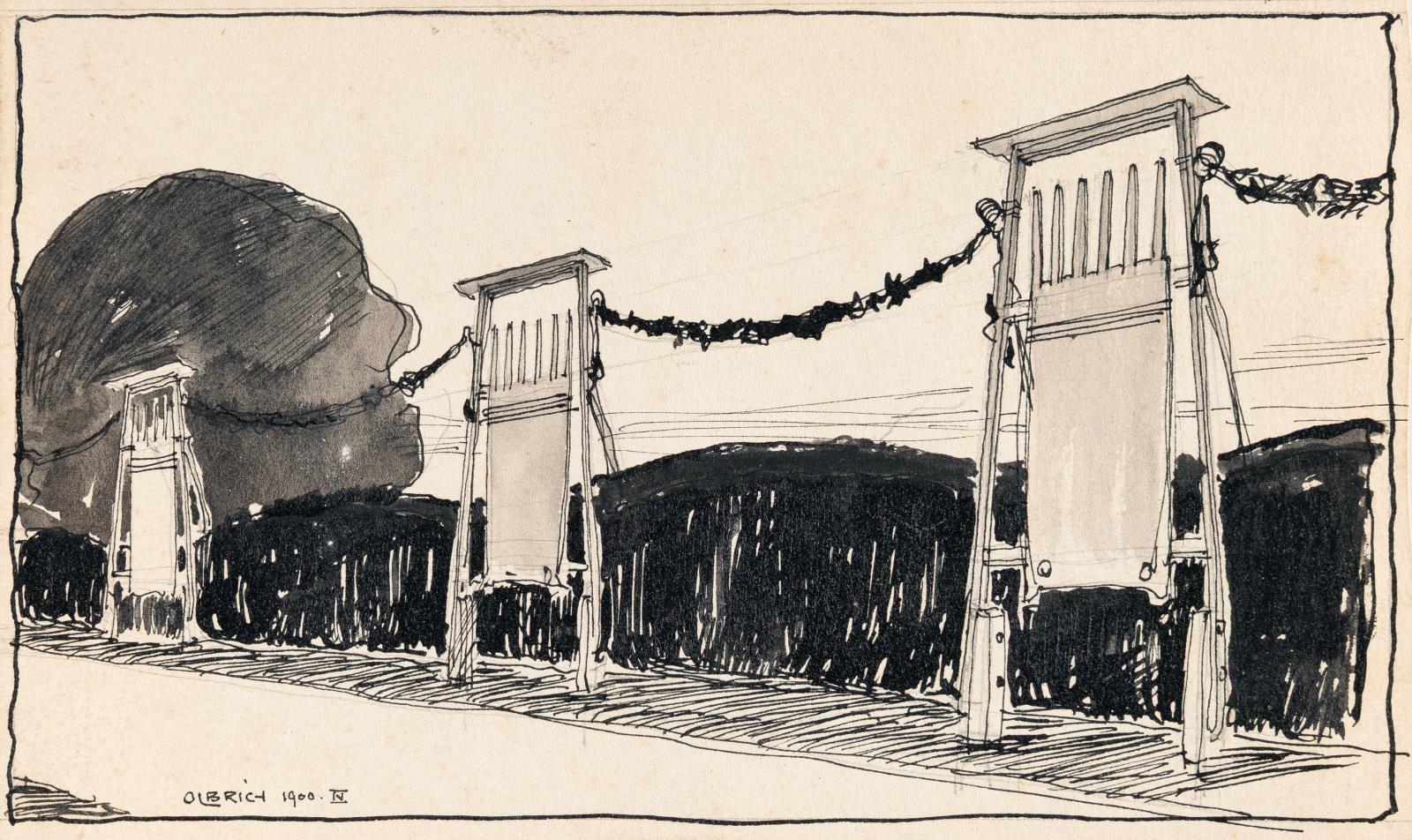
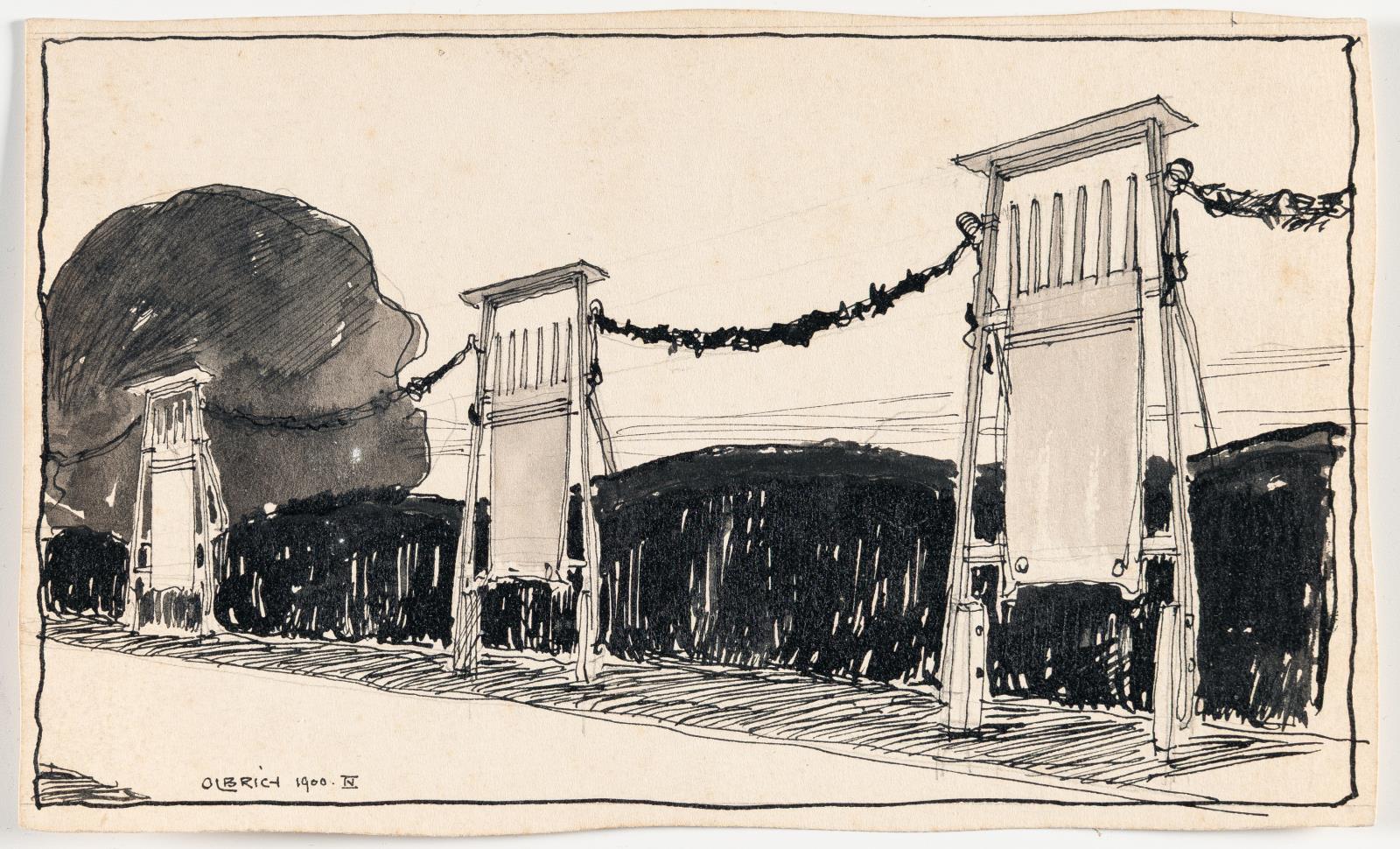
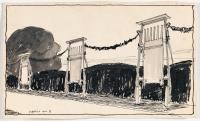
Design for the fencing of the exhibition grounds at Mathildenhöhe in Darmstadt
Artista
Joseph Maria Olbrich
1867 Troppau - Düsseldorf 1908
Provenienza
Private collection, Germany.
Share


Descrizione
In 1899, Grand Duke Ernst Ludwig of Hesse and by Rhine founded the artists’ colony on the Mathildenhöhe in Darmstadt with the aim of uniting art and craftsmanship to create a new way of life. The artists appointed by the Grand Duke designed not only individual exhibits, but entire residential buildings complete with their interiors, in keeping with the then-prevalent concept of the Gesamtkunstwerk. In 1901, the artists’ colony held its first exhibition under the title ‘A Document of German Art’, which is still regarded today as a milestone of Art Nouveau and early Modernism in Germany. Acting as a kind of artistic director was the architect Joseph Maria Olbrich, who had been appointed from Vienna and bore primary responsibility for the overall architectural planning of the ensemble. He was the ideal choice, for in his day he was what we would today somewhat loosely call a designer. In a manner not uncharacteristic of art around 1900, he espoused an expanded concept of art that dissolved the boundaries between genres. Olbrich’s work is a ‘Gesamtkunstwerk’ in which various arts such as architecture, crafts, etc. are united and complement one another. He had caused a sensation in 1897–98 as the architect of the Vienna Secession exhibition building and, in the summer of 1899, accepted the Grand Duke’s invitation to Darmstadt. There he immediately began planning the exhibition, which included not only the exhibition buildings and houses of the artists’ colony but also temporary structures such as the entrance pavilion and the enclosure of the exhibition grounds. As an admission fee was charged for the exhibition, which was officially opened on 15 May 1901, the grounds had to be fenced off. Olbrich did not view the fencing as a purely functional barrier but as an integral part of the Mathildenhöhe Gesamtkunstwerk, featuring artistic elements in their own right. The exhibition catalogue states: "In order to elevate the demarcation of the exhibition grounds to an artistic moment and to make this serve the exhibition’s revenue, panels were erected at intervals of 6 metres, designed to display advertising posters on both the inside and outside. Each panel displays advertising posters. Through these ideas, alongside the purpose of demarcation, a body of artistic work was also inspired and an ideal space created for poster art." Regarding the entrance area with the fence—which no longer exists today and is preserved only in historical photographs (Fig. )—only one design by Olbrich, created in April 1900 and housed in the Hessisches Landesmuseum in Darmstadt, was previously known. The drawing, which includes dimensional details, is of a technical and constructive nature in its frontal presentation and does not possess the evocative effect of our previously unknown sheet, also created in April 1900. In a loose, sketch-like style, Olbrich presents the poster stands, linked by garlands, in a perspective arrangement leading into the depth, like an ancient Egyptian phalanx against a background of vegetation depicted only in broad strokes. There is something essential about the poster stands; their presentation is reminiscent of the processional avenues of Egyptian temples, the black of the trees and the bushes lining the path contrasting with the white paper background – a sort of negative effect is created, from which the sheet derives its great appeal. In contrast to the drawing in Darmstadt, our sheet aims for a scenographic effect that gives an idea of the impact of the execution, which was in the hands of the master woodcarver Wilhelm Rahn in Darmstadt. Dr Peter Prange