Antonio Calderara
"Orizzonte bicromo b"




Artista
Antonio Calderara
1903 Abbiategrasso - Vacciago 1978
Ulteriori informazioni
Mit einem Fotozertifikat des Archivio Antonio Calderara, Mailand, vom 29.9.2021.
Das Werk ist im Archivio Antonio Calderara, Mailand, unter der Nummer "0448" registriert.
Das Werk ist im Archivio Antonio Calderara, Mailand, unter der Nummer "0448" registriert.
Mostra
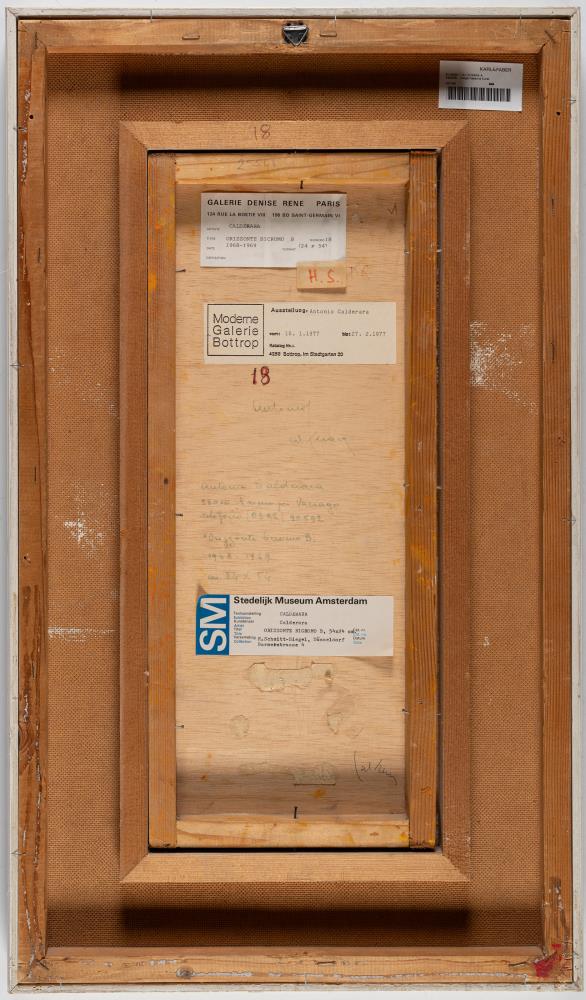
Galerie Denise René, Paris 1971, cat. no. 18, with label on the reverse;
Antonio Calderara, Moderne Galerie, Bottrop 1977, with label on the reverse;
Antonio Calderara, Stedelijk Museum, Amsterdam 1977, cat. no. 25, with label on the reverse;
Gli Orizzonti nell’Idea di Luce di Silvio Wolf, Fondazione Antonio e Carmela Calderara, Vacciago di Ameno 2016, colour ill. p. 5.
Antonio Calderara, Moderne Galerie, Bottrop 1977, with label on the reverse;
Antonio Calderara, Stedelijk Museum, Amsterdam 1977, cat. no. 25, with label on the reverse;
Gli Orizzonti nell’Idea di Luce di Silvio Wolf, Fondazione Antonio e Carmela Calderara, Vacciago di Ameno 2016, colour ill. p. 5.
Provenienza
Collection of Prof. Dipl.-Des. Helmut Schmitt-Siegel, Düsseldorf, on a label on the reverse;
Private collection.
Private collection.
Share


Descrizione
"In 1957–58, my exploratory interest turned to light, the light that permeates and dissolves everything, so that it plays a role only for itself." Antonio Calderara
• Captivating colour-field painting
• Antonio Calderara is one of the best-known representatives of Minimalism in Europe
• Calderara participated in the Venice Biennale as early as 1948 and 1956
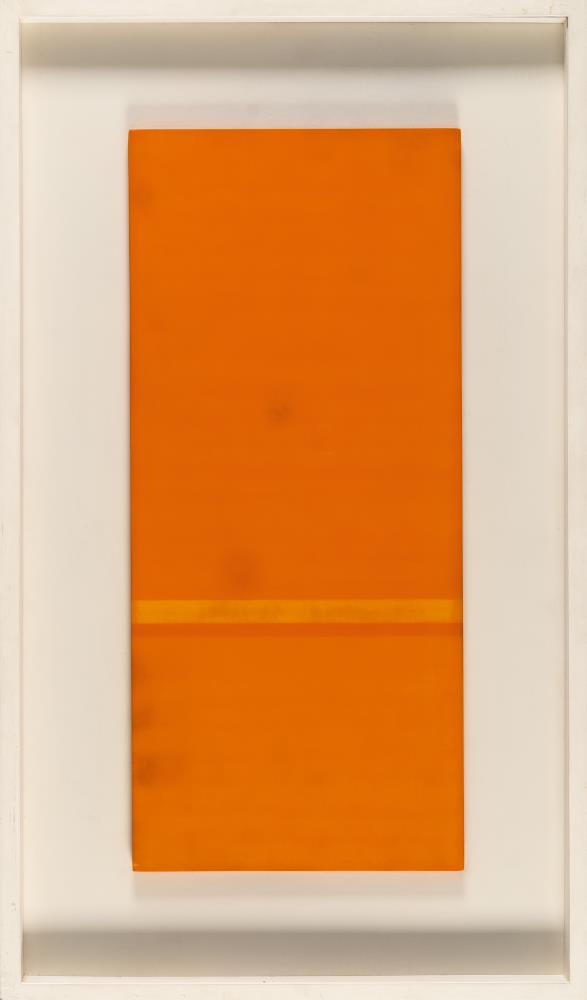
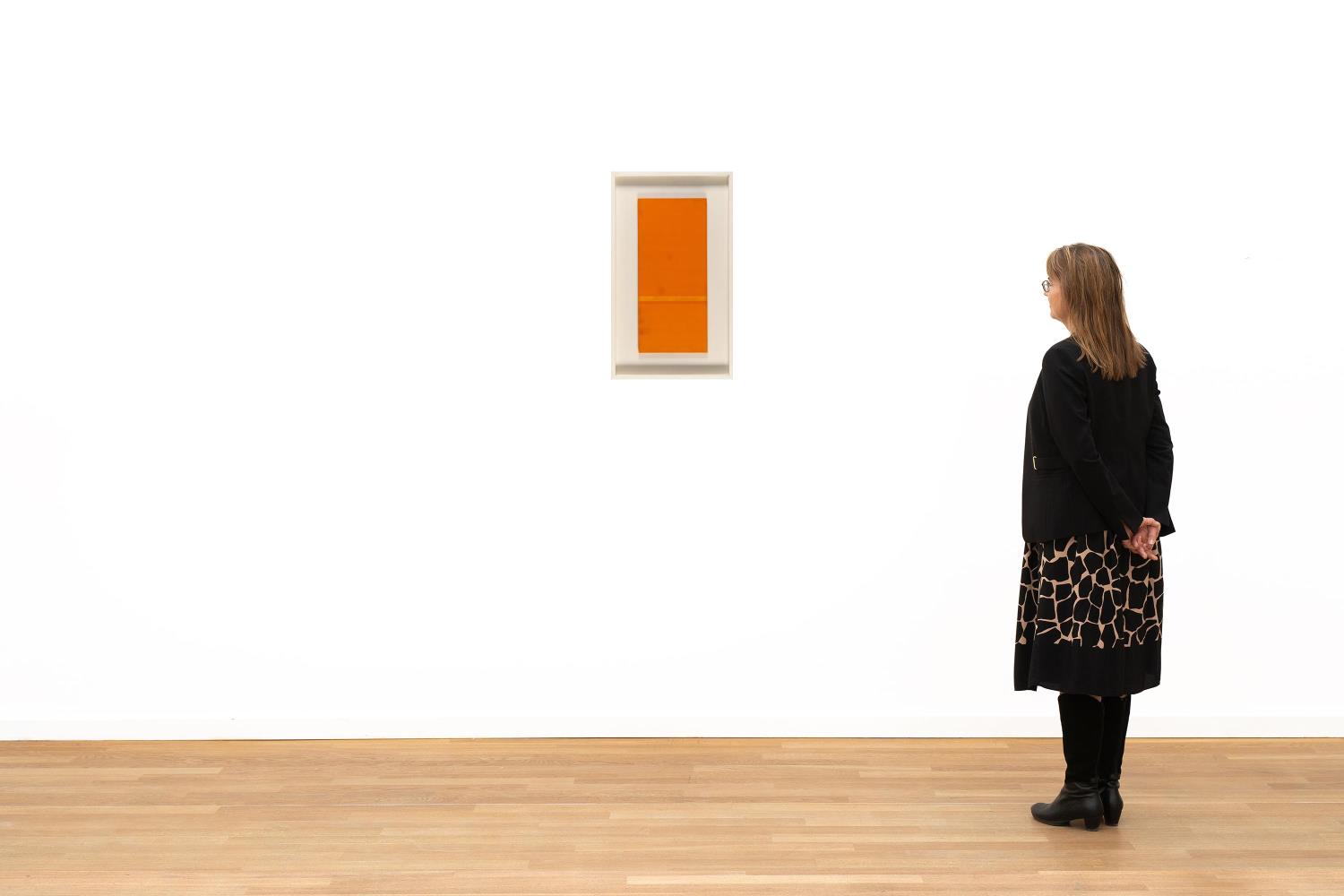
"Orizzonte bicromo b" from 1968 is exemplary of the late phase of Antonio Calderara’s oeuvre. Since the late 1950s, his painting has increasingly moved away from representational references, undergoing a radical reduction to colour, light and composition. The seemingly monochrome colour field, dominated by warm orange tones, is divided by two fine horizontal lines with minimal colour contrast. It functions less as a dividing element than as a subtle transition between two almost immaterial fields of colour. Here, colour is not employed as an expressive medium, but as a vehicle for light and stillness. The horizontal division, which is also named in the title ‘Two-Coloured Horizon’, can be read as a subtle reference to landscape or the horizon, yet remains deliberately ambivalent. What is decisive is not the reference, but the experience of balance, tranquillity and concentration. Calderara’s painting thus operates at the intersection of Concrete Art and spiritual abstraction: it aims for a contemplative perception in which the image can be experienced as a place of light and inner order.
• Captivating colour-field painting
• Antonio Calderara is one of the best-known representatives of Minimalism in Europe
• Calderara participated in the Venice Biennale as early as 1948 and 1956
"Orizzonte bicromo b" from 1968 is exemplary of the late phase of Antonio Calderara’s oeuvre. Since the late 1950s, his painting has increasingly moved away from representational references, undergoing a radical reduction to colour, light and composition. The seemingly monochrome colour field, dominated by warm orange tones, is divided by two fine horizontal lines with minimal colour contrast. It functions less as a dividing element than as a subtle transition between two almost immaterial fields of colour. Here, colour is not employed as an expressive medium, but as a vehicle for light and stillness. The horizontal division, which is also named in the title ‘Two-Coloured Horizon’, can be read as a subtle reference to landscape or the horizon, yet remains deliberately ambivalent. What is decisive is not the reference, but the experience of balance, tranquillity and concentration. Calderara’s painting thus operates at the intersection of Concrete Art and spiritual abstraction: it aims for a contemplative perception in which the image can be experienced as a place of light and inner order.