Joan Miró
"Peinture"
Artista
Joan Miró
1893 Montroig bei Barcelona - Palma de Mallorca 1983
Ulteriori informazioni
Dupin/Lelong-Mainaud 546.
Mostra
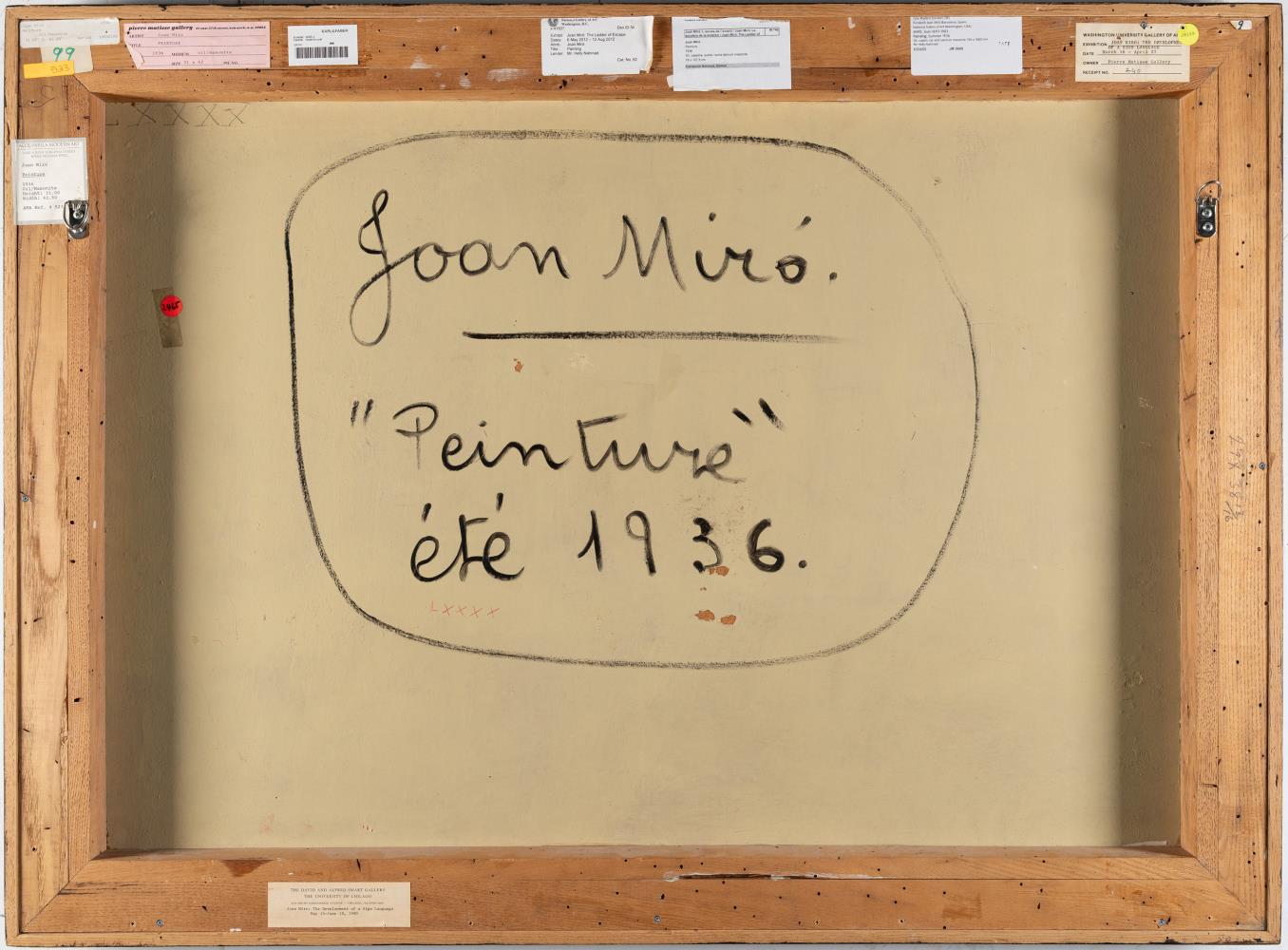
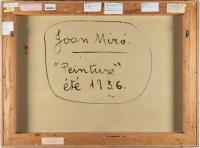
Joan Miró. The Development of a Sign Language, Washington University Art Gallery, St Louis//The David and Alfred Smart Gallery, University of Chicago, 1980, Kat.-Nr. 38, s/w Abb. S. 45, verso mit den Etiketten;
Miró. The ladder of escape/La escalera de la evasión, Tate Modern, London u.a. 2011/2012, Kat.-Nr. 62, farb. Abb. S. 89, verso mit den Etiketten der Stationen in London, Barcelona und Washington D.C.;
Miró. Vers l'infiniment libre vers l'infiniment grand, Musée Paul Valéry, Sète 2014, Kat.-Nr. 12, S. 84/85, farb. Abb.;
Joan Miró. La realidad absoluta. Paris 1920-1945, Guggenheim Museum, Bilbao 2023, farb. Abb. S. 119;
Joan Miró. Poetry into Painting, Tokyo Metropolitan Art Museum, Tokio 2025, Kat.-Nr. 39, farb. Abb.;
Joan Miró. The Assassination of Painting, Vito Schnabel Gallery, St. Moritz 2026, o. Kat.
Miró. The ladder of escape/La escalera de la evasión, Tate Modern, London u.a. 2011/2012, Kat.-Nr. 62, farb. Abb. S. 89, verso mit den Etiketten der Stationen in London, Barcelona und Washington D.C.;
Miró. Vers l'infiniment libre vers l'infiniment grand, Musée Paul Valéry, Sète 2014, Kat.-Nr. 12, S. 84/85, farb. Abb.;
Joan Miró. La realidad absoluta. Paris 1920-1945, Guggenheim Museum, Bilbao 2023, farb. Abb. S. 119;
Joan Miró. Poetry into Painting, Tokyo Metropolitan Art Museum, Tokio 2025, Kat.-Nr. 39, farb. Abb.;
Joan Miró. The Assassination of Painting, Vito Schnabel Gallery, St. Moritz 2026, o. Kat.
Letteratura
Dupin, Jacques, Miró, Paris 1961, cat. no. 447, p. 327.
Provenienza
Pierre Matisse Gallery, New York, label on the reverse;
Acquavella Modern Art Galleries, New York, label on the reverse;
Claude Kechichian, Matignon Fine Art, Paris;
Private collection, Monaco.
Acquavella Modern Art Galleries, New York, label on the reverse;
Claude Kechichian, Matignon Fine Art, Paris;
Private collection, Monaco.
Share


Descrizione
• A major work from the famous Masonite series of summer 1936 — one of the most radical and at the same time most concentrated groups of works in Joan Miró’s oeuvre
• Created immediately at the outset of the Spanish Civil War, Miró here condenses his iconic formal language into a new, uncompromising visual concept of extraordinary intensity
• Exhibited, among others, in the major Miró retrospective at Tate Modern (2011), at the Guggenheim Museum Bilbao (2023) and at the Tokyo Metropolitan Art Museum (2025)
In the summer of 1936, Joan Miró retired to the family estate, Mas Miró, in Mont-roig del Camp, south-west of Tarragona. The farm, which his father had purchased in 1911, had been far more than a summer residence for Miró since the early 1920s: It was here that he created his first major artistic work, ‘La masia’ (1921/22), and it was here that, drawing on his direct experience of the Catalan landscape, he developed the visual vocabulary that would henceforth characterise his work — sun, moon, star, bird and female figure. Mont-roig remained his most important retreat and place of work for decades.
When Miró arrived there in the summer of 1936, Spain was on the brink of a political state of emergency: on 17 July, General Franco staged a coup, and the Spanish Civil War began. In this tense situation, between June and October 1936, a cohesive group of 27 works on Masonite was created, which is today regarded as one of the most radical and at the same time most concentrated series in Miró’s oeuvre. The present painting, like all the works in this series simply titled ‘Peinture’, is part of it. In October, Miró left Spain for Paris, not to return until 1940.
Already in the two years prior, Miró had been going through a phase whose works are inscribed as his "peintures sauvages": small-format works on cardboard, copper and sandpaper, in which figures are distorted into grotesque, monstrous forms and the colour palette darkens. A programmatic departure from the academic pictorial tradition, which Miró himself described as the "assassinat de la peinture" (murder of painting) and which was to shape his artistic output from 1927 to 1937.
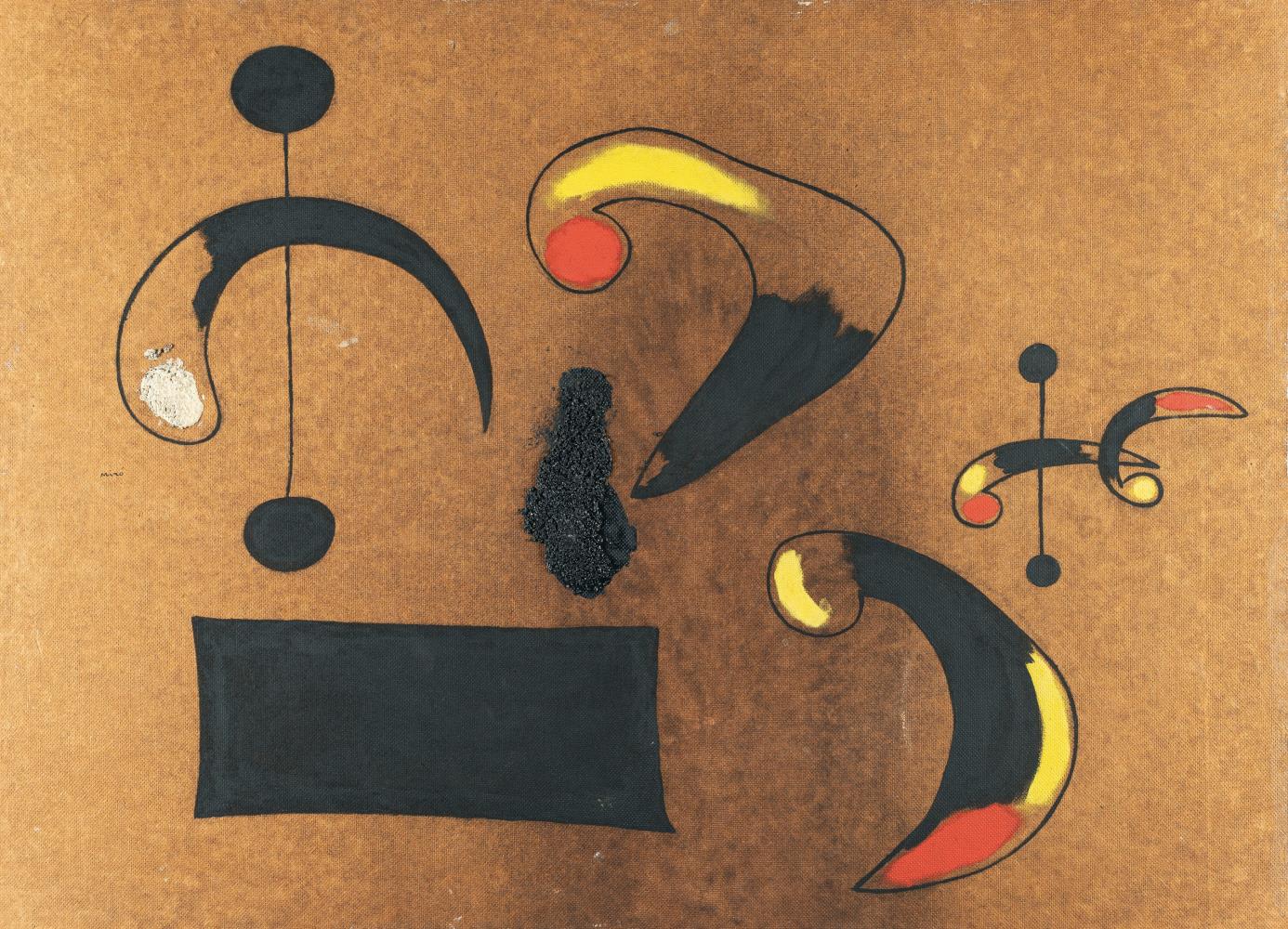
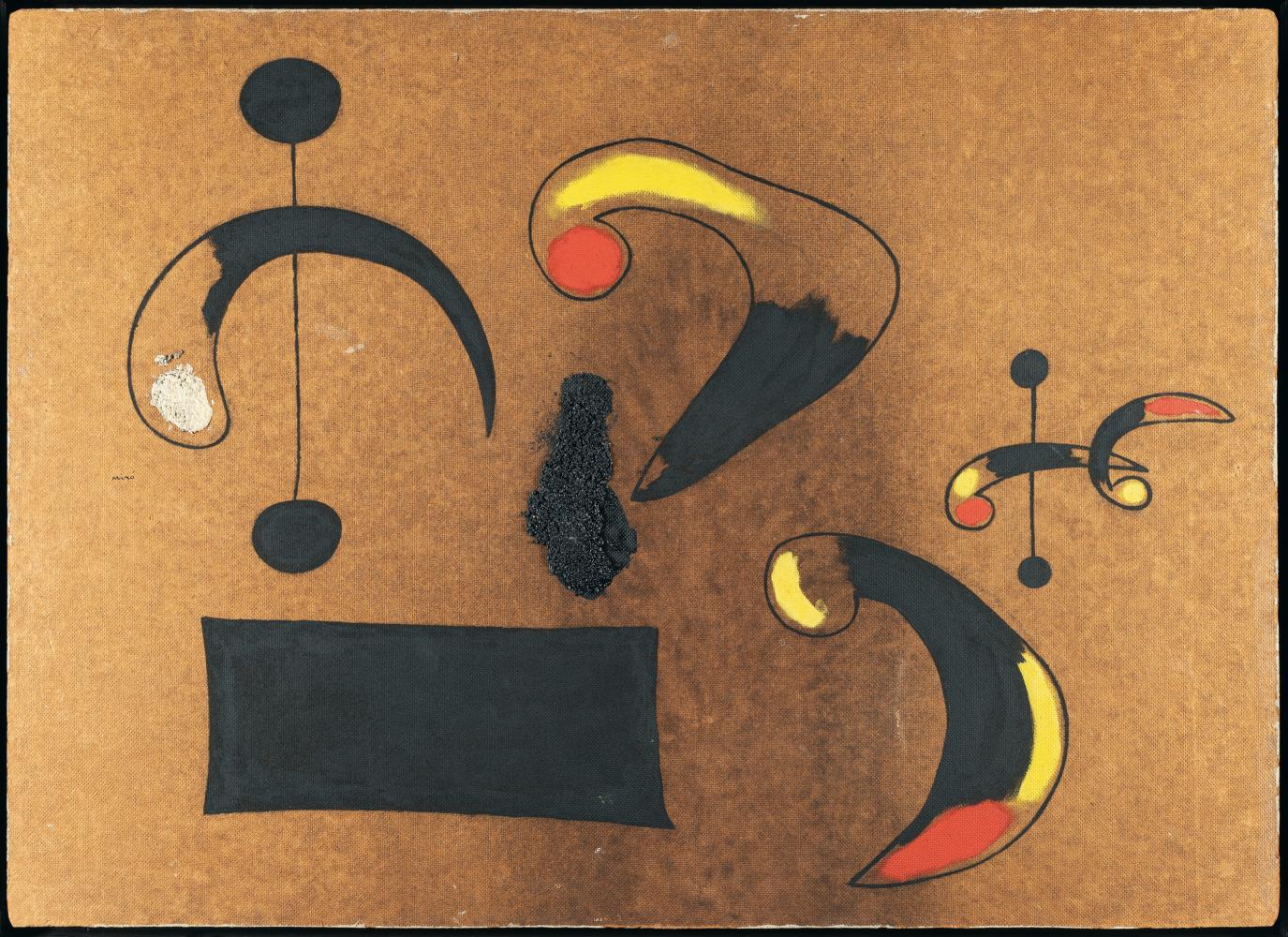
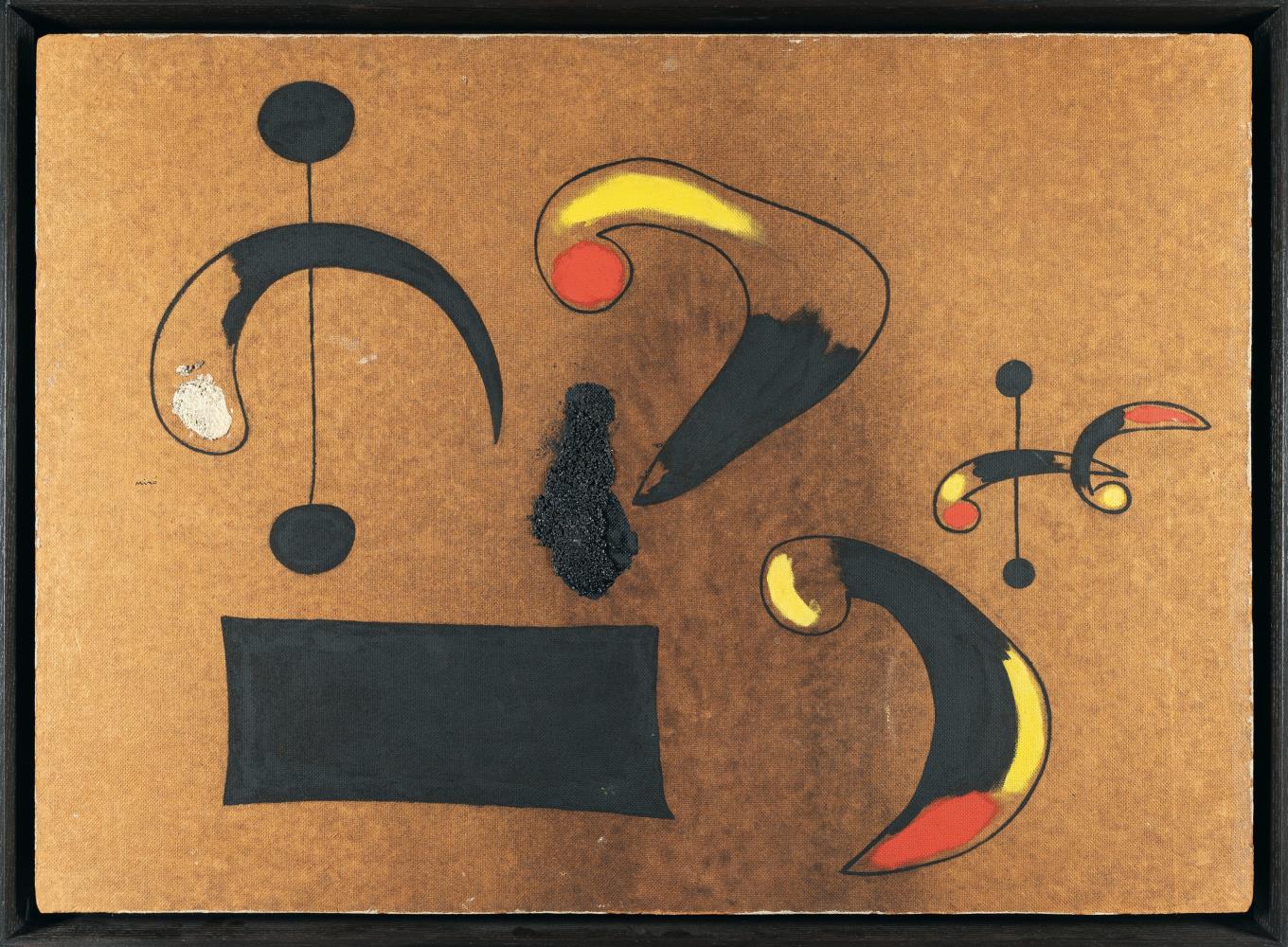
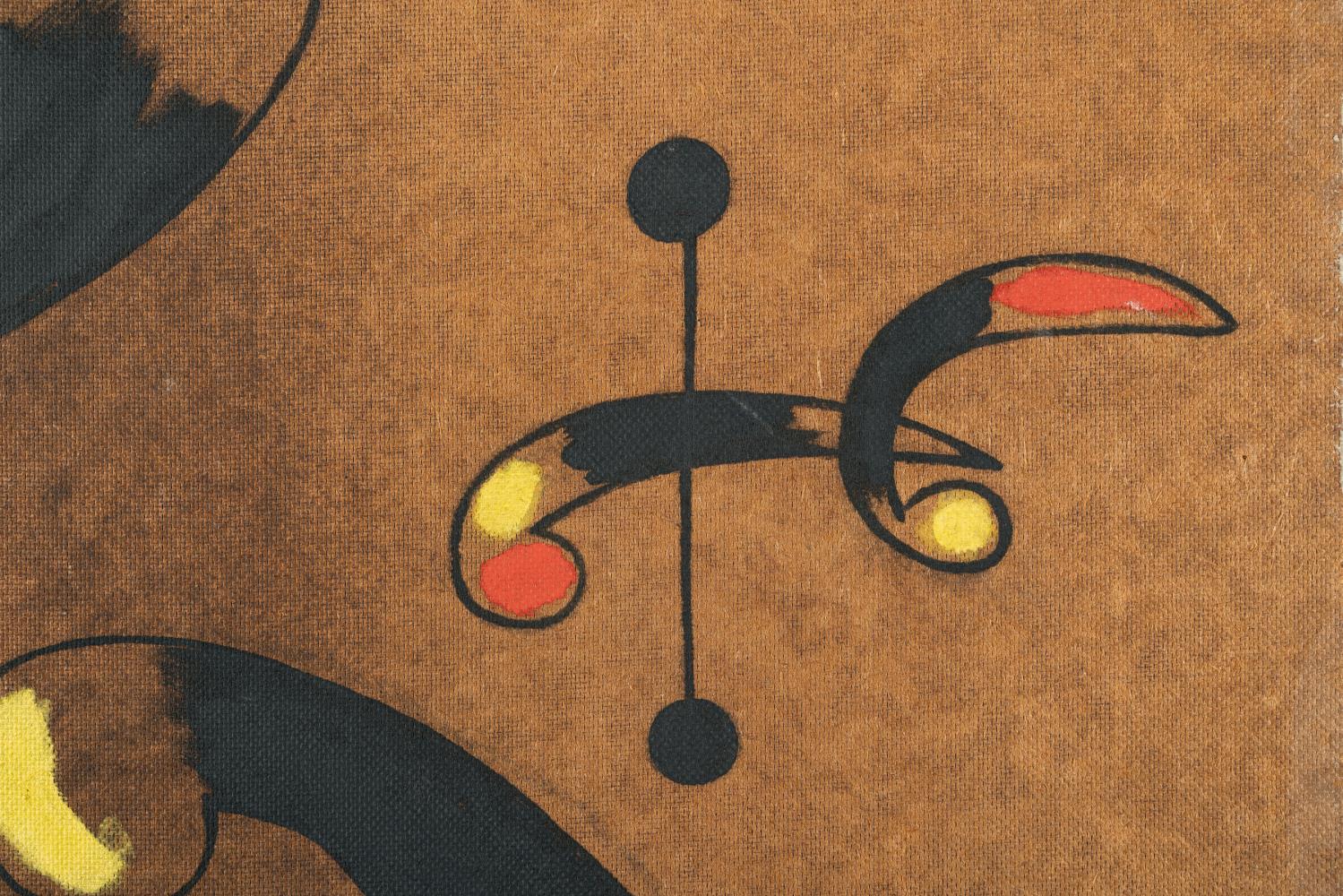
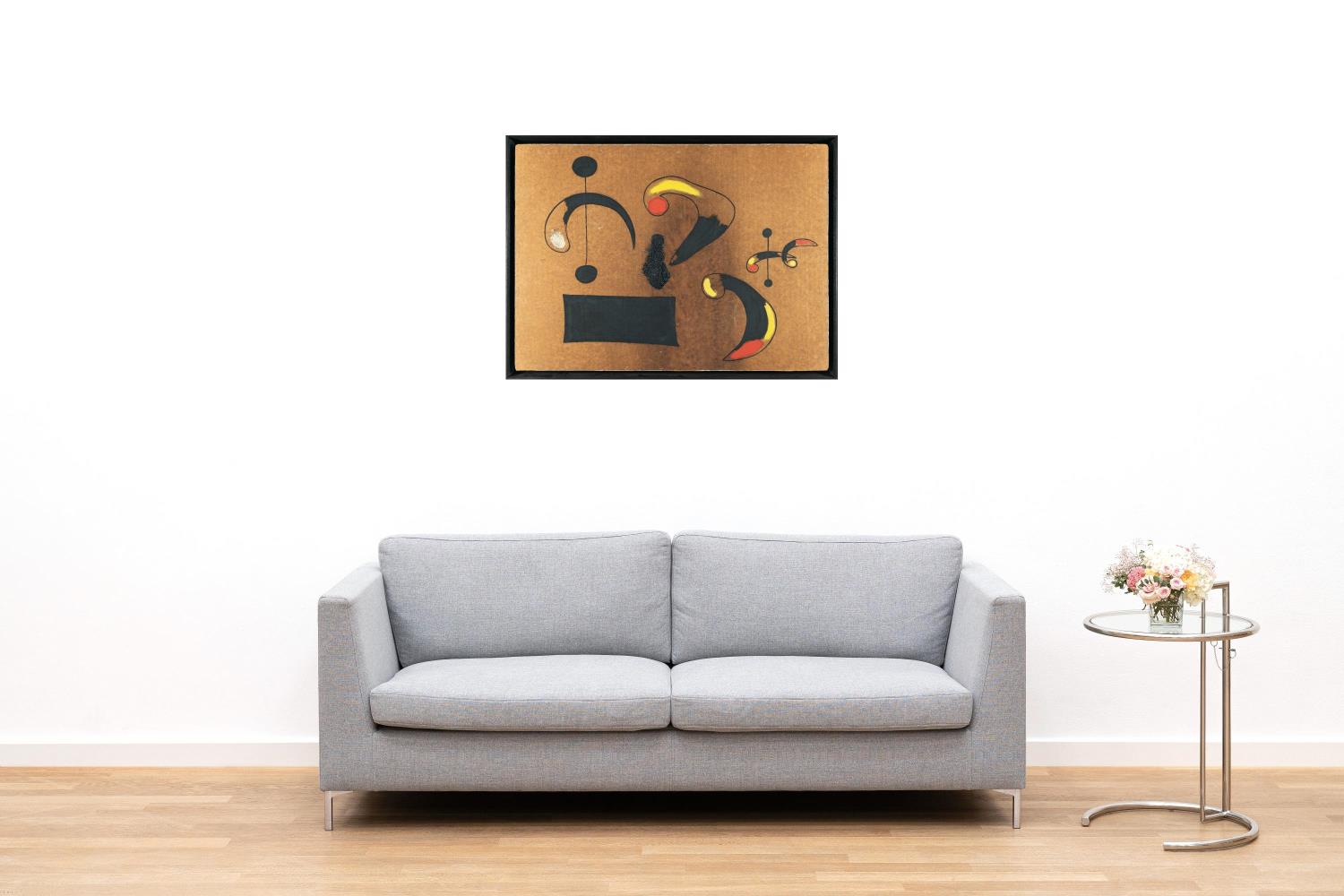
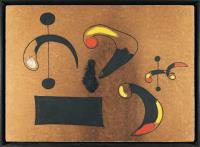
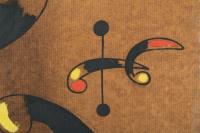
The 1936 summer series consistently continues this engagement with the picture support and takes it to a new level. Cardboard, copper and sandpaper give way to Masonite — an industrially manufactured wood fibreboard only invented in 1924. On this surface, Miró combines oil with casein, tar and sand. The support material remains visible. The warm brown, grainy surface of the Masonite is not primed, but serves as the picture ground. Upon it are a few sharply contoured marks, sprayed, brushed, rubbed in. In an uncompromising condensation, Miró sets out his iconic formal vocabulary. Black contours against a warm, material-specific ground, accompanied by bold colour accents in red, yellow and also white, which seem to glow from within. Contrasting with this is the black core at the centre of the picture, a condensed relief formed from sand, corresponding to a black, mysterious rectangle that seems to exert a magnetic pull on the amorphous formations of signs in motion. The clear formal language, the vibrant rhythm and the luminous colour make "Peinture" one of the most captivating and powerful works in the overall series.
Miró himself conceived these 27 works as a sequence. In one of the preliminary sketches, he notes that they are to be understood as cinematic sequences, specifying the dominant colour and each element. He even considers the idea of projecting them onto a large canvas and hanging wire objects in front of it, inspired by his own work as a stage designer. Ultimately, this idea remained unrealised, but it illustrates Miró’s understanding of an interdisciplinary concept of art.
Miró’s radicalism in this series of Masonite paintings is an assault — an assault on the picture surface, on the conventions of painting, on expectations of what a painting ought to be. In the face of a devastating war, Miró finds a concentrated artistic mode of expression that henceforth underpins his own work and, in its uncompromising nature, will influence subsequent generations of artists.
This painting was on display at the Tate Modern in 2011 as part of the major retrospective ‘Miró’, and at the Guggenheim Bilbao in 2023 in the exhibition ‘Joan Miró. Absolute Reality. Paris, 1920–1945"; the Tokyo Metropolitan Art Museum displayed the work in 2025 in the exhibition "Joan Miró. Poetry into Painting".
• Created immediately at the outset of the Spanish Civil War, Miró here condenses his iconic formal language into a new, uncompromising visual concept of extraordinary intensity
• Exhibited, among others, in the major Miró retrospective at Tate Modern (2011), at the Guggenheim Museum Bilbao (2023) and at the Tokyo Metropolitan Art Museum (2025)
In the summer of 1936, Joan Miró retired to the family estate, Mas Miró, in Mont-roig del Camp, south-west of Tarragona. The farm, which his father had purchased in 1911, had been far more than a summer residence for Miró since the early 1920s: It was here that he created his first major artistic work, ‘La masia’ (1921/22), and it was here that, drawing on his direct experience of the Catalan landscape, he developed the visual vocabulary that would henceforth characterise his work — sun, moon, star, bird and female figure. Mont-roig remained his most important retreat and place of work for decades.
When Miró arrived there in the summer of 1936, Spain was on the brink of a political state of emergency: on 17 July, General Franco staged a coup, and the Spanish Civil War began. In this tense situation, between June and October 1936, a cohesive group of 27 works on Masonite was created, which is today regarded as one of the most radical and at the same time most concentrated series in Miró’s oeuvre. The present painting, like all the works in this series simply titled ‘Peinture’, is part of it. In October, Miró left Spain for Paris, not to return until 1940.
Already in the two years prior, Miró had been going through a phase whose works are inscribed as his "peintures sauvages": small-format works on cardboard, copper and sandpaper, in which figures are distorted into grotesque, monstrous forms and the colour palette darkens. A programmatic departure from the academic pictorial tradition, which Miró himself described as the "assassinat de la peinture" (murder of painting) and which was to shape his artistic output from 1927 to 1937.
The 1936 summer series consistently continues this engagement with the picture support and takes it to a new level. Cardboard, copper and sandpaper give way to Masonite — an industrially manufactured wood fibreboard only invented in 1924. On this surface, Miró combines oil with casein, tar and sand. The support material remains visible. The warm brown, grainy surface of the Masonite is not primed, but serves as the picture ground. Upon it are a few sharply contoured marks, sprayed, brushed, rubbed in. In an uncompromising condensation, Miró sets out his iconic formal vocabulary. Black contours against a warm, material-specific ground, accompanied by bold colour accents in red, yellow and also white, which seem to glow from within. Contrasting with this is the black core at the centre of the picture, a condensed relief formed from sand, corresponding to a black, mysterious rectangle that seems to exert a magnetic pull on the amorphous formations of signs in motion. The clear formal language, the vibrant rhythm and the luminous colour make "Peinture" one of the most captivating and powerful works in the overall series.
Miró himself conceived these 27 works as a sequence. In one of the preliminary sketches, he notes that they are to be understood as cinematic sequences, specifying the dominant colour and each element. He even considers the idea of projecting them onto a large canvas and hanging wire objects in front of it, inspired by his own work as a stage designer. Ultimately, this idea remained unrealised, but it illustrates Miró’s understanding of an interdisciplinary concept of art.
Miró’s radicalism in this series of Masonite paintings is an assault — an assault on the picture surface, on the conventions of painting, on expectations of what a painting ought to be. In the face of a devastating war, Miró finds a concentrated artistic mode of expression that henceforth underpins his own work and, in its uncompromising nature, will influence subsequent generations of artists.
This painting was on display at the Tate Modern in 2011 as part of the major retrospective ‘Miró’, and at the Guggenheim Bilbao in 2023 in the exhibition ‘Joan Miró. Absolute Reality. Paris, 1920–1945"; the Tokyo Metropolitan Art Museum displayed the work in 2025 in the exhibition "Joan Miró. Poetry into Painting".