Carl Spitzweg
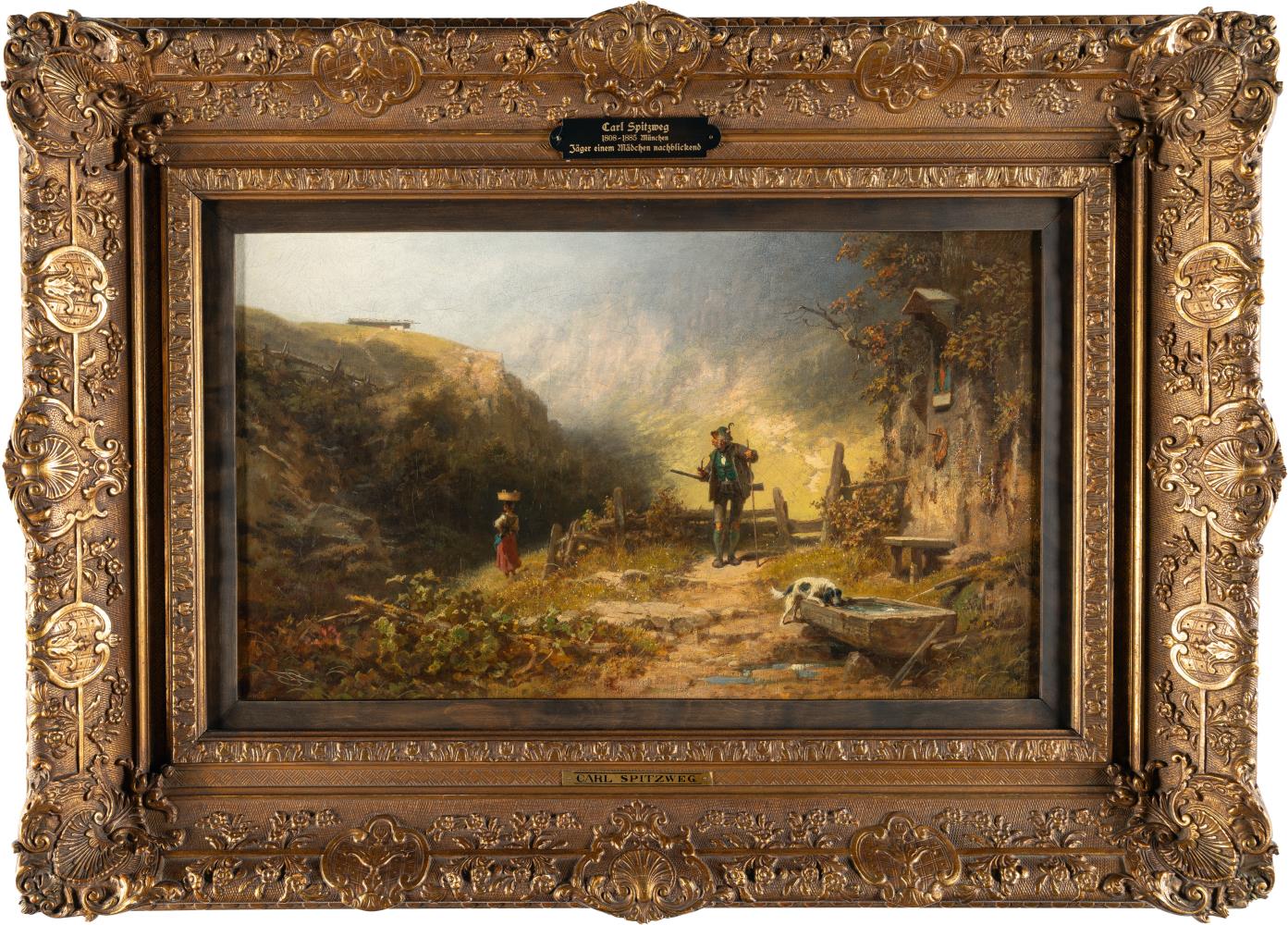
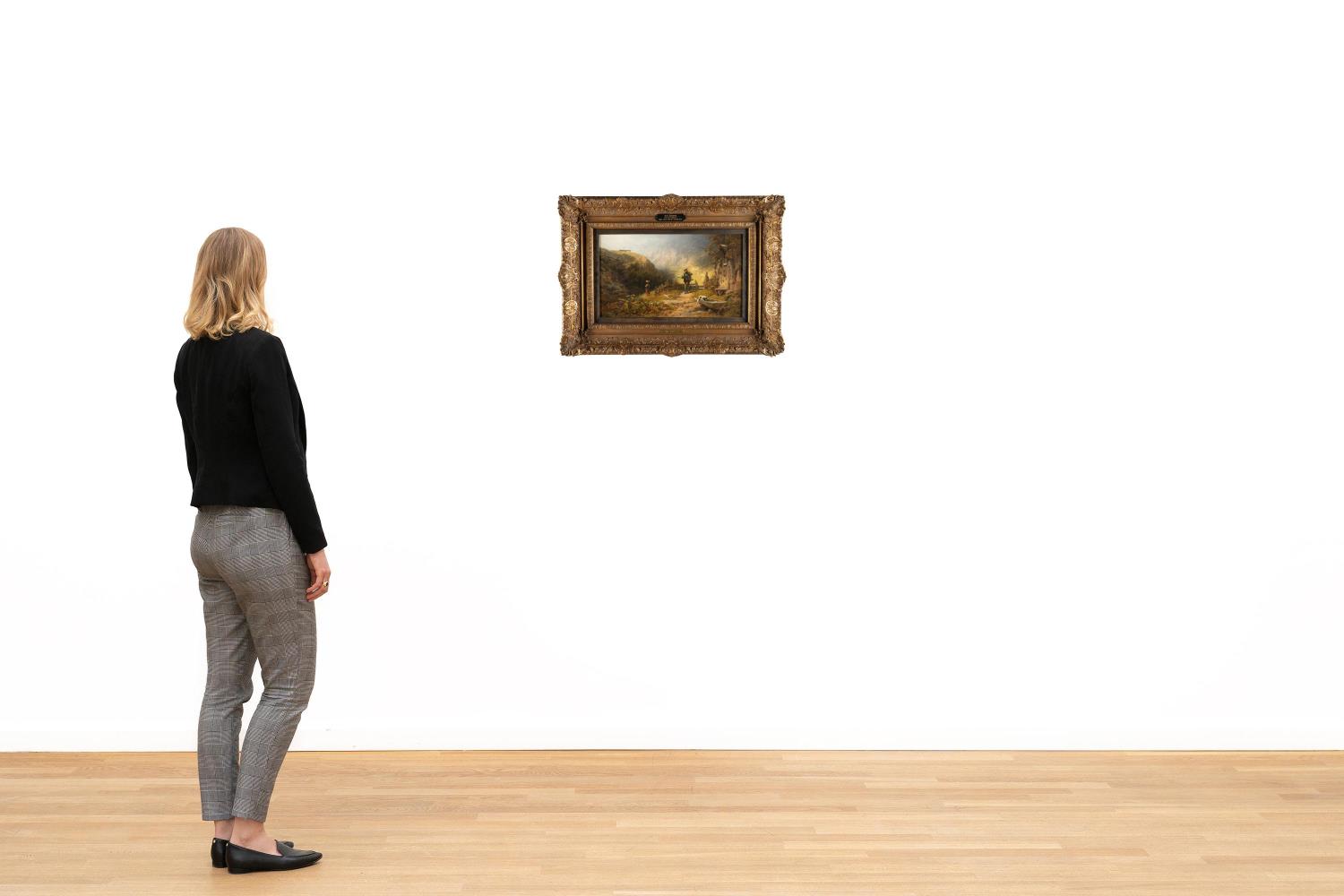
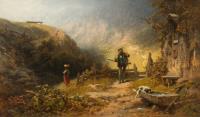
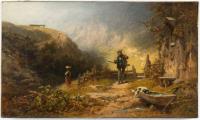
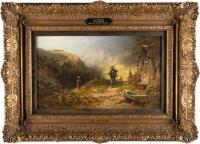
Hunter, looking back at a girl
Artista
Carl Spitzweg
1808 - München - 1885
Ulteriori informazioni
Wichmann 1492.
Mostra
23. Sonderausstellung, Nationalgalerie, Berlin 1886, Kat.-Nr. 54;
Spitzweg-Ausstellung, Rudolfinum, Prag 1887, Kat.-Nr. 31;
Gedächtnis-Ausstellung, Kunstverein München 1908, Kat.-Nr. 36;
Ausstellung, Wimmer & Co. (Kolb), München 1916, Kat.-Nr. 46;
Ausstellung, Galerie Abels, Köln 1928;
Verkaufsausstellung, Hugo Helbing, München 1930;
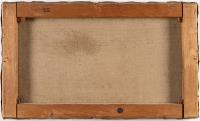
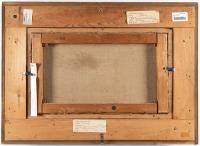
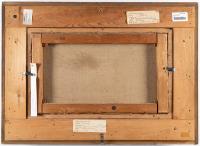
Carl Spitzweg. Reisen und Wandern in Europa und der Glückliche Winkel, Seedamm Kulturzentrum Pfäffikon/Haus der Kunst, München 2003, S. 206, Kat.-Nr. 109, mit farb. Abb. auf der Rahmenrückseite mit dem Etikett.
Spitzweg-Ausstellung, Rudolfinum, Prag 1887, Kat.-Nr. 31;
Gedächtnis-Ausstellung, Kunstverein München 1908, Kat.-Nr. 36;
Ausstellung, Wimmer & Co. (Kolb), München 1916, Kat.-Nr. 46;
Ausstellung, Galerie Abels, Köln 1928;
Verkaufsausstellung, Hugo Helbing, München 1930;
Carl Spitzweg. Reisen und Wandern in Europa und der Glückliche Winkel, Seedamm Kulturzentrum Pfäffikon/Haus der Kunst, München 2003, S. 206, Kat.-Nr. 109, mit farb. Abb. auf der Rahmenrückseite mit dem Etikett.
Letteratura
Ostini, Fritz von, From Carl Spitzweg’s World, Barmen 1924, p. 9; Elsen, Albert, Carl Spitzweg, Vienna 1948 (1952), p. 102, no. 80, ill.; Roennefahrt, Günther, Carl Spitzweg. A Descriptive Catalogue of his Paintings, Oil Studies and Watercolours, Munich 1960, no. 388; Kalkschmidt, Ernst, Carl Spitzweg and his World, 4th ed., Munich 1966, p. 120, fig. 85; Albrecht, Siegfried (Siegfried Wichmann), Carl Spitzweg’s Painter’s Paradise, Stuttgart 1968, pp. 142ff., p. 170, no. 40; Wichmann, Siegfried, Carl Spitzweg and his Circle of Friends, exhibition catalogue, Munich 1968, p. 49, no. 106, fig. 79; Wichmann, Siegfried, Carl Spitzweg. Drawings, Watercolours and Oil Paintings, Vienna 1968, cat. no. 130; Wichmann, Siegfried, Carl Spitzweg. The Chronology of Signatures in the Work of Carl Spitzweg. The Forgers and their Methods, Sindelfingen 1976, p. 46; Wichmann, Siegfried, Carl Spitzweg. Hunter with a Girl in the Forest. Documentation, Starnberg-Munich 1984, pp. 34ff, ill.; Wichmann, Siegfried, Carl Spitzweg and the French Draftsmen, exhibition catalogue, Haus der Kunst, Munich 1985, pp. 301 and 477, no. 537; Wichmann, Siegfried, Carl Spitzweg. Art, Costs and Conflicts, Frankfurt/Berlin 1991, p. 339, no. 364; Wichmann, Siegfried, Carl Spitzweg. The Hunter in the Forest. Documentation, Starnberg-Munich 1994, p. 26, colour ill.; Wichmann, Siegfried, Carl Spitzweg. Passing By. Dairymaid in the Mountains. Documentation, Starnberg-Munich 1995, pp. 38–39, colour ill.; Wichmann, Siegfried, Carl Spitzweg. Old Hunter à la Kobell. Hunter Watching a Girl. Documentation, Starnberg-Munich 1997, pp. 5–57, colour ill.; Wichmann, Siegfried, Carl Spitzweg. The Hunter’s Farewell. Documentation, Starnberg-Munich 1998, p. 42, colour ill.
Provenienza
Probably sales catalogue no. 364: ‘Old Hunter (à la Kobell); sold in 1878 to Baroness Caroline von Gumppenberg (1816–1889), Munich; private collection, Germany.
lot_group
1 Dipinti
Share


Descrizione
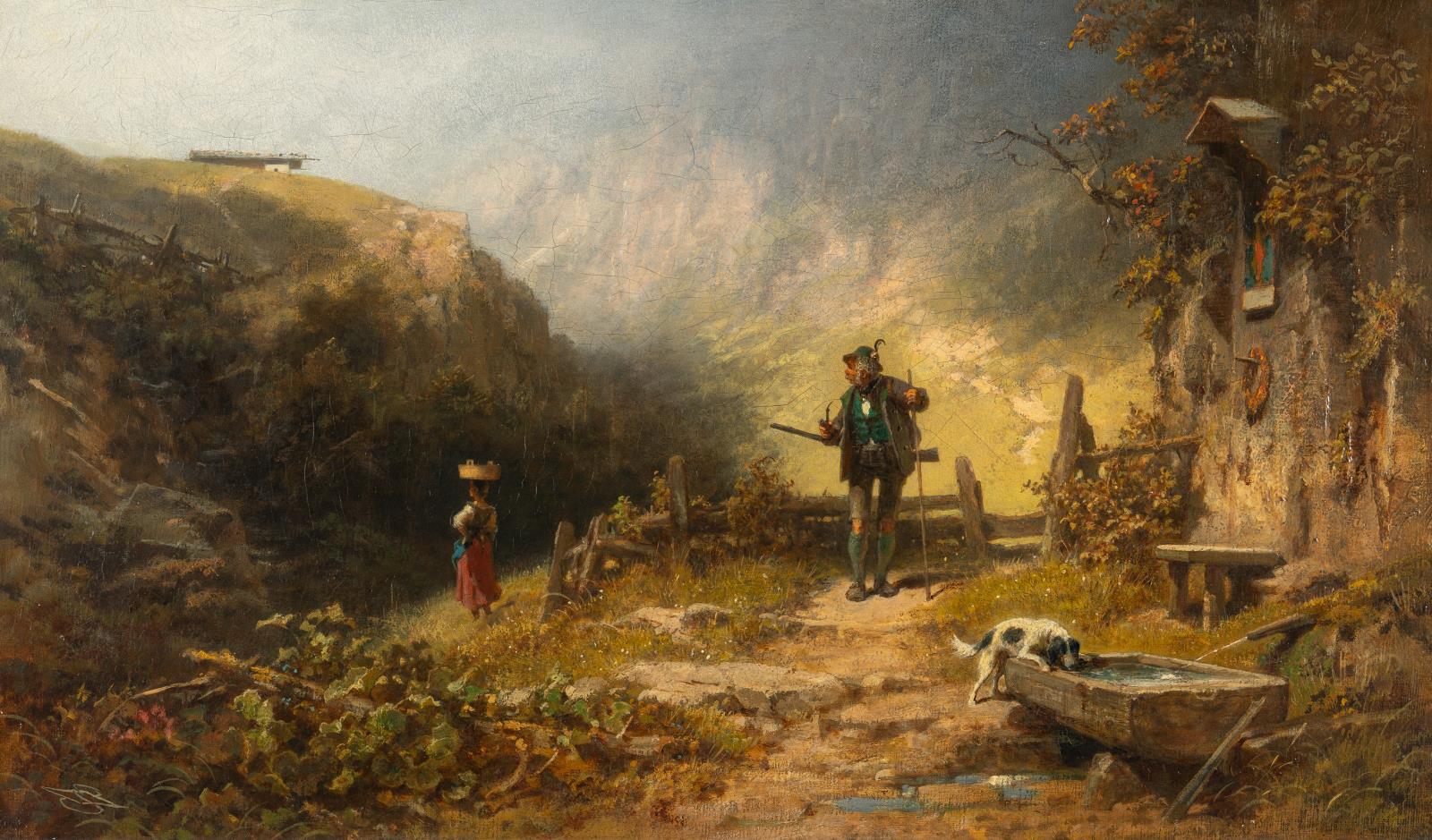
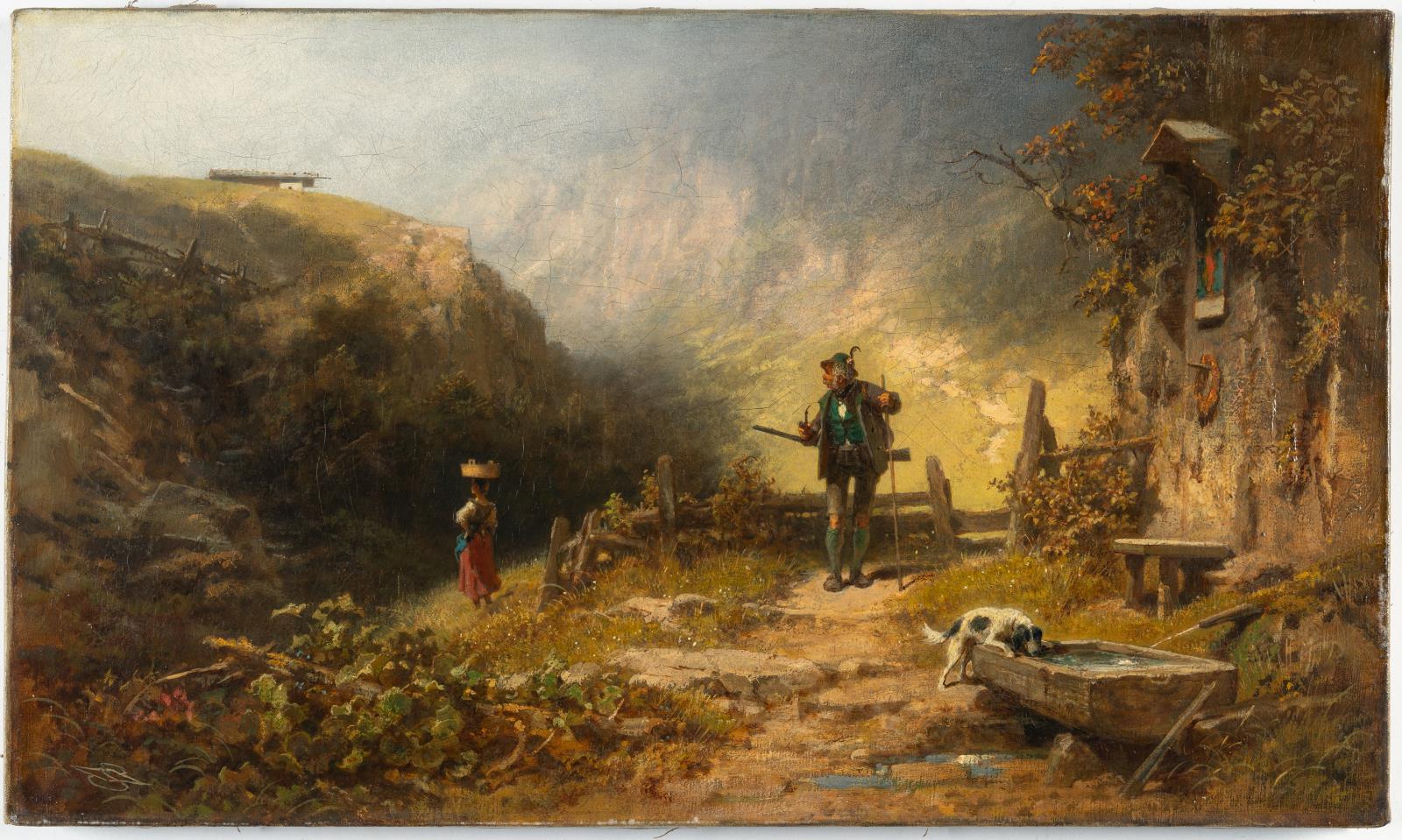
The encounter between the sexes occupies a prominent place in Spitzweg’s work and is not always devoid of biographical elements. His great love, Clara Lechner, died of pulmonary catarrh before their planned wedding, and following this painful loss, Spitzweg never entered into another serious relationship. Throughout his life, he remained the proud bachelor whom he depicted countless times in his paintings. Indeed, the themes of love and marriage are present in his work to an extent rarely seen in the work of any other artist – paintings such as The Intercepted Love Letter or The Eternal Bridegroom depict such encounters between the sexes, which were mostly of a fleeting nature. This is also the case in our painting, in which a hunter gazes after a dairymaid walking down a path into a small valley to climb up to the dairy hut, which is visible to the left behind the rugged hilltop. The dairymaid, with her load balanced on her head, dressed in a red skirt, blue apron, golden-yellow bodice and white blouse, embodies the artist’s ideal of womanhood, which he has explored in numerous thematically similar paintings. Have she and the hunter met before and spoken to one another, perhaps arranging to meet again? Or is this a depiction of an unfulfilled longing, a missed opportunity to approach the young woman, which the hunter now ponders with a wistful gaze? As always, Spitzweg leaves this question open, emphasising the fleeting nature of their encounter and leaving the viewer to their own moral judgement and imagination. As so often, Spitzweg depicts the hunter not as a heroic conqueror of nature but as a somewhat eccentric oddball who does not always return from the hunt successfully. Our painting is known by various titles, including *The Hunter Kobell* (also *Le Chasseur Kobell*), which does not refer to Spitzweg’s fellow painter Wilhelm von Kobell, but, according to an old tradition, to the Munich dialect poet and professor of mineralogy Franz von Kobell, whose physics lectures Spitzweg had attended at the University of Munich in 1829–30. The hunter is said to bear Kobell’s facial features and forms part of a series of portraits and genre scenes in Spitzweg’s late work, in which he depicts well-known figures as typical characters. But is our painting a genre scene at all, or is it rather a landscape? This question actually always arises with Spitzweg – everyday activities are too closely interwoven with his conception of nature. Here, too, the path leads into a ravine that separates longing from reality; the severed ivy branch in the left foreground and the water trough with the drinking dog on the right, the rock face with its wayside shrine and bench, and finally the gate, setting the stage for the hunter, behind whom the ravine opens up in a green, turbulent palette reminiscent of the colour swirls in a William Turner painting. Here Spitzweg reveals himself as a magnificent colourist who translates colour into emotion; here the loose brushwork characteristic of his late work reveals the almost proto-Impressionist traits of his painting. Dr Peter Prange