Carl Spitzweg
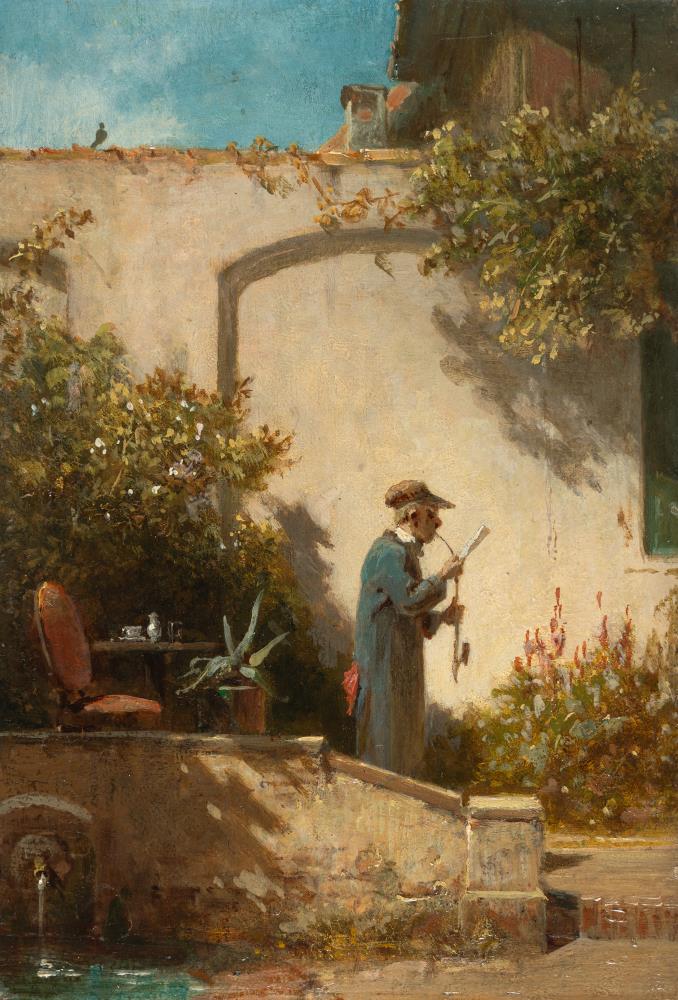
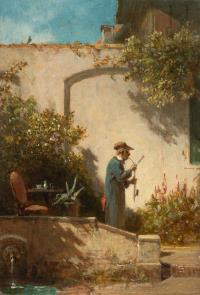
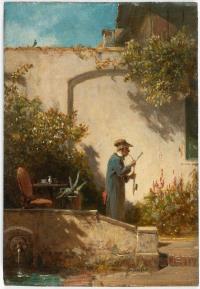
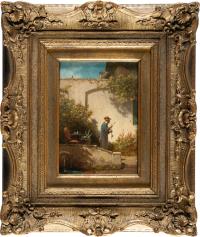
The Newspaper Reader in the Garden

Artista
Carl Spitzweg
1808 - München - 1885
Ulteriori informazioni
Wichmann 519 (?).
Mostra
Schönemann & Lampl, München 1927, Kat.-Nr. 21, Abb. Taf. 3.
Letteratura
Roennefahrt, Günther, Carl Spitzweg. Descriptive Catalogue of his Paintings, Oil Studies and Watercolours, Munich 1960, no. 883 (?).
Provenienza
Private collection, Germany.
lot_group
1 Dipinti
Share


Descrizione
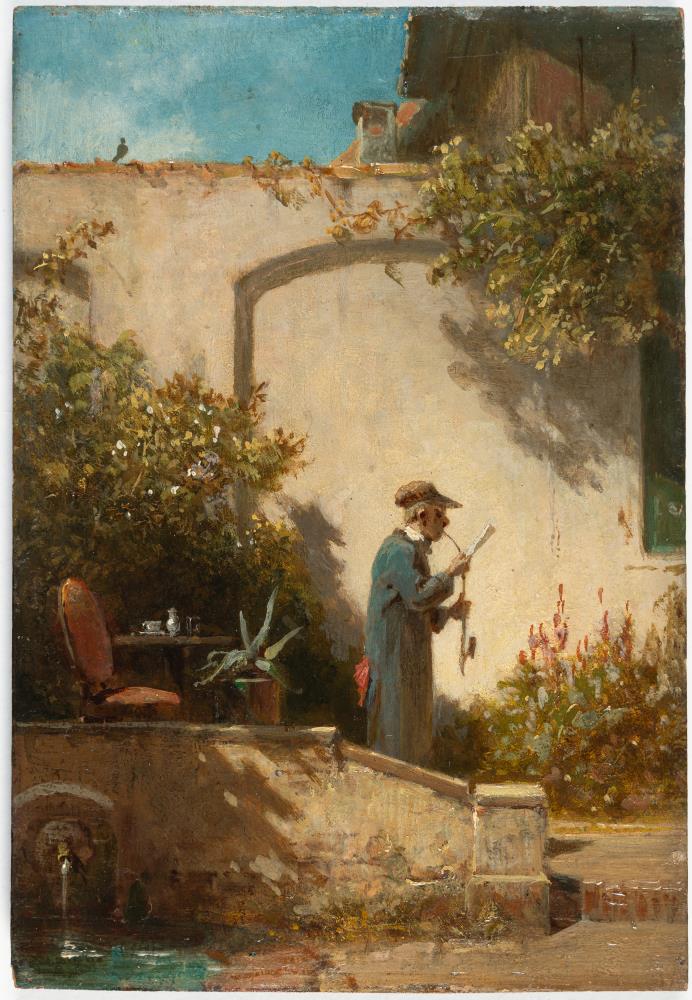
An elderly gentleman in a dark blue dressing gown, wearing a fashionable peaked cap, stands at the centre of his little world, smoking his long tobacco pipe and absorbed in reading his newspaper or a letter. It is early morning; the sun is taking hold of the day with all its might, a day the old gentleman has begun with his breakfast. To the left stands the small breakfast table, still set, with the chair he has left to devote himself to his reading. The elderly gentleman is alone in his garden, entirely to himself, and just as he is shielded from the outside world internally, so he acts on a sort of stage, screened off to the left and right, to the rear and even to the front by a balustrade. The outside world is shut out; high walls protect him; no one disturbs him; the plants and bushes flourish around him; even the agave, characteristic of Spitzweg, is present; and only the view of the blue sky above the wall signals contact with an imaginary outside world. It is a staging very similar to that which Spitzweg employed on numerous other occasions – one recalls his depictions of eccentric cactus and flower enthusiasts who perform on stages similarly shielded from the outside world and enjoy the true pleasures of life undisturbed. In these works, Spitzweg creates a kind of locus amoenus, a lovely place where man and nature are united in peaceful harmony. Our solitary reader also presents such an idyll, in which one feels one can hear the splashing of water from the fountain, and one might leave it at that, noting that Spitzweg takes up central themes of the Biedermeier period, such as the retreat into private life, within this contemplative tranquillity. Yet the old gentleman’s activity is not as innocuous as it appears: the depiction of readers and book lovers occupies a significant place in Spitzweg’s oeuvre and constitutes highly emotional themes for him – even in his most famous painting, the poor poet reads in his sparse attic room – at a time when a reading public was developing, when compulsory schooling enabled young people to read, and when lending libraries promoted access to popular literature. There is the bookworm standing on a ladder in his library, lost in a book, or the antiquarian who threatens to be swallowed up by the flood of his books – Spitzweg repeatedly depicts readers or people engrossed in books and occupied with them, such as librarians, writers or scholars. The numerous newspapers, which were already appearing daily at that time, promised a share in the world and were of significance for the formation of bourgeois society that can scarcely be underestimated; reading meant education and was well-suited to increasingly dissolving class boundaries. At the same time, in the society of the Vormärz period, which Spitzweg himself had lived through, the reader was threatened by censorship, for the regime of the Restoration and the political conditions following the failure of the 1848 Revolution had largely restricted civil rights. Newspapers and reading societies were banned or subject to state censorship; even smoking in the streets and public places was prohibited, which is why, for many, retreating into private life was the only way to protect themselves from censorship. Dr Peter Prange