Carl Spitzweg
The Quartet
Artista
Carl Spitzweg
1808 - München - 1885
Ulteriori informazioni
Wichmann 1560.
Mostra
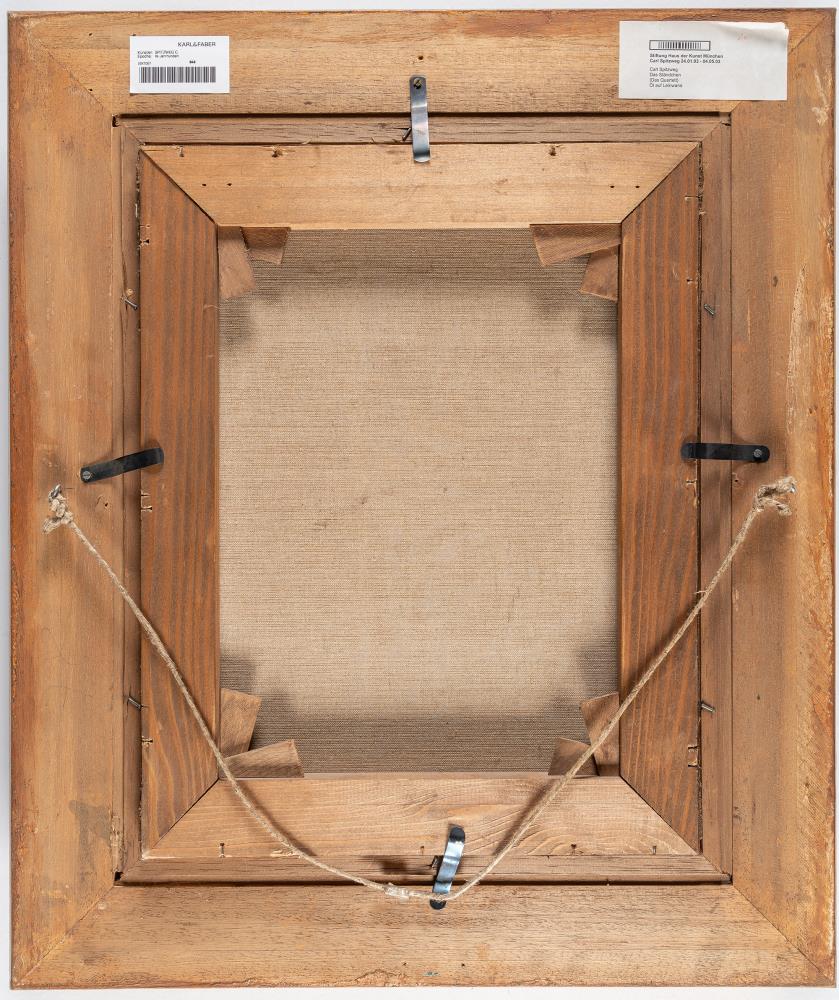
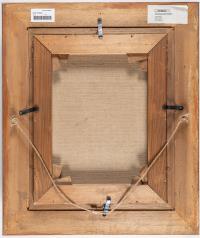
Carl Spitzweg. Reisen und Wandern in Europa und der Glückliche Winkel, Seedamm Kulturzentrum Pfäffikon/Haus der Kunst, München 2003, S. 206, Kat.-Nr. 174, mit farb. Abb. auf der Rahmenrückseite mit dem Etikett.
Letteratura
Wichmann, Siegfried, Carl Spitzweg. Pictures of Serenaders, Street Singers and Night Singers. A Contribution to the Musical Spitzweg, Starnberg-Munich 1975, No. 29; Wichmann, Siegfried, Carl Spitzweg. Night-time Serenade, Starnberg-Munich 1995, pp. 24ff., colour ill.
Provenienza
Collection, Switzerland (1966). Private collection, New York. Private collection, Germany.
lot_group
1 Dipinti
Share


Descrizione
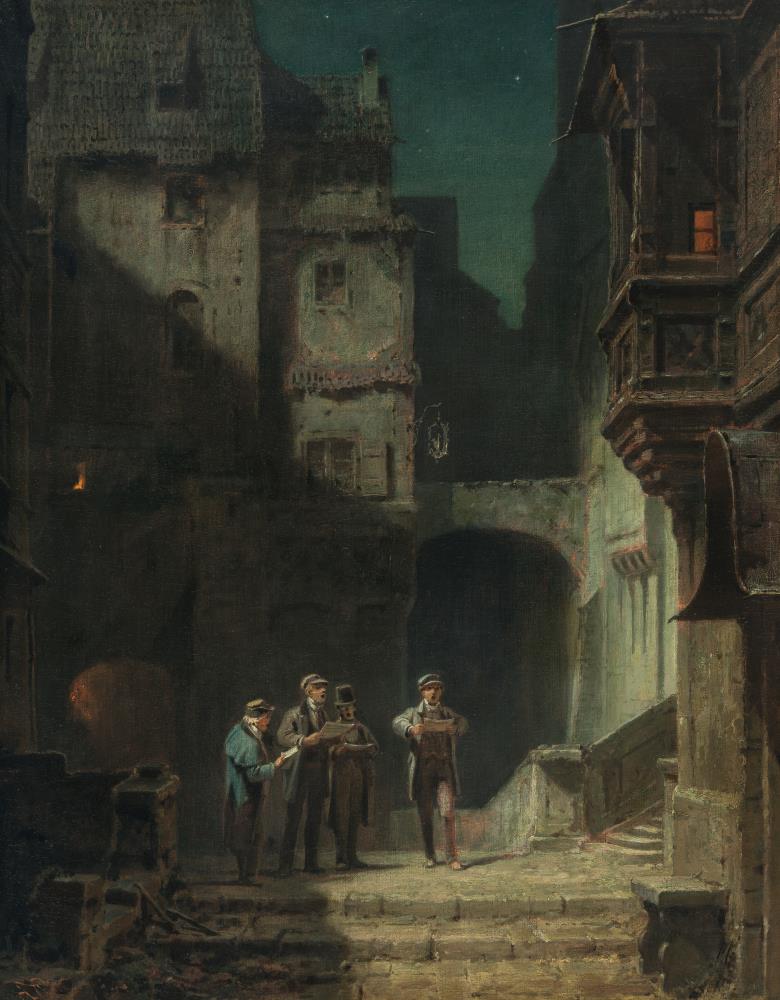
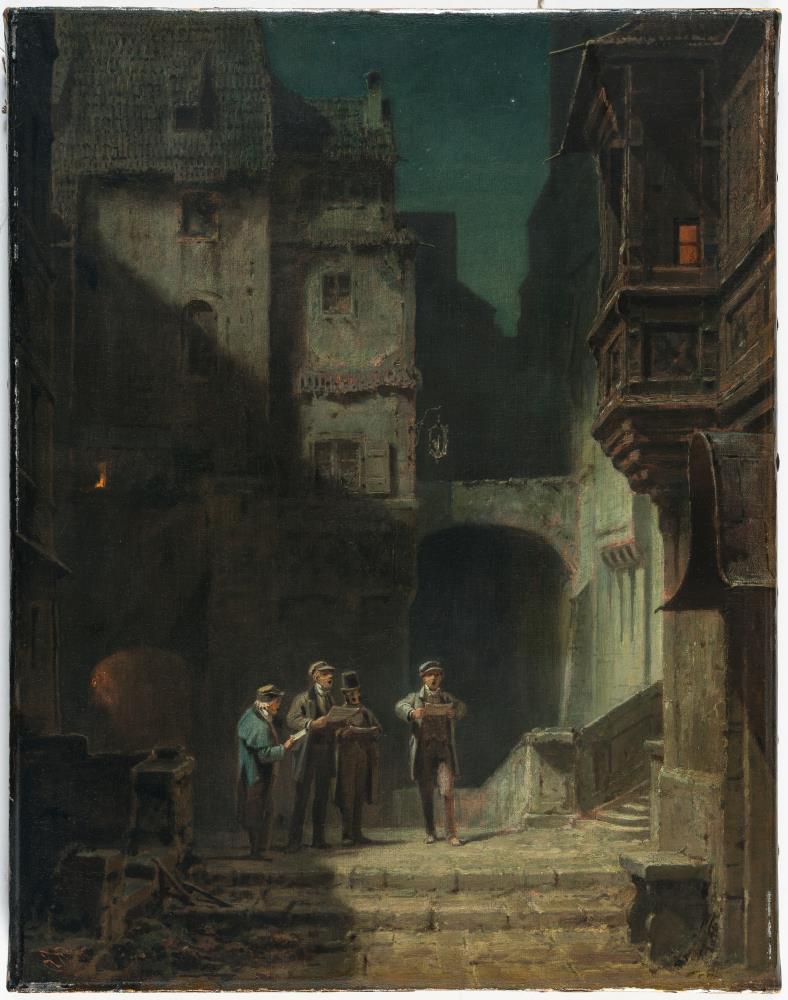
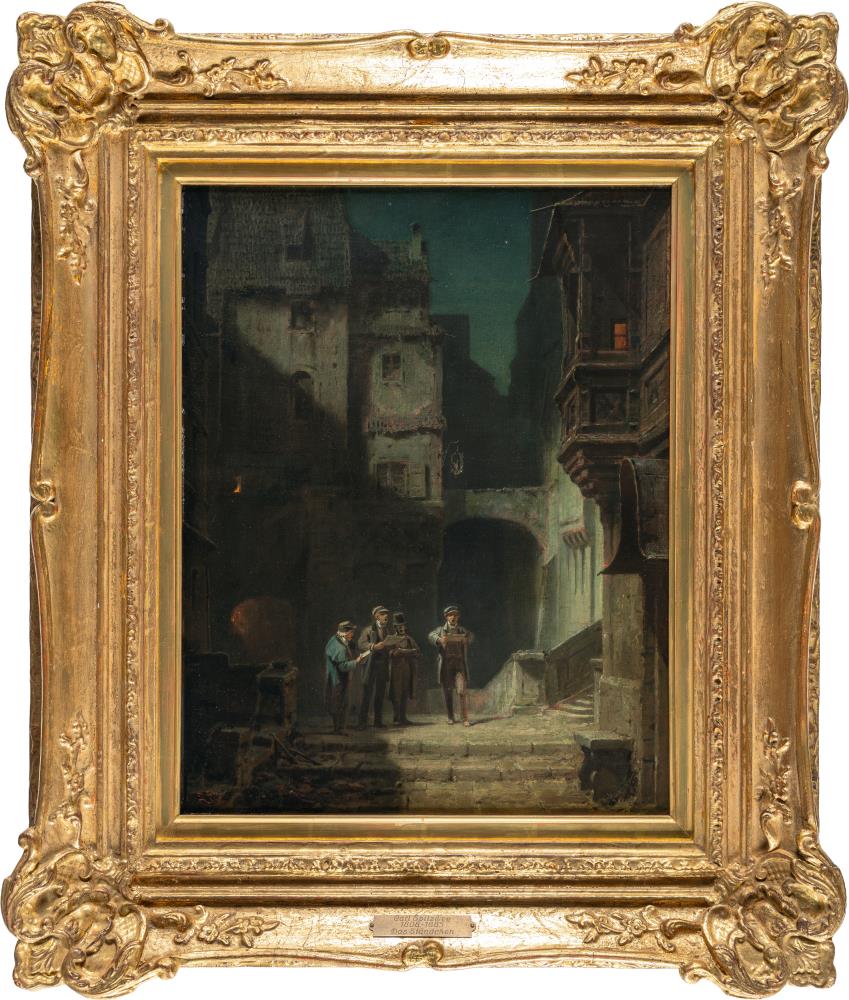
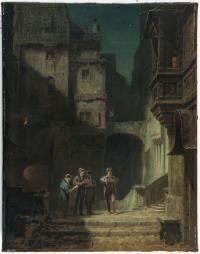
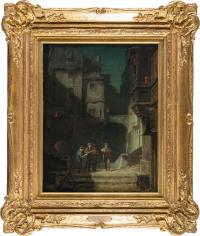
After 1860, the mystery of the night increasingly found its way into Spitzweg’s tranquil pictorial world; he painted night scenes that captured on canvas the reflection of the blue-green moonlight on the houses of the towns and the shining stars in the firmament. These night scenes include his numerous night watchmen, who were ubiquitous at the time, as well as groups of musicians who wandered through the streets singing. Spitzweg was a music lover and depicted serenades, bands, and groups of street and chamber musicians in daylight and, particularly, in the darkness of night. In our painting, four singers have gathered on a brightly lit, stage-like landing, their sheet music before them. Their clothing, their various headwear – hat, peaked cap and top hat – and their enthusiasm for singing equally combine bourgeois sensibility and devotion to art. The singer on the left in the blue coat, evidently the eldest, is shown in profile, whilst the other three face the viewer more or less head-on – they are grouped in a slight curve on the landing. From there, various small staircases lead into the town, forwards, to the left and to the right, without it being clear where they lead. One of the defining features of Spitzweg’s cityscapes is that, whilst he drew inspiration from the medieval towns he visited on his numerous travels, he used this to create fantastical urban spaces in his paintings in a highly idiosyncratic manner. Houses of great height and narrow width with few windows crowd around the staircase, devoid of light; on the right, a whimsical bay window juts into the picture, with a small light visible within. Much like his landscape paintings, Spitzweg also conceives of the urban space as a gorge receding into the distance; it is more of an ephemeral backdrop, everything is cramped, crowded and, at night, so mysterious that one is reminded of the narrow, winding alleys of Venice. And then the light, which illuminates the stage like a spotlight – it glances off the house facades and falls with full intensity on the facade on the right and the staircase landing. It is in these powerful stagings of light that Spitzweg plays with artificial and natural light: whilst the foreground is powerfully illuminated as a stage, the moonlit expanse of the starry sky in the background appears in a greenish-bluish light. Spitzweg’s oeuvre contains various versions and variations of a nocturnal serenade, all of great pictorial and atmospheric appeal. Unlike most other versions, our painting lacks a protagonist to whom the singing is addressed – the beloved who appears at the window. One may thus imagine that the musicians’ song is particularly imbued with the hope and longing that the beloved might yet appear in the illuminated bay window – as so often, Spitzweg does not reveal whether the singers’ courtship is successful, leaving the outcome of this little serenade to the viewer’s imagination. Dr Peter Prange