Carl Spitzweg
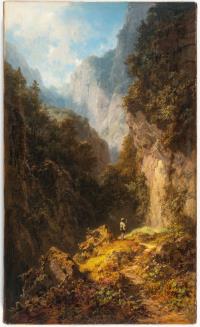
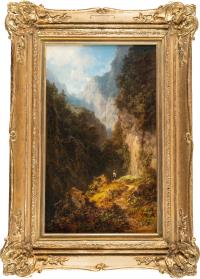
The Eagle Hunter

Artista
Carl Spitzweg
1808 - München - 1885
Ulteriori informazioni
Wichmann 1131.
Mostra
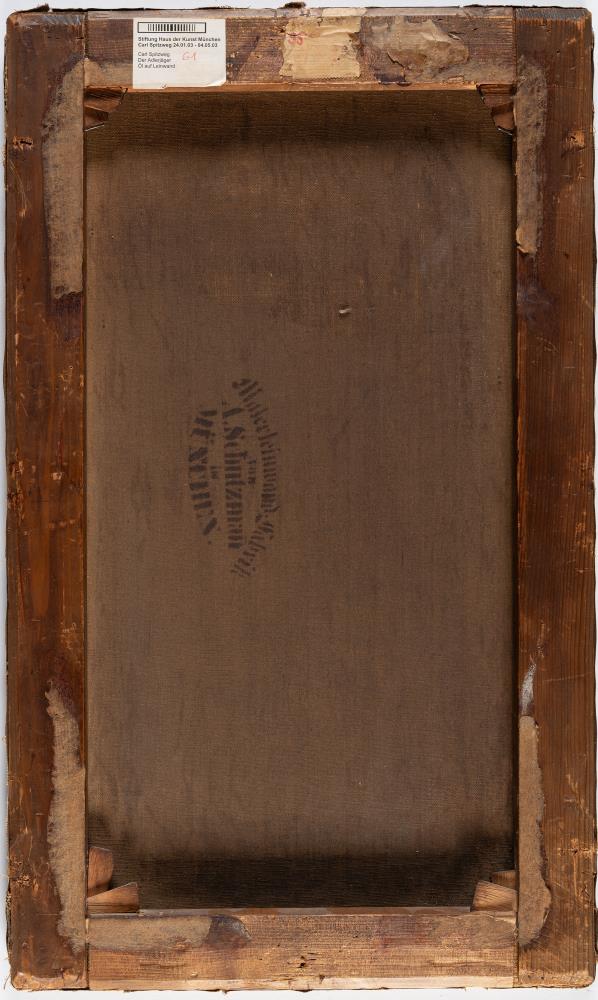
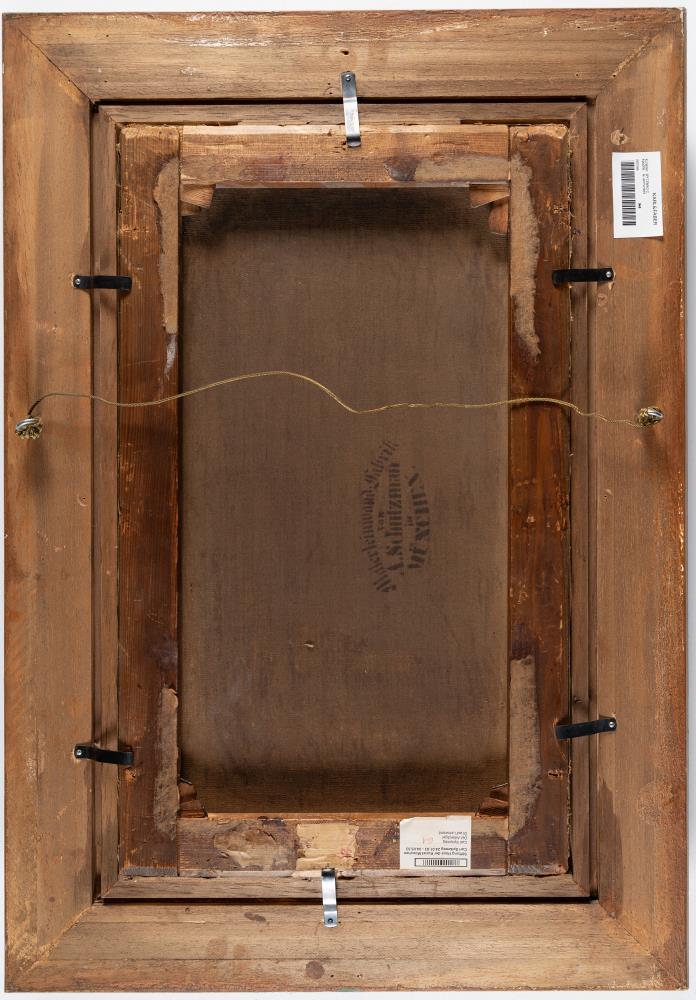
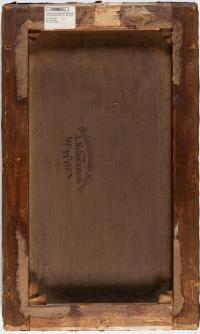
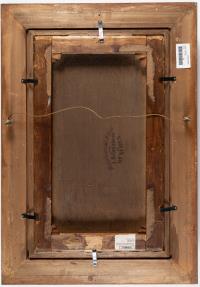
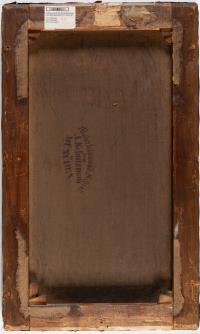
Carl Spitzweg. Reisen und Wandern in Europa und der Glückliche Winkel, Seedamm Kulturzentrum Pfäffikon/Haus der Kunst, München 2003, S. 206, Kat.-Nr. 106, mit farb. Abb. auf der Rahmenrückseite mit dem Etikett.
Letteratura
Roennefahrt, Günther, Carl Spitzweg. Descriptive Catalogue of his Paintings, Oil Studies and Watercolours, Munich 1960, no. 413; Wichmann, Siegfried, Carl Spitzweg. Art, Costs and Conflicts, Frankfurt/Berlin 1991, p. 337, no. 336; Wichmann, Siegfried, Carl Spitzweg. Eagle Hunter in the Landscape, Starnberg-Munich 1998, pp. 28–29, b/w ill. 151.
Provenienza
Probably sale catalogue no. 336: "1. Alpine Hunter, large format, [...]", sold in 1876 to August Humplmayr (1829–1885), Munich; Wimmer & Co, Munich (1941); private collection, Munich; private collection, Germany.
lot_group
1 Dipinti
Share


Descrizione
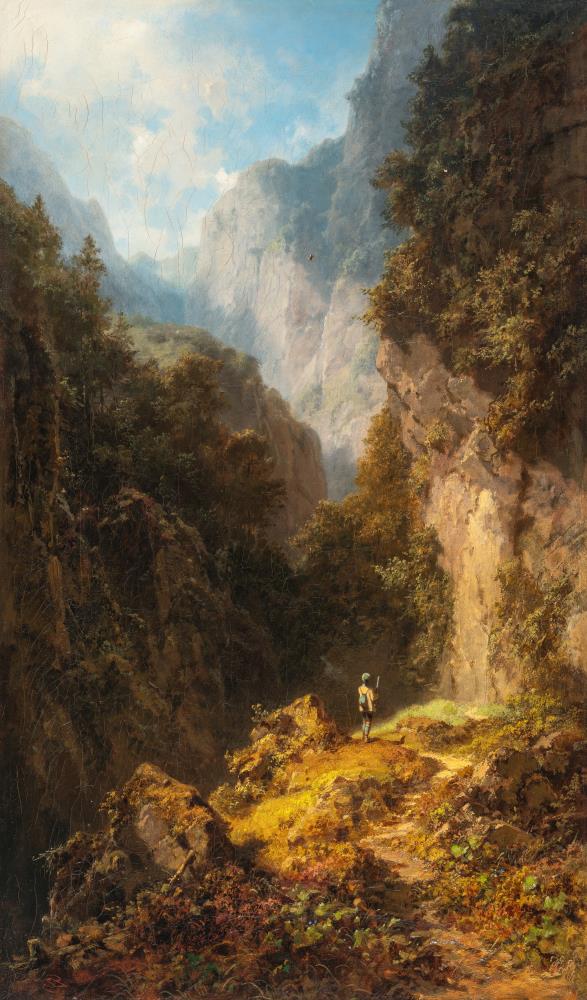
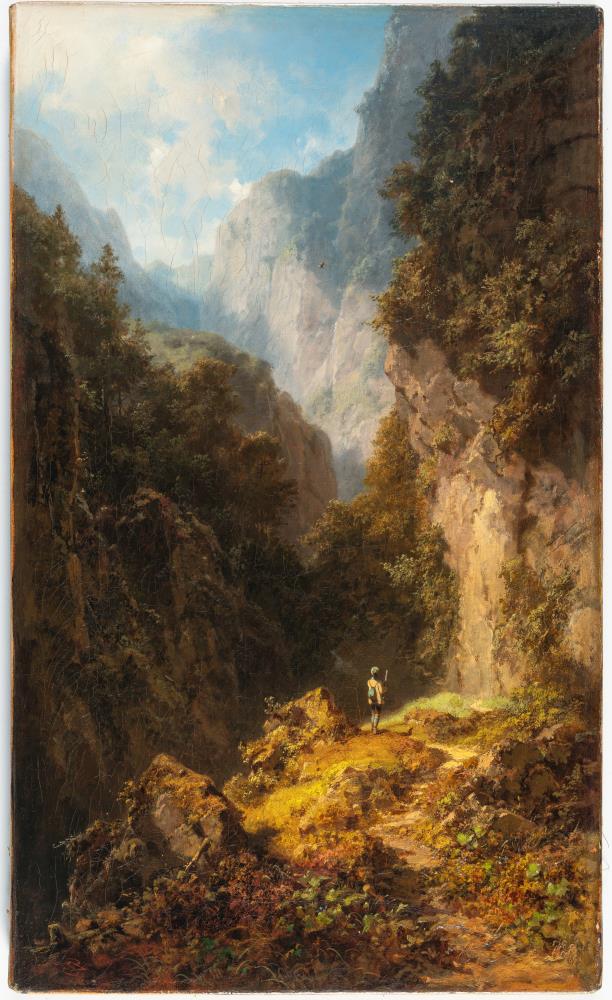
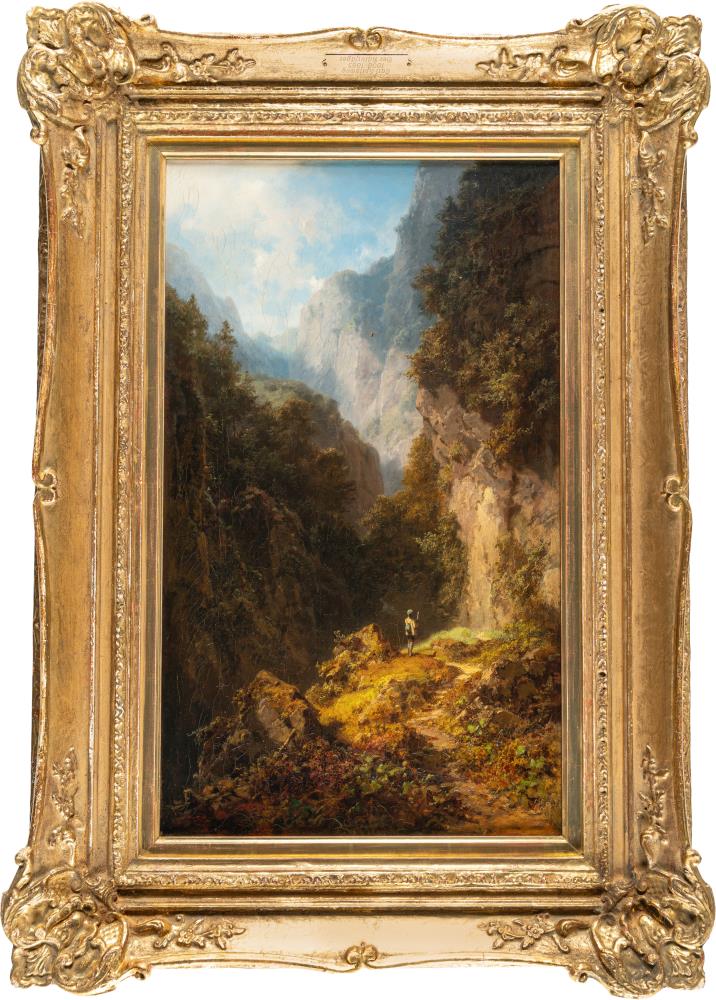
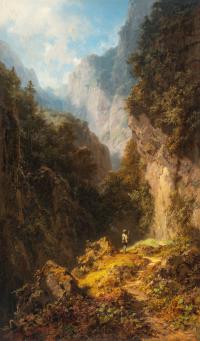
At the bottom of a path, on the edge of the precipice overlooking the narrow gorge, stands a hunter with a rifle in his hand; he has his back turned to us, and one is involuntarily reminded of the iconic, solitary figures seen from behind in the works of the great Romantic painter Caspar David Friedrich. Spitzweg’s hunter, too, is alone; he seems almost to be swallowed up by the mighty gorge and appears small, almost lost, in the face of the overwhelming natural landscape, yet he is not lost in thought as in Friedrich’s work, but alert. He is scanning for his prey; he is watching an eagle which he has evidently shot and which is now spiralling downwards into the gorge as it opens up towards the still cloud-shrouded sky. Spitzweg breaks with the Romantic pictorial form of the figure seen from behind by translating it into the mundane realism of the hunting motif, and in doing so he reveals, not without irony, his understanding of Romanticism. The hunter must have set out early; it is early morning, when the rising light of the sun is gradually taking hold of the ravine and dispelling the last mist of the night. The hunter is bathed in a warm, morningy golden-brown, whilst the other side of the ravine remains in deep shadow. It is a staging of the overpowering, sublime nature characteristic of Spitzweg, in which the motif of the deep ravine – inaccessible to humans and effectively bathed in light and shadow – recurs time and again. It is evident that Spitzweg is drawing on his theatrical experiences here and applying them to his paintings. This work, which is relatively large by Spitzweg’s standards, belongs to a whole group of paintings on the theme of the ‘eagle hunter’ (Wichmann 2002, nos. 1124–1137), which, according to Siegfried Wichmann, were created around 1865–70. Like almost all the themes Spitzweg addresses, they touch upon cultural-historical contexts, which also applies to the motif of the eagle hunter, which was deeply rooted in bourgeois society at the time. With his numerous paintings, Spitzweg took up a tradition that was widespread in the Alpine region at the time, which was not the hunting with eagles common in other cultures, but rather a fierce hunt for the eagle. In the 19th century, the golden eagle in particular was regarded in the Alps as a constant threat to the valuable livestock of mountain farmers, who feared it as a thief of lambs. The eagle was therefore systematically hunted, which eventually led to its near-total extermination; in the 19th century, the state even encouraged the hunt by offering bounties for its capture, and high prices could be fetched for its plumage. The most famous eagle hunter in the Bavarian Highlands at that time was the personal huntsman of Prince Regent Luitpold of Bavaria, Leo Dorn from Oberstdorf, who is said to have bagged a total of 77 eagles and was officially proclaimed ‘King of the Eagles’ by Prince Regent Luitpold after his 50th kill in the late 1890s. The heroisation and romanticisation of the eagle hunter went so far that Ludwig Ganghofer erected a literary monument to him in his *Deutsches Jägerbuch*. Dr Peter Prange