Pablo Picasso
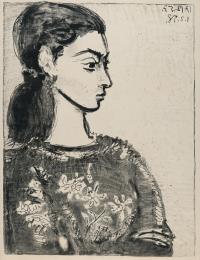
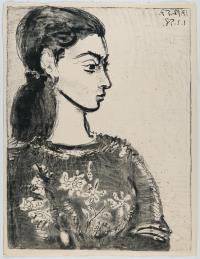
Woman in a Floral Blouse
Artist
Pablo Picasso
1881 Málaga - Mougins bei Cannes 1973
Further information
Mourlot 307 II (von III).
Provenance
Private collection, France.
Share


Description
• Portrait of Jacqueline Roque, Picasso’s most important muse and his last wife
• Popular motif – Jacqueline inspired Picasso to create more than 400 works
• Rare second state, preserved in only a few proofs
In the summer of 1952, Pablo Picasso first met Jacqueline Roque at the Madoura ceramics workshop in Vallauris, where she was working as a sales assistant. She became his last partner and the central muse of his late work. In the years that followed, he produced more than 400 portraits in which Picasso explored her appearance through ever-changing formal variations and techniques.
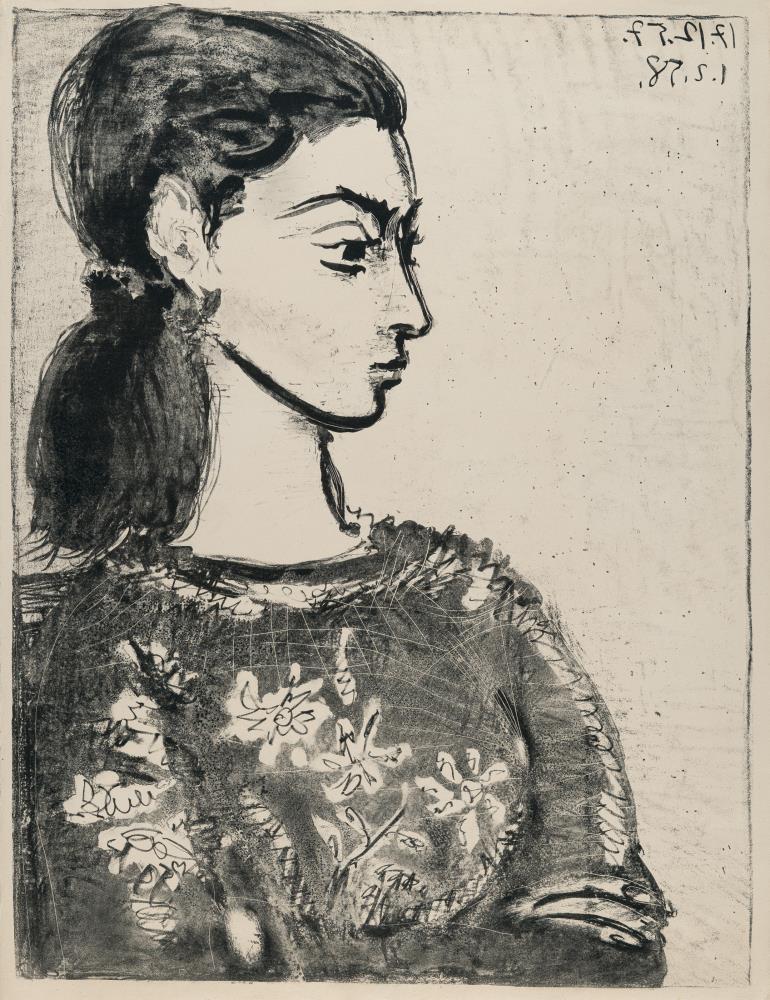
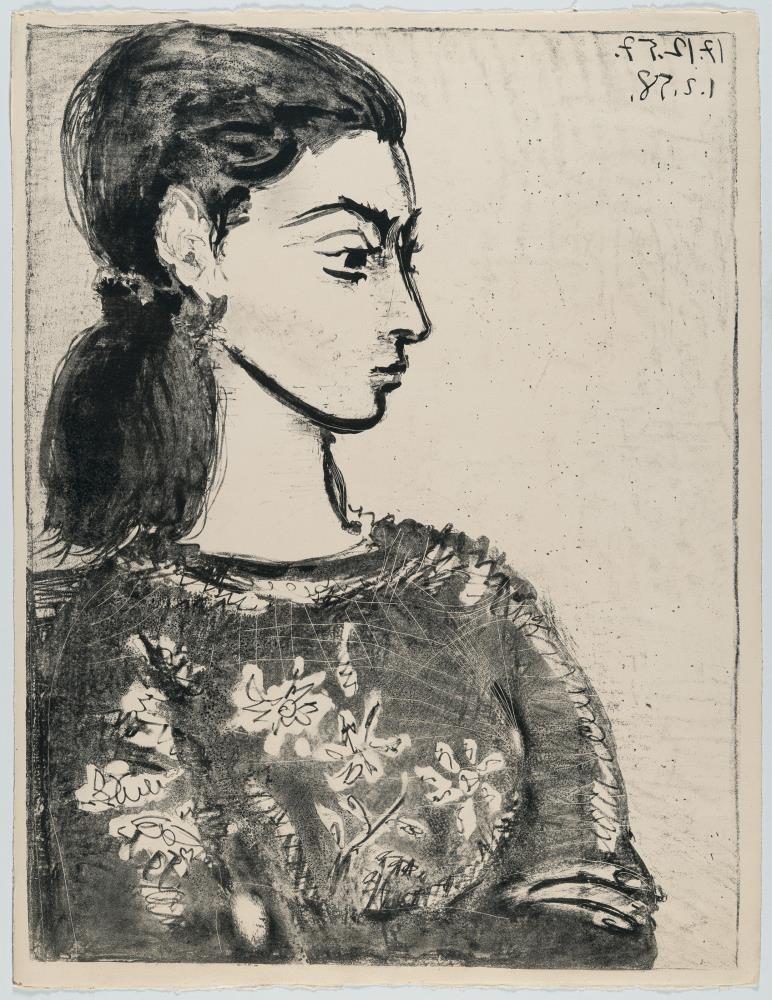
Picasso created the lithograph ‘Femme au corsage à fleurs’ in 1957/58, over the course of a year. It survives in three Impressions, with the dates of the working stages noted by the artist in the top right-hand corner. It was executed on a zinc plate in close collaboration with the printer Fernand Mourlot.
This second state captures an early phase of the working process. The depiction focuses on Jacqueline’s profile, rendered with bold, partly broad lines. The physiognomic features – the straight line of the forehead and nose, the almond-shaped eye and the elongated neck – are already clearly defined, whilst the internal structure of the blouse, the hair and the face appear even less differentiated than in the final, third state.
Only a few proofs of this second version exist; no edition was printed and it is very rare on the auction market.
• Popular motif – Jacqueline inspired Picasso to create more than 400 works
• Rare second state, preserved in only a few proofs
In the summer of 1952, Pablo Picasso first met Jacqueline Roque at the Madoura ceramics workshop in Vallauris, where she was working as a sales assistant. She became his last partner and the central muse of his late work. In the years that followed, he produced more than 400 portraits in which Picasso explored her appearance through ever-changing formal variations and techniques.
Picasso created the lithograph ‘Femme au corsage à fleurs’ in 1957/58, over the course of a year. It survives in three Impressions, with the dates of the working stages noted by the artist in the top right-hand corner. It was executed on a zinc plate in close collaboration with the printer Fernand Mourlot.
This second state captures an early phase of the working process. The depiction focuses on Jacqueline’s profile, rendered with bold, partly broad lines. The physiognomic features – the straight line of the forehead and nose, the almond-shaped eye and the elongated neck – are already clearly defined, whilst the internal structure of the blouse, the hair and the face appear even less differentiated than in the final, third state.
Only a few proofs of this second version exist; no edition was printed and it is very rare on the auction market.