Franz Ludwig Catel
The Fisherman’s Happy Homecoming
Artist
Franz Ludwig Catel
1778 Berlin - Rom 1856
Literature
Andreas Stolzenburg: The Landscape and Genre Painter Franz Ludwig Catel (1778–1856), exhibition catalogue, Casa di Goethe, Rome, ed. by Ulrike Bongaerts, Rome 2007, p. 70, Fig. 39.
Provenance
Galerie im Bayerischen Hof, Munich; private collection, southern Germany (acquired from the aforementioned gallery in the 1970s).
Share


Description
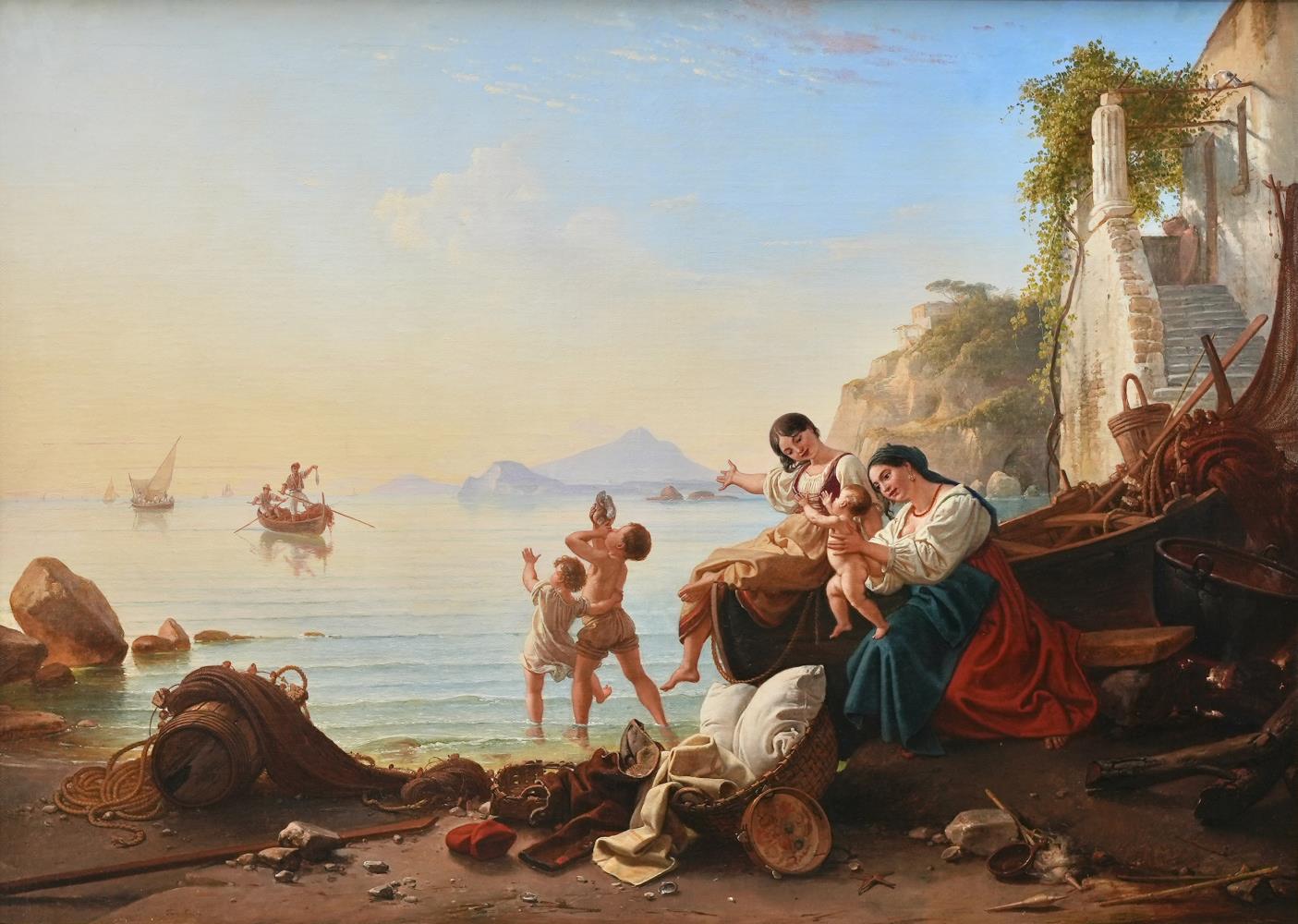
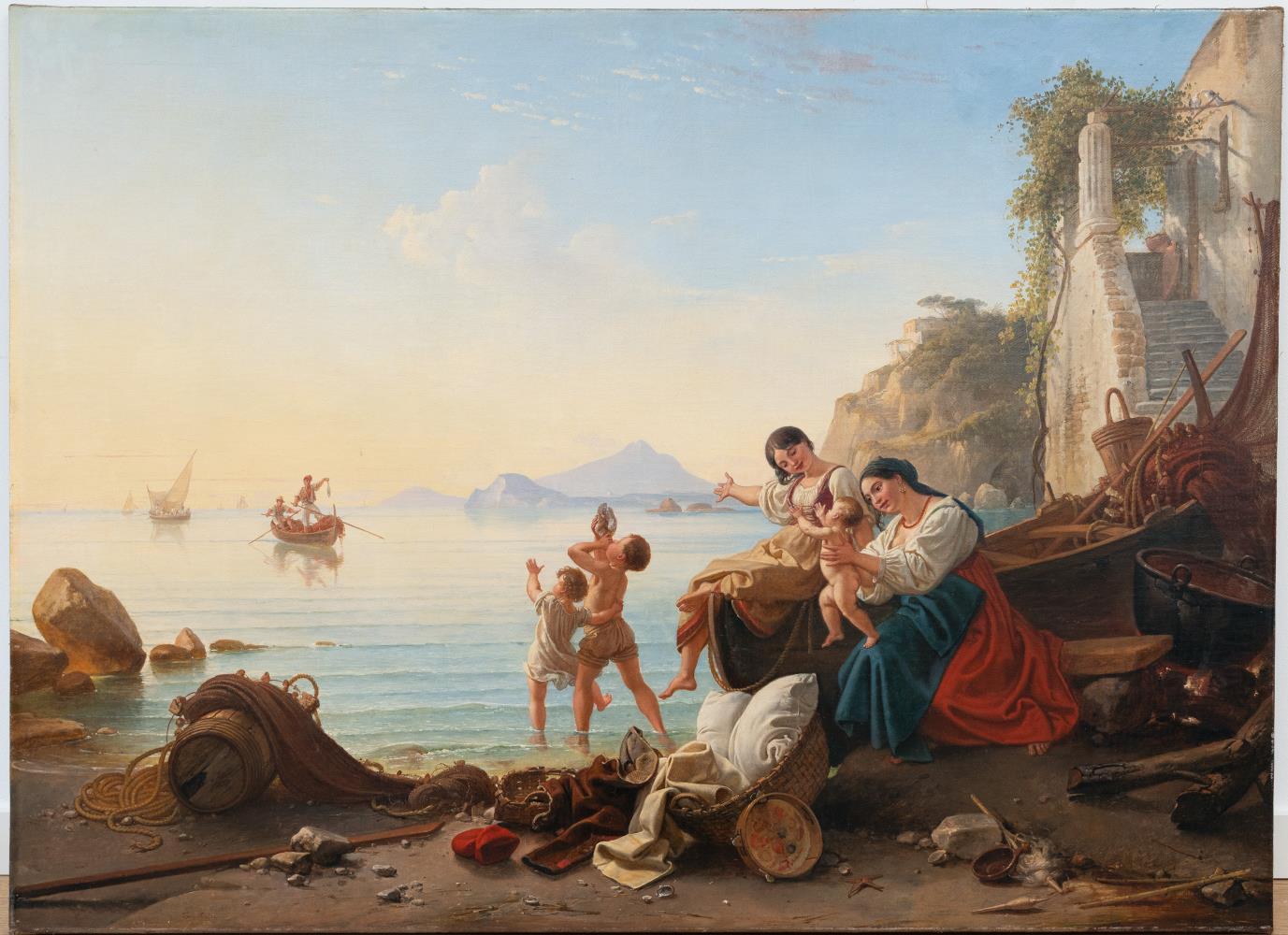
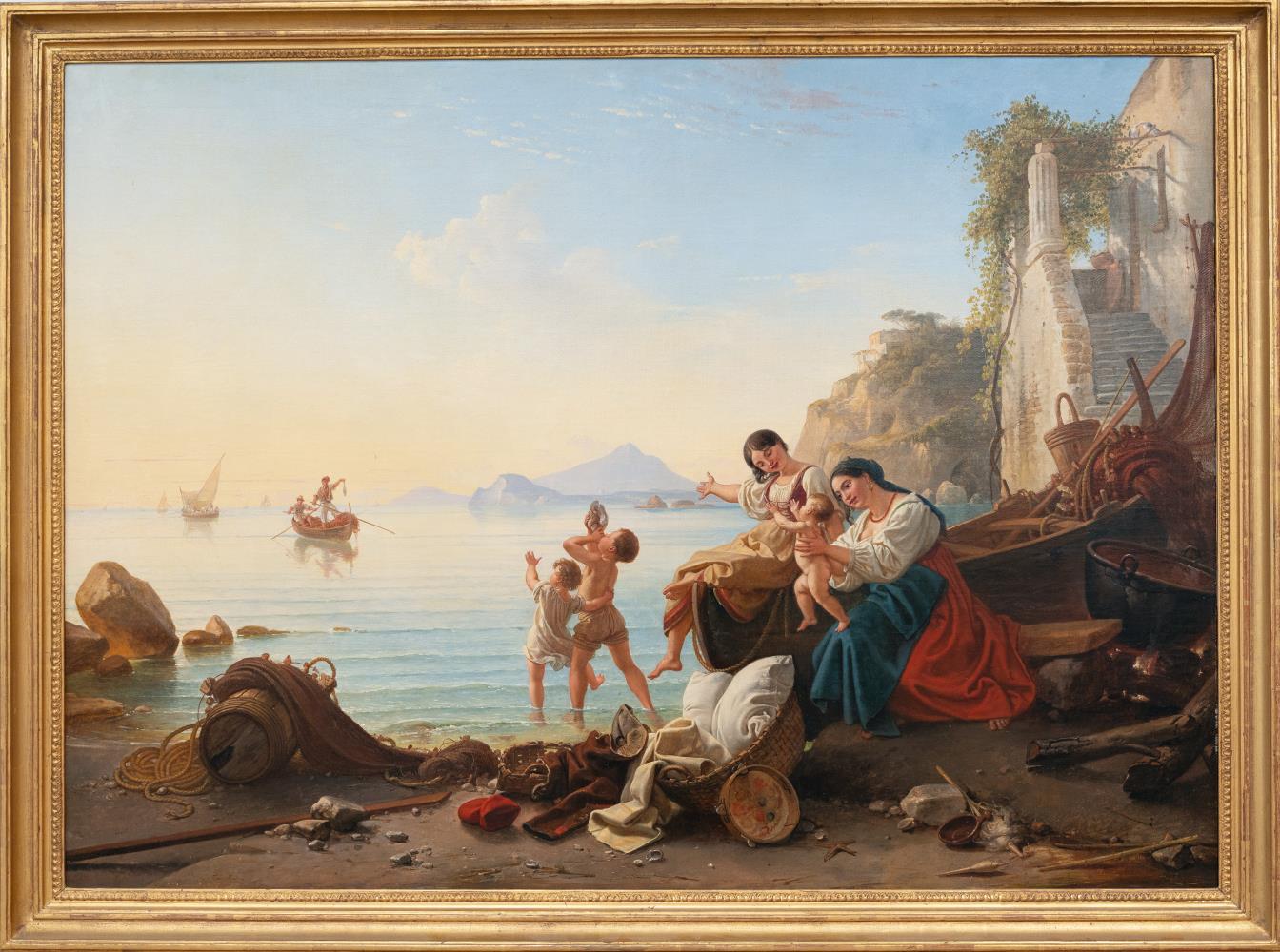
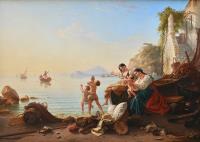
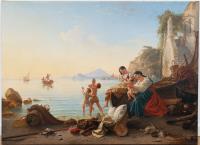
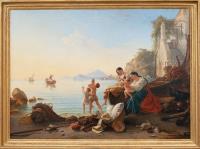
It is a scene brimming with happiness and joy – two fishermen’s wives wait on the seashore for the return of their successful husbands in their boat, from which they are already proudly displaying their catch in the distance. The women have paused their work and are crouching on a boat lying on the shore to welcome their husbands, together with the children. They have left their work – the laundry in the basket – on the shore, alongside nets, ropes and other fishing gear. The two older boys can hardly wait; they have run into the barely rippling water, the younger one waving cheerfully at them, whilst the older one greets them loudly with a conch shell. Even the youngest, sitting on his mother’s lap, is quite excited and stretches his little arms out towards them expectantly. The evening will end on a happy note, and soon the reunited families will climb the stone steps to their home together to celebrate their joyful homecoming. It is an idyllic scene that Franz Ludwig Catel, a native of Berlin, has set against a southern coastal landscape. Past the dwelling with its vine-covered pergola – a typical feature of the south – the eye falls upon the rugged cliffs of Capo Miseno on the Gulf of Naples, with the offshore islands of Procida and Ischia looming faintly in the distance in the soft evening light. The light glides gently over the calm sea and fades towards the horizon in a quiet, hazy sfumato – where sky and sea become one. The sea view forms the compositional counterpoint to the shaded coastal strip, from which the figures emerge in a colour scheme of white, light brown, red and blue. It is through such atmospheric paintings that Catel is still able to awaken a longing for the South in today’s viewer. Our painting is one of Catel’s major works; he enjoyed great success with the public through his idyllic and solemn depictions of the sea. ‘His seascapes are of great effect, and as he is also a history painter, his landscapes are well-composed,’ wrote Schorn’s Kunstblatt in 1825, the most important art journal of the time. And a year later, the Blätter für Literarische Unterhaltung admired his successful combination of figure and landscape: "The figures are depicted so truthfully and naturally that everyone can happily imagine themselves in the idyllic existence of these contented people. And then the […] prominent distance, Capo Miseno with the islands of Procida and Ischia. Time and again, the gaze, intoxicated with joy, is drawn to the wondrous, exquisite blue of the sky and its watery expanse, and to the magic of art that has become the most magnificent nature." Indeed, Catel, like no other of the German painters in Rome, combined landscape and genre; he made the lives of the fishermen and Neapolitan folk life the subject of his art – most impressively in the well-known painting ‘Rural Festival in Pozzuoli’, which is housed in the Neue Pinakothek in Munich and offers a similar view of the islands of Procida and Ischia. Catel had come to Rome in 1811 and lived there until his death in 1856; in 1820–21 he spent a considerable time in Naples, where he met, among others, the Norwegian Johan Christian Dahl, with whom he undertook excursions into the surrounding countryside. He returned to Rome with a large collection of studies, which he developed into paintings—some of them large-scale—in the following years. Catel was the most commercially successful German painter in Rome; therefore several variants of many of his paintings exist – including our painting, of which a smaller, though mirror-image version was formerly owned by the architect Leo von Klenze, well-known in Munich: "The happy homecoming of the boatman, whom his family joyfully awaits on the shore (at Cape Misene on the island of Ischia); and, as a counterpart, the fisherman threatened by the storm at sea, whom his wife and children, watching from the shore in despair, see as doomed to certain doom (part of the island of Capri)" (quoted from Julius Max Schottky: On Munich’s Art Treasures and Artistic Endeavours Dedicated to the Public, Munich 1833, p. 247). In 1841, King Ludwig I of Bavaria had acquired Klenze’s collection of paintings, which later became part of the collection of the Neue Pinakothek, which he founded – Catel’s painting of the happy homecoming was also included, which is now in Berchtesgaden Castle in the possession of the Wittelsbach Compensation Fund, whilst the counterpart depicting the fisherman’s doom is now lost. Catel had first taken up the theme of the shipwrecked fisherman in 1824 in a painting—now also lost—commissioned by the famous collector and patron Johann Gottlob von Quandt in Dresden, in which, in contrast to the joy depicted in our painting, the man’s complete ‘physical helplessness in the face of the wild forces of nature’ is expressed, as Quandt himself wrote. This was the other, terrifying side of the sea, which had not yet lost its terror, but which could be endured from a distance – indeed, aesthetic pleasure could even be derived from contemplating the dramatic painting with its stormy sea, crashing waves and the family’s despair. It is, in a sense, an echo of the theory of the sublime, which was significant in the 18th century, capable of evoking a beautiful shudder in the viewer as long as they were in safety and experienced the danger only indirectly. In the 18th century, French painters such as Philippe-Jacques de Loutherbourg the Younger and Claude Joseph Vernet had popularised the theme of the sea storm, which Catel revisited under the banner of Romanticism – with a clear focus on the pain and suffering of the fisherman’s family left behind. Several versions of the fisherman’s ill-fated return home also existed, though their current whereabouts are unknown – there is no documentation to suggest that our painting, which is thought to have been created in the second half of the 1820s, was once part of a pair featuring the ill-fated return. Dr Peter Prange