John Baldessari
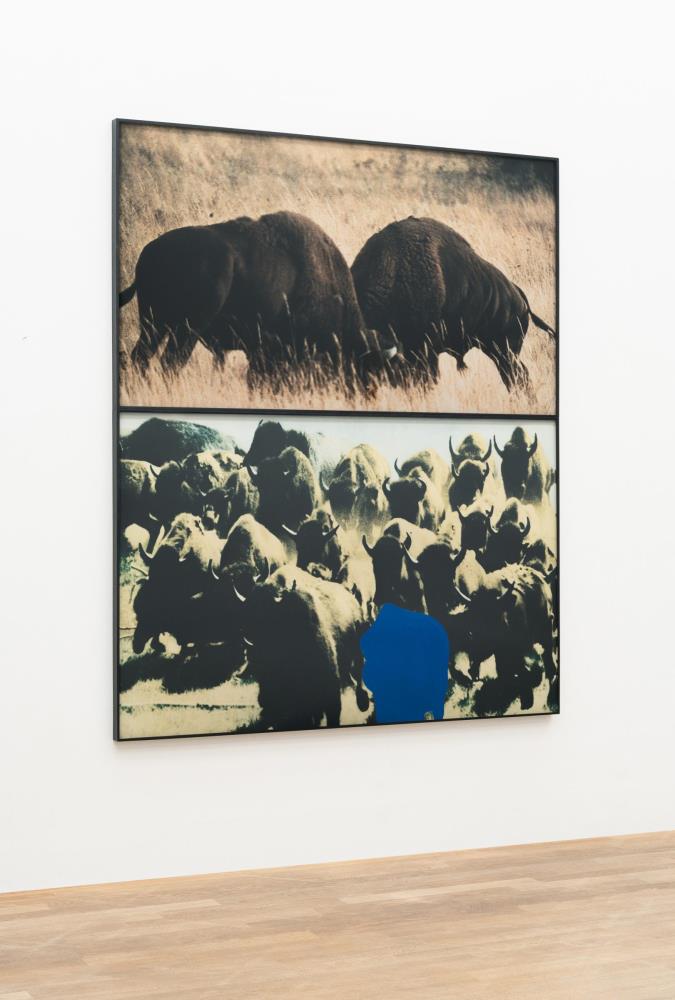
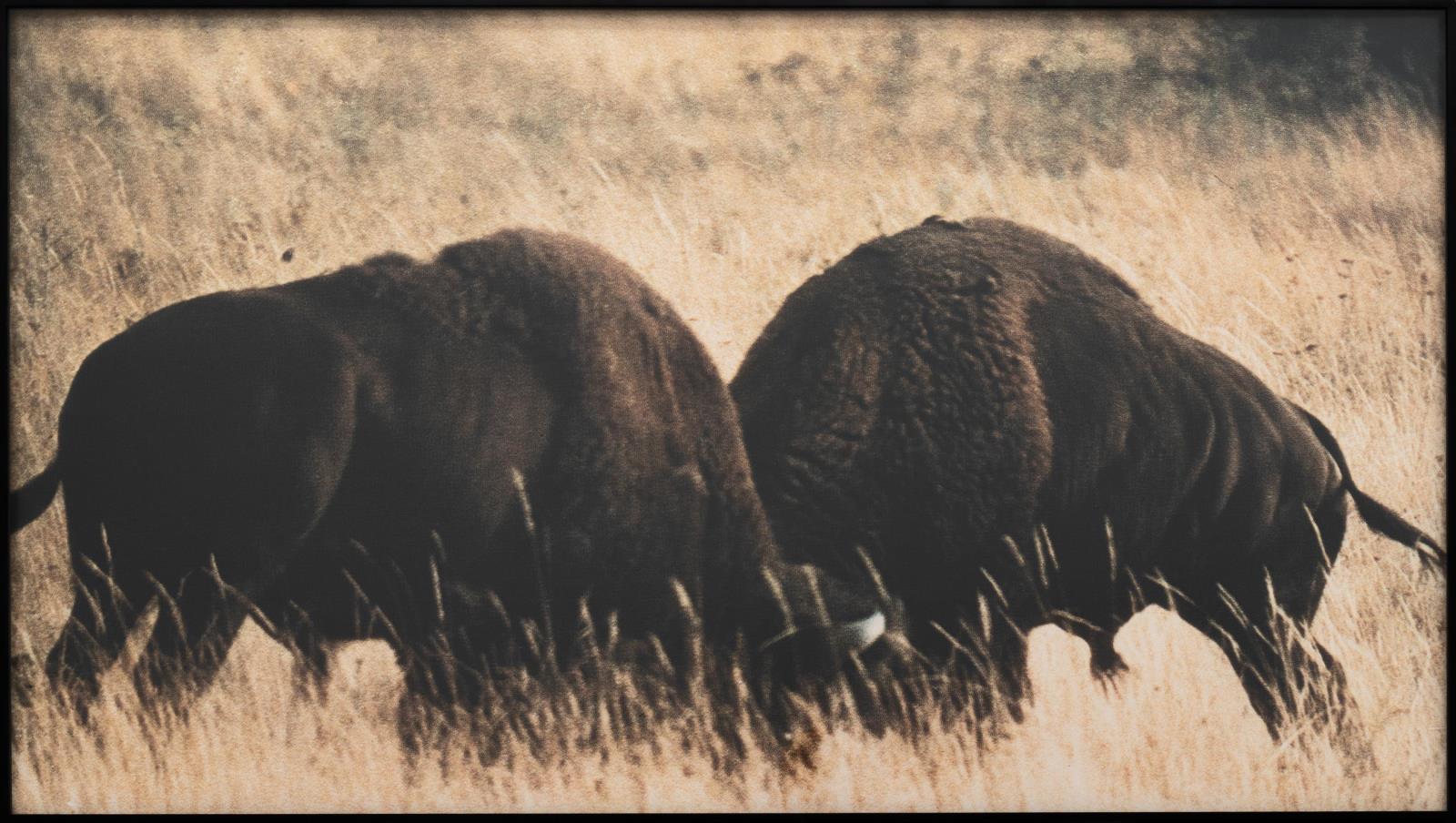
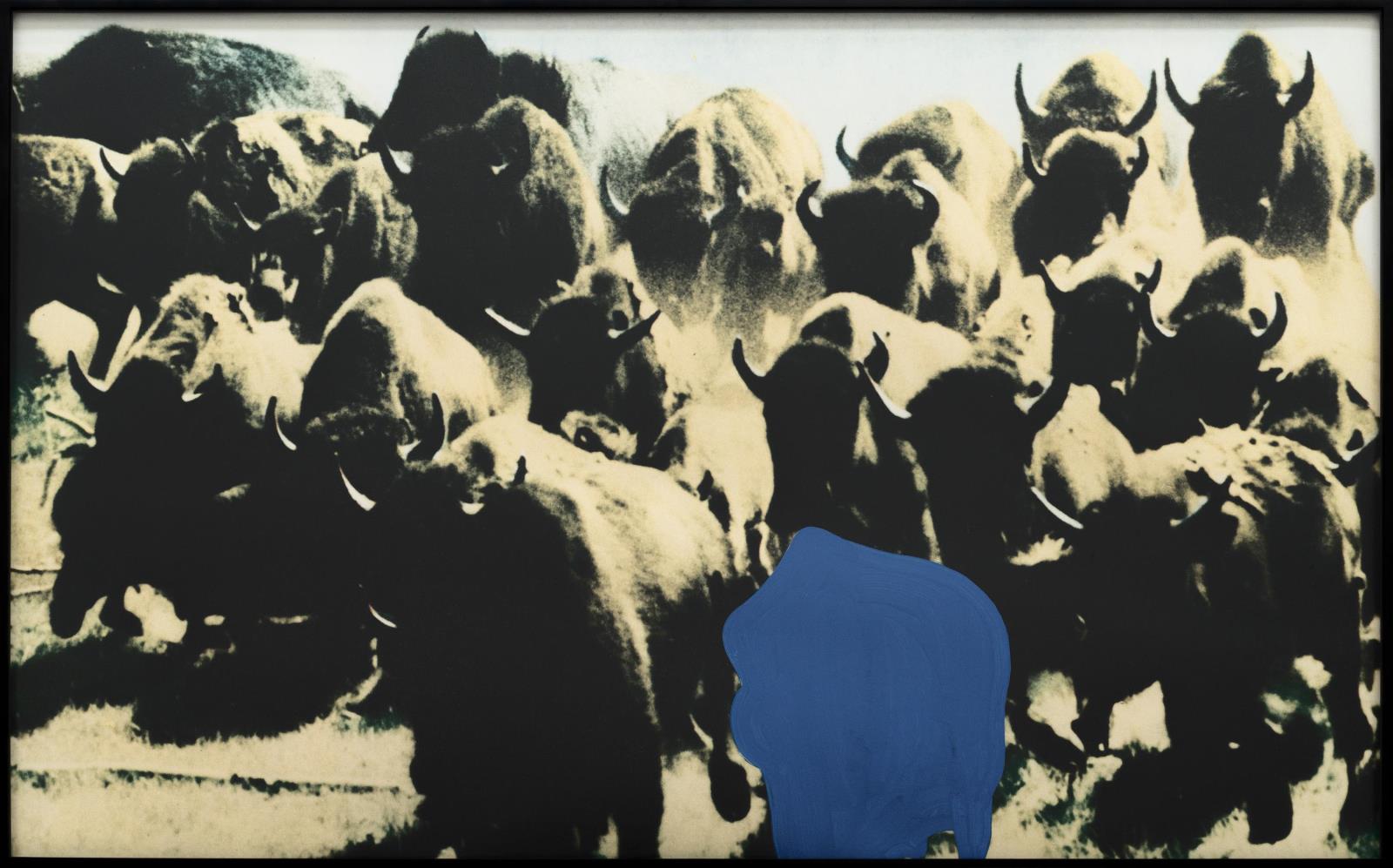
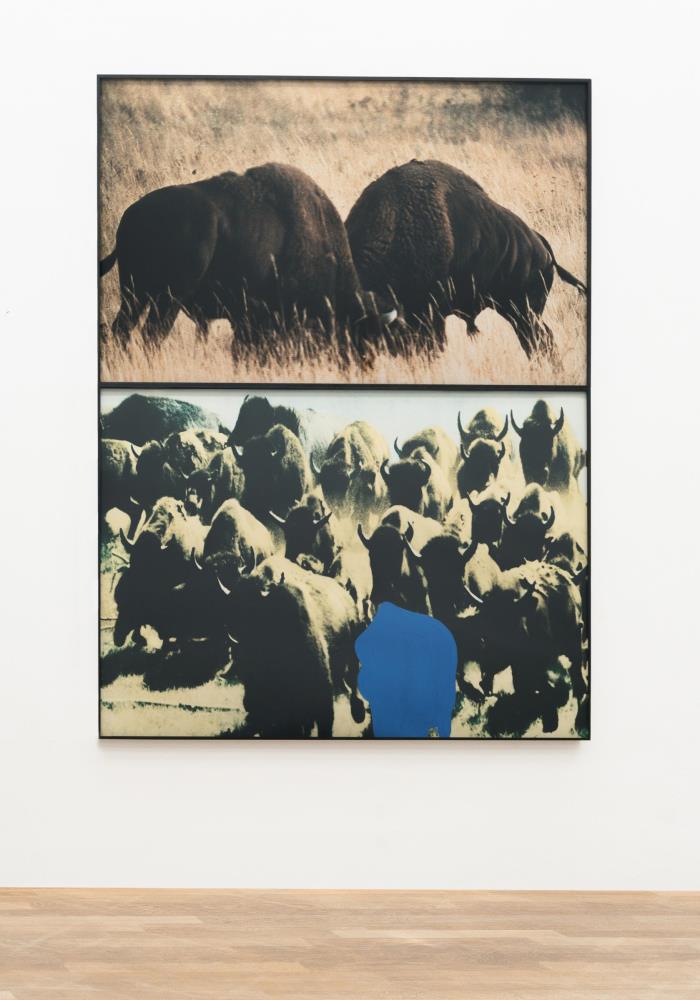
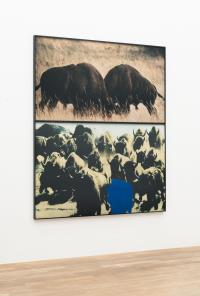
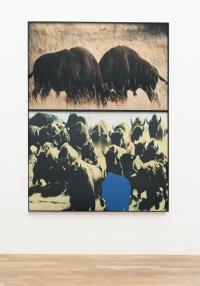
Two Bison/Group of Bison (with blue shape)




Artist
John Baldessari
Additional Description
C-Print und Vinylfarbe (2-teilig). In Künstlerrahmen. (1990). Ca. 108 x 192 cm und ca. 123 x 192 cm (Gesamtmaß ca. 231 x 192 cm).
Period
(1931 National City/Kalifornien - Venice/Kalifornien 2020)
Technique
Paintings
Ausstellung
Donald Young Gallery, Chicago 11.1.1991 (o. Kat.) ; Donald Young Gallery, Seattle 3.10.1991 (o. Kat.) ; Donald Young Gallery, Seattle 24.7.1992 (o. Kat.) ; John Baldessari, Hochschule für Angewandte Kunst, Wien 1996, farb. Abb. S. 15 ; John Baldessari, Galeria Pedro Oliveira, Porto 1996, o. Kat ;
Literature
Saltz, Jerry, John Baldessari: The Curious Discovery of A+I(Ov.)=∞,or the Smile of Reason, Forum International, Nr. 14, Antwerpen 1992, S. 68 - 79, mit farb. Abb. S. 78; Knight, Christopher, An interview with John Baldessari (1992), for the Archives of American Art, Smithsonian Institution, Santa Monica/CA, veröffentlicht 2013 auf americansuburbx.com, mit farb. Abb.
Provenance
Donald Young Gallery, Chicago, verso auf der Rahmenrückwand mit dem Etikett; Marian Goodman Gallery, London, verso auf der Rahmenrückwand mit dem Etikett; Sprüth Magers, Los Angeles; Privatsammlung, Süddeutschland, 2021 bei Vorgenannter erworben.
Share


Description
- Museum piece from the artist's most important creative phase
- Characteristic two-part work with concise "blue shape".
- Works by Baldessari can be found in all major museum collections in the USA, the artist's estate is represented by Galerie Sprüth Magers, Berlin, London, Los Angeles
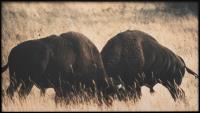
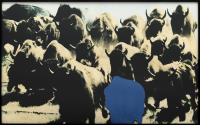
In the year "Two Bison/Group of Bison" was created, John Baldessari was already a star among contemporary American West Coast artists. He combines the influences of pop art with those of conceptual art and minimalism in an unprecedented way. In the preceding years, Baldessari's work had undergone a significant change in terms of both content and form: The motifs he selects for his large-format works come from film stills, newspapers and magazines, which he himself describes as an inexhaustible anonymous bank of images. With the help of an enlarger in Los Angeles, who also works for the film industry, Baldessari has these "found motifs" photographed and enlarged (and thus, incidentally, provides us today with a great phenomenology of the media of our time). Baldessari then places these image quotations in a new, often unexpected context, thus creating enigmatic narratives. "Two Bison/Group of Bison" is an outstanding example of this approach. Here, the artist combines two motifs with different perspectives and color values that look as if they were taken from National Geographic. There is no animal in the USA with a greater cultural symbolic value than the bison. It stands for concentrated strength, endurance and harmony with nature, but also the enormous historical significance it had for indigenous tribes. If you place the two motifs in relation to each other and arrange them on top of each other on the wall as determined by the artist, a field of tension is created that suddenly allows for a whole range of interpretations. When Baldessari says that the theme of his works is always "the space between" - i.e. the distance or collision of the motifs he combines - he is alluding to a principle of duality that determines everything: What lies between danger and harmlessness, weakness and strength, nature and civilization?
QUOTE: "Sort of fundamental to my work is the collision, let's say, colliding of various images. In that sense, I consider myself a poet. If you use the idea of a poet being a person who can use language well and precisely...colliding images, for me, is that too."
John Baldessari on "Spaces between series" 1984, in: More than you wanted to know about John Baldessari, Vol. 2: 1975 - 2011, Zurich 2013.
Pardo/Dean Vol. III 1990.105.
- Characteristic two-part work with concise "blue shape".
- Works by Baldessari can be found in all major museum collections in the USA, the artist's estate is represented by Galerie Sprüth Magers, Berlin, London, Los Angeles
In the year "Two Bison/Group of Bison" was created, John Baldessari was already a star among contemporary American West Coast artists. He combines the influences of pop art with those of conceptual art and minimalism in an unprecedented way. In the preceding years, Baldessari's work had undergone a significant change in terms of both content and form: The motifs he selects for his large-format works come from film stills, newspapers and magazines, which he himself describes as an inexhaustible anonymous bank of images. With the help of an enlarger in Los Angeles, who also works for the film industry, Baldessari has these "found motifs" photographed and enlarged (and thus, incidentally, provides us today with a great phenomenology of the media of our time). Baldessari then places these image quotations in a new, often unexpected context, thus creating enigmatic narratives. "Two Bison/Group of Bison" is an outstanding example of this approach. Here, the artist combines two motifs with different perspectives and color values that look as if they were taken from National Geographic. There is no animal in the USA with a greater cultural symbolic value than the bison. It stands for concentrated strength, endurance and harmony with nature, but also the enormous historical significance it had for indigenous tribes. If you place the two motifs in relation to each other and arrange them on top of each other on the wall as determined by the artist, a field of tension is created that suddenly allows for a whole range of interpretations. When Baldessari says that the theme of his works is always "the space between" - i.e. the distance or collision of the motifs he combines - he is alluding to a principle of duality that determines everything: What lies between danger and harmlessness, weakness and strength, nature and civilization?
QUOTE: "Sort of fundamental to my work is the collision, let's say, colliding of various images. In that sense, I consider myself a poet. If you use the idea of a poet being a person who can use language well and precisely...colliding images, for me, is that too."
John Baldessari on "Spaces between series" 1984, in: More than you wanted to know about John Baldessari, Vol. 2: 1975 - 2011, Zurich 2013.
Pardo/Dean Vol. III 1990.105.