Jean Dubuffet
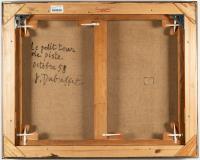
Le Petit Tour de Piste
Artist
Jean Dubuffet
Provenance
Gallery Arthur Tooth & Sons, Ltd, London;
Private collection, Tombridge;
Galleri Haaken, Oslo;
Sotheby's, London 21.10.2003, lot 389;
Private collection, Europe.
Private collection, Tombridge;
Galleri Haaken, Oslo;
Sotheby's, London 21.10.2003, lot 389;
Private collection, Europe.
Share


Description
- Jean Dubuffet invented the concept of Art Brut and claimed sovereignty of interpretation for himself
- His work is characterized by the search for a primal art beyond all formalism
- Typical painting by Dubuffet in earthy, coarse brown tones
Raw. Original. Visceral. Timeless. Unaesthetic. Rough. Fascinating. Beautiful.
There are many descriptions for the works of Jean Dubuffet. They all circle around the works, but never hit the mark; after all, translating the visual stimulus into words is doomed to failure. In his work, Dubuffet is in search of a "true" art, an art beyond and beyond the learned, an art as created by pure (human) nature. Does the bowerbird think it is making art when it decorates its nest? Dubuffet believes that this form of art can be found in others: In people without formal education, in children, in people with mental illness or developmental delays and in some indigenous groups. He collects what he understands as "Art Brut" and claims to be the only one allowed to assign this term. At the same time, other artists, researchers and collectors are also attempting similar definitions; in the English-speaking world, for example, the term "outsider art" is gaining acceptance as an alternative. Although all the different terms have different definitions in detail and sometimes slip into discriminatory stereotypes, they have one thing in common: the idea that there is something like a primordial human art to which access is blocked by intellect and knowledge.
Dubuffet's own art cannot therefore be Art Brut in the literal sense à la lettre. Born into the French upper middle classes in 1901, he received a formal art education. Although this was limited to drawing courses and was followed by studies in the humanities, according to Dubuffet's definition, this denied him access to primitive art. In the 1920s, his art was characterized by surrealism, and it was not until 1942 that his painting style became increasingly naive, until he found his way to primitivism (a term that should also be used critically) after the Second World War.
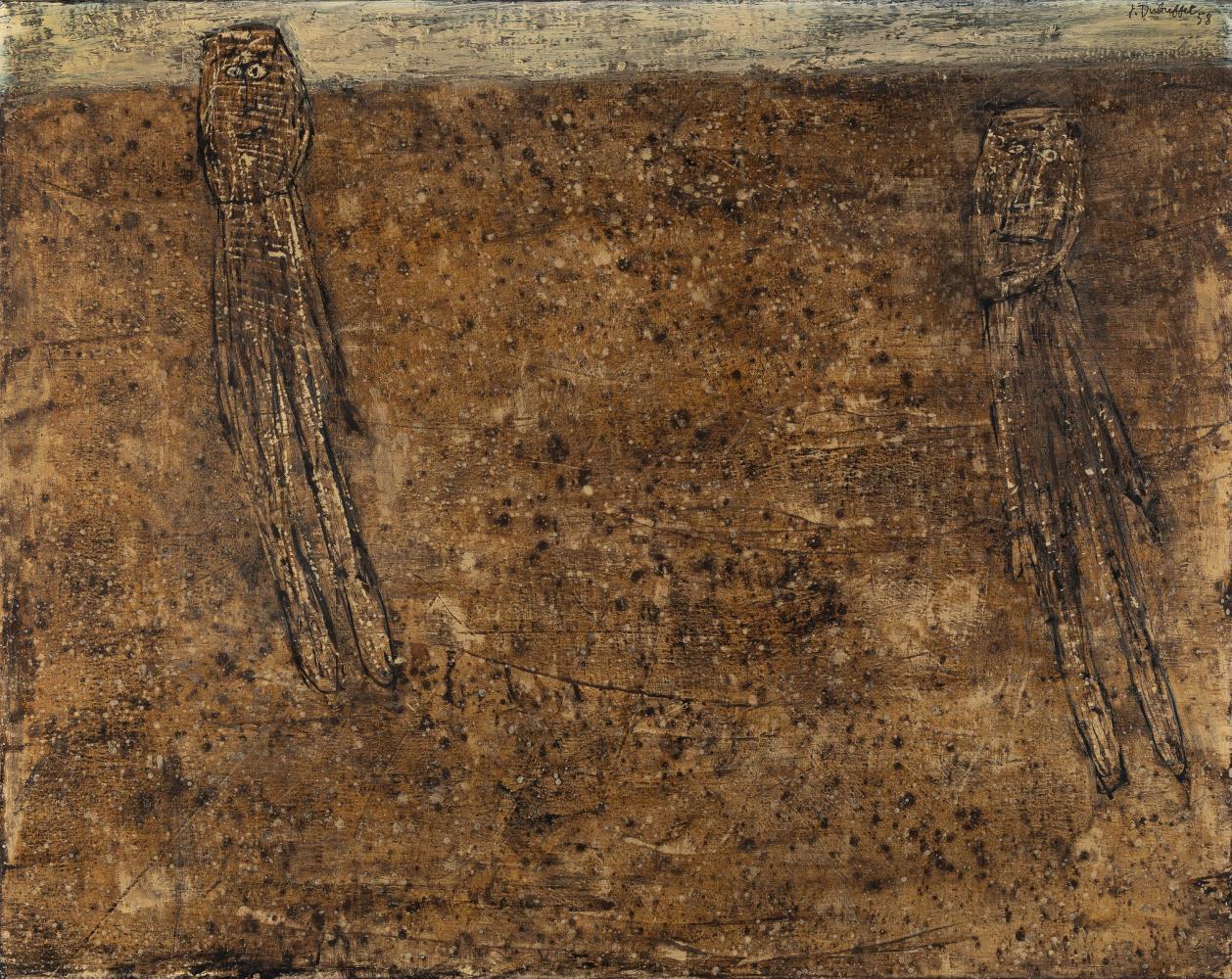
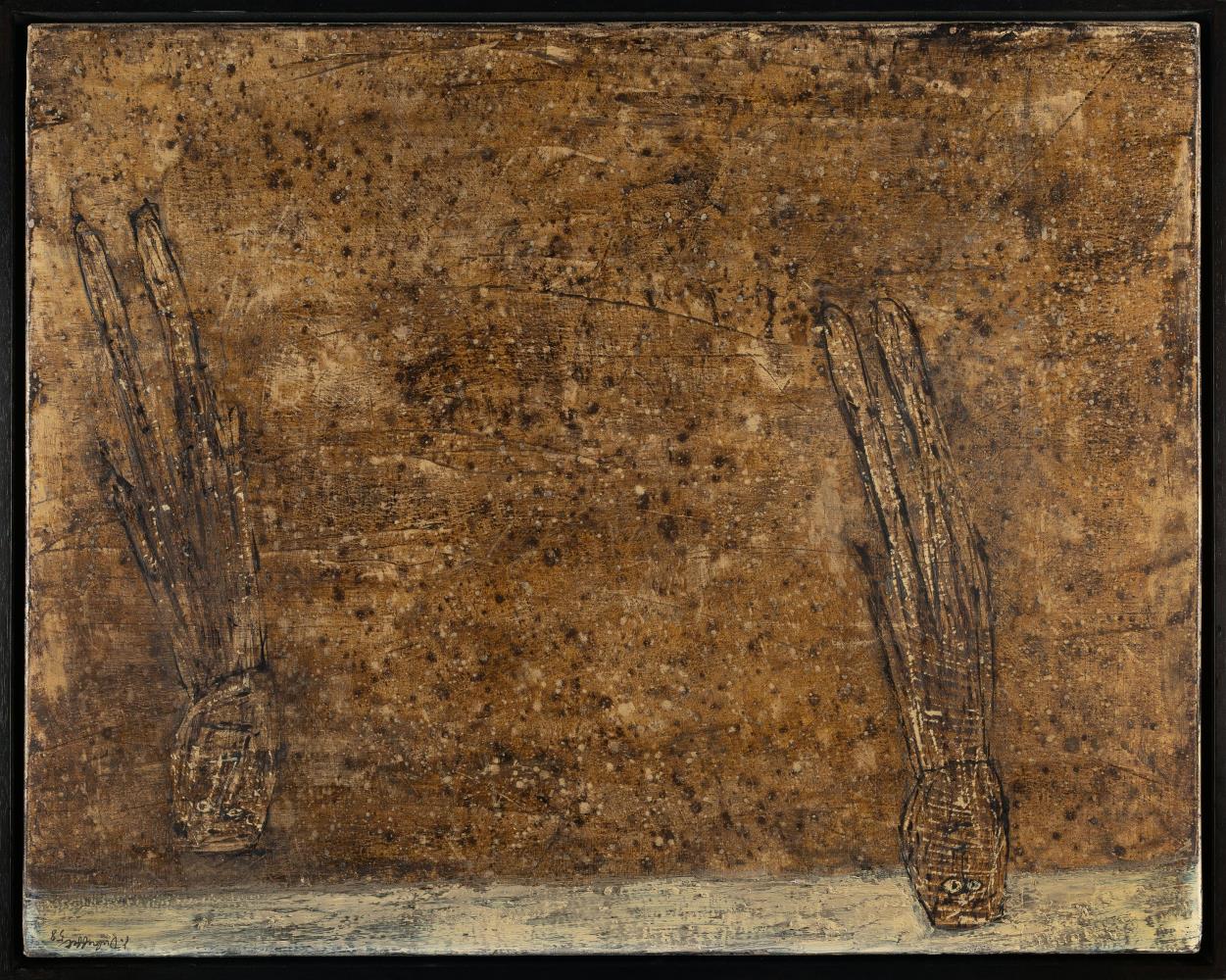
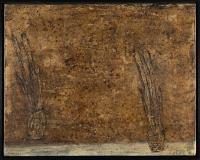
Jean Dubuffet then became internationally famous with paintings like this one. He roughly structured the painting ground with clay tones. Earth colors that are coarse and rich in particles. On it are two figures, humanoids, cephalopods. Max Loreau describes it as follows: "Others Characters emerge on canvas in this month of April 1958 (...) these beings thus take stock of their dialogue with texture; like spirits eager to find themselves making their way through the inconsistencies from which they emanate: all bubbling with what resists them and keep on weighting on them; panting imaginations quivering with insatiable desires without objects." (Max Loreau, "Catalogue Intégral des travaux de Jean dubuffet, Célébration du Sol II, Texturologies, Topographies", Fascicule XIV, Lausanne, 1969, p. 8)
Dubuffet uses visual references to the art of certain indigenous groups, to early childhood stages of development - the so-called cephalopod is a figure that appears in people from around the age of two and can be used as a sign of developmental disorders in child psychology in the later course of development. His way of painting and his work is, like this text, only a circling around, an approach, but never an achievement. What Dubuffet seeks remains closed to him.
Loreau XIV 60.
- His work is characterized by the search for a primal art beyond all formalism
- Typical painting by Dubuffet in earthy, coarse brown tones
Raw. Original. Visceral. Timeless. Unaesthetic. Rough. Fascinating. Beautiful.
There are many descriptions for the works of Jean Dubuffet. They all circle around the works, but never hit the mark; after all, translating the visual stimulus into words is doomed to failure. In his work, Dubuffet is in search of a "true" art, an art beyond and beyond the learned, an art as created by pure (human) nature. Does the bowerbird think it is making art when it decorates its nest? Dubuffet believes that this form of art can be found in others: In people without formal education, in children, in people with mental illness or developmental delays and in some indigenous groups. He collects what he understands as "Art Brut" and claims to be the only one allowed to assign this term. At the same time, other artists, researchers and collectors are also attempting similar definitions; in the English-speaking world, for example, the term "outsider art" is gaining acceptance as an alternative. Although all the different terms have different definitions in detail and sometimes slip into discriminatory stereotypes, they have one thing in common: the idea that there is something like a primordial human art to which access is blocked by intellect and knowledge.
Dubuffet's own art cannot therefore be Art Brut in the literal sense à la lettre. Born into the French upper middle classes in 1901, he received a formal art education. Although this was limited to drawing courses and was followed by studies in the humanities, according to Dubuffet's definition, this denied him access to primitive art. In the 1920s, his art was characterized by surrealism, and it was not until 1942 that his painting style became increasingly naive, until he found his way to primitivism (a term that should also be used critically) after the Second World War.
Jean Dubuffet then became internationally famous with paintings like this one. He roughly structured the painting ground with clay tones. Earth colors that are coarse and rich in particles. On it are two figures, humanoids, cephalopods. Max Loreau describes it as follows: "Others Characters emerge on canvas in this month of April 1958 (...) these beings thus take stock of their dialogue with texture; like spirits eager to find themselves making their way through the inconsistencies from which they emanate: all bubbling with what resists them and keep on weighting on them; panting imaginations quivering with insatiable desires without objects." (Max Loreau, "Catalogue Intégral des travaux de Jean dubuffet, Célébration du Sol II, Texturologies, Topographies", Fascicule XIV, Lausanne, 1969, p. 8)
Dubuffet uses visual references to the art of certain indigenous groups, to early childhood stages of development - the so-called cephalopod is a figure that appears in people from around the age of two and can be used as a sign of developmental disorders in child psychology in the later course of development. His way of painting and his work is, like this text, only a circling around, an approach, but never an achievement. What Dubuffet seeks remains closed to him.
Loreau XIV 60.