Max Ernst
Déchets d'oeuvres („Abfälle vom Werk“)
Artist
Max Ernst
Exhibition
Max Ernst. Déchets d'Atelier - Lueurs de Génie, Galerie Alphones Chave, Vence 1968 ;
Exhibition of works by Max Ernst, The Seibu Museum of Art, Tokyo/Museum of Modern Art Hyogo, Kobe 1977, cat. no. 123, b/w illus;
Max Ernst. Abfälle vom Werk/Déchets d'oeuvres. Originals and prints from the Peter Schamoni Collection, Villa Böhm, Neustadt/Weinstraße 1978, b/w illus. on the cover ;
Max Ernst. Retrospective, Haus der Kunst, Munich/Nationalgalerie, Berlin 1979, cat. no. 324, b/w illus. p. 345, label on verso ;
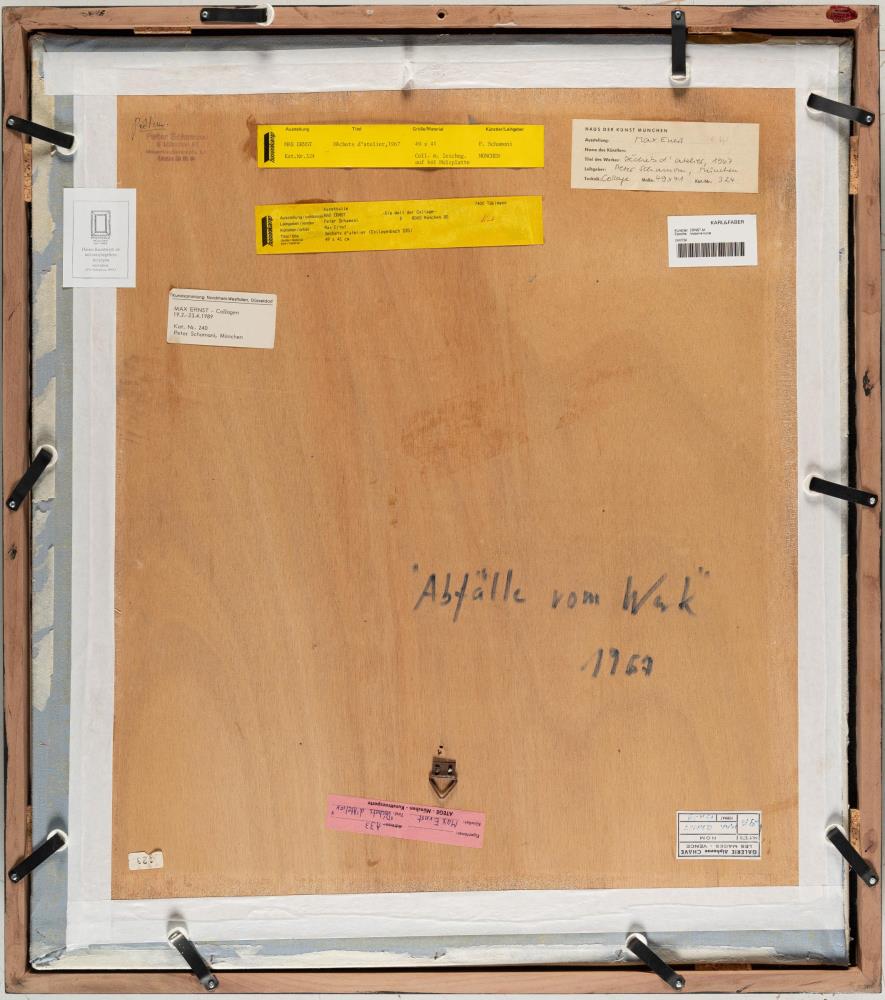
Max Ernst - Collagen, Inventar und Widerspruch, Kunsthalle, Tübingen et al. 1988/89, cat. no. 240, b/w ill. 535, color plate 105, verso with label or corresponding shipping label ;
Journeys of discovery to Max Ernst. The Peter Schamoni Collection, Max Ernst Museum, Brühl 2013, col. Illus. p. 151.
Exhibition of works by Max Ernst, The Seibu Museum of Art, Tokyo/Museum of Modern Art Hyogo, Kobe 1977, cat. no. 123, b/w illus;
Max Ernst. Abfälle vom Werk/Déchets d'oeuvres. Originals and prints from the Peter Schamoni Collection, Villa Böhm, Neustadt/Weinstraße 1978, b/w illus. on the cover ;
Max Ernst. Retrospective, Haus der Kunst, Munich/Nationalgalerie, Berlin 1979, cat. no. 324, b/w illus. p. 345, label on verso ;
Max Ernst - Collagen, Inventar und Widerspruch, Kunsthalle, Tübingen et al. 1988/89, cat. no. 240, b/w ill. 535, color plate 105, verso with label or corresponding shipping label ;
Journeys of discovery to Max Ernst. The Peter Schamoni Collection, Max Ernst Museum, Brühl 2013, col. Illus. p. 151.
Literature
Schamoni, Peter, Max Ernst Maximiliana, die widerrechtliche Ausübung der Astronomie, Munich 1974, b/w illus. p. 46;
Spies, Werner, Max Ernst - Collagen, Inventar und Widerspruch, Cologne 1974, cat. no. 535, b/w ill.
Spies, Werner, Max Ernst - Collagen, Inventar und Widerspruch, Cologne 1974, cat. no. 535, b/w ill.
Provenance
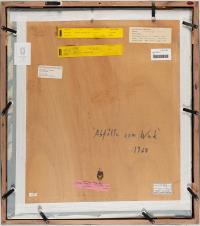
Galerie Alphonse Chave, Vence, with the label on the verso;
Collection Peter Schamoni, Munich, acquired from the aforementioned;
Collection, Austria.
Collection Peter Schamoni, Munich, acquired from the aforementioned;
Collection, Austria.
Share


Description
- Max Ernst uses collage to develop surreal moments
- Template for a poster for an Ernst exhibition
- From the collection of the famous film producer Peter Schamoni
Is this art or can it go?
In the case of Max Ernst's work, there is a clear answer to this well-known joke: It's waste, and that's exactly why it's art!
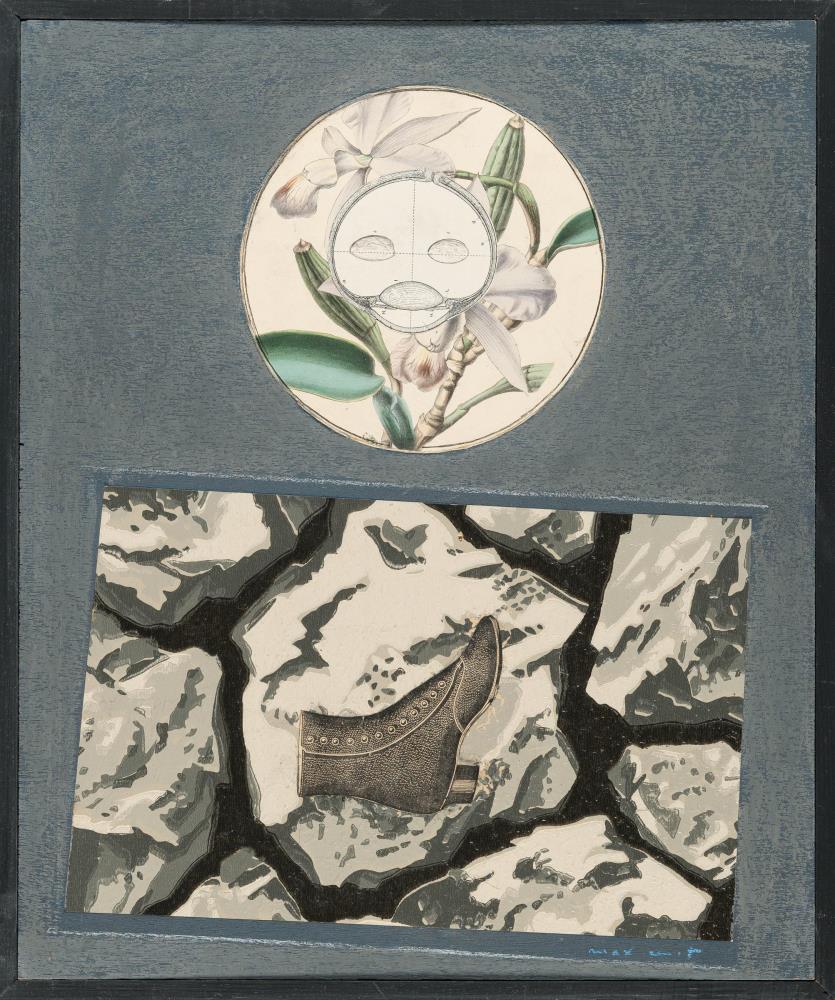
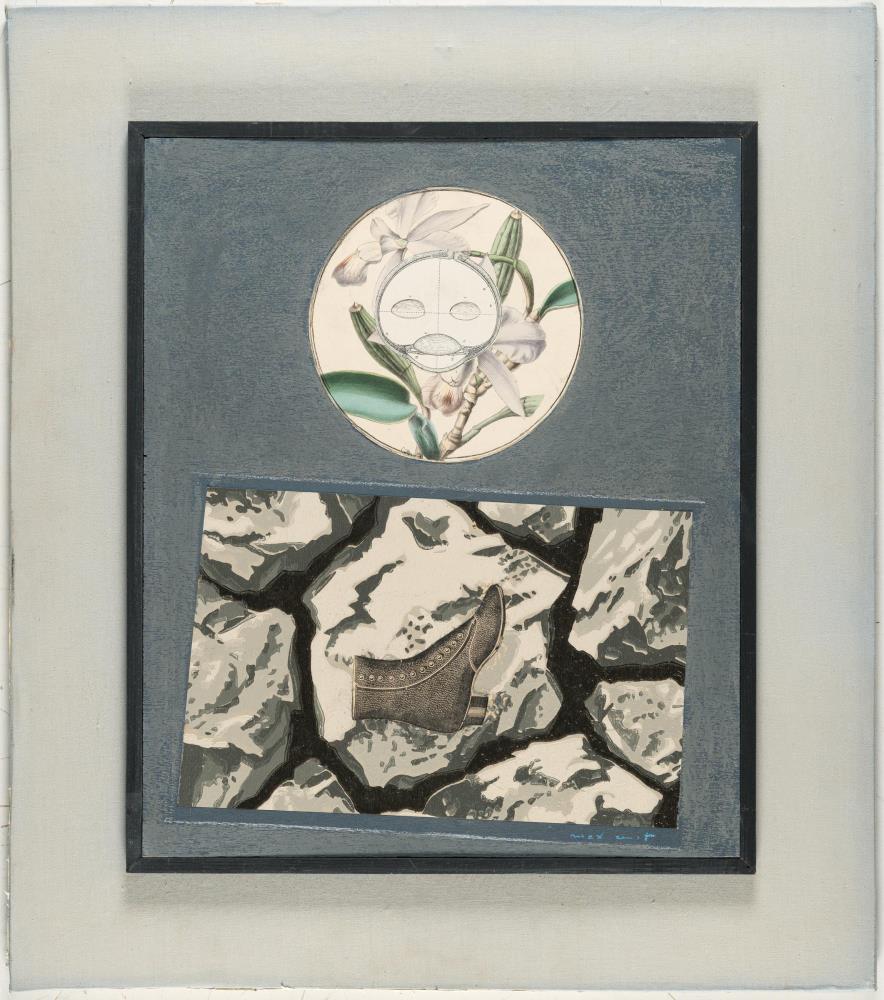
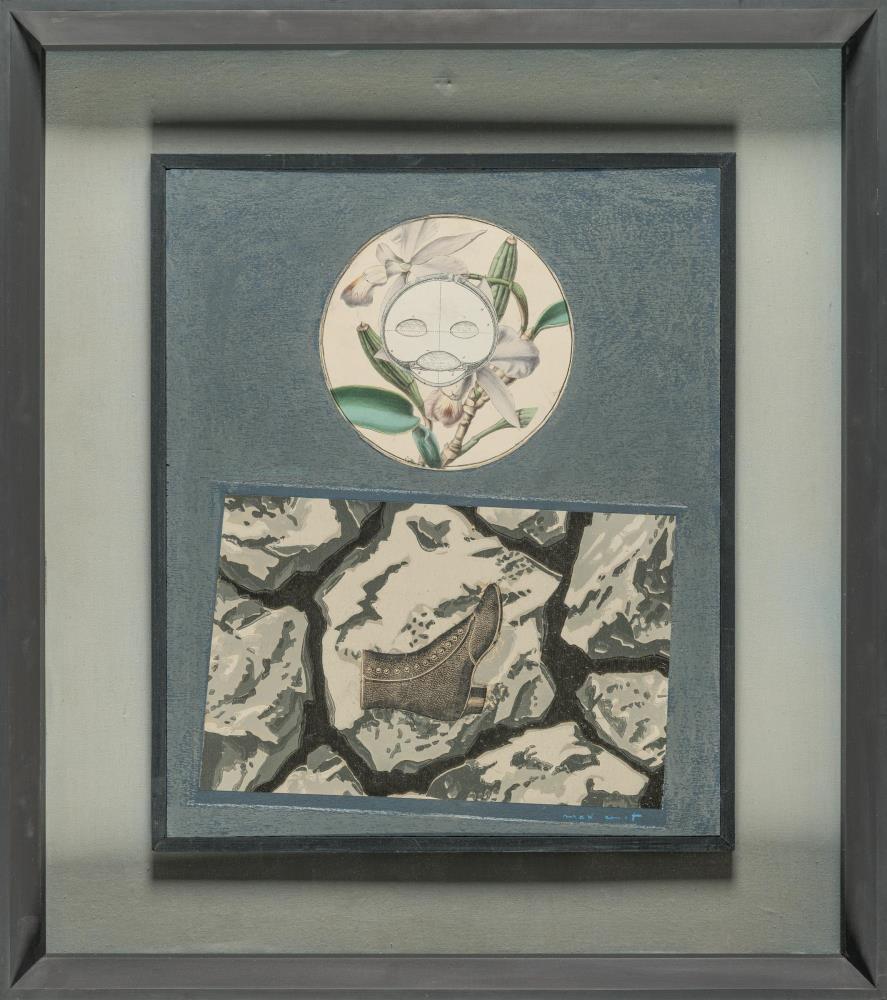
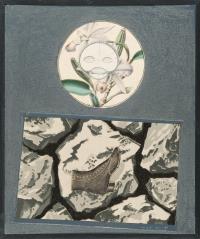
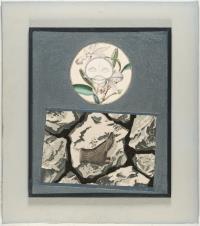
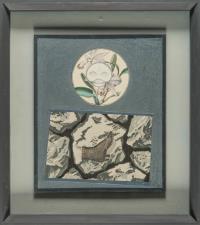
Because "Déchtets d'oeuvres" means nothing other than "art waste" and thus refers directly to the way the work is made. What we see here is a collage in which Ernst brings various found paper prints, such as botanical illustrations or advertisements, into a new surrealist context. In 1968, the great age of Surrealism was already over, but Ernst once again collected what he could find to create a poster for his major exhibition. What we see here is therefore a self-reference and poster template in one.
We can puzzle over the content in a surreal manner: Below, a woman's shoe on a slanted field of stone chunks. Above, the longitudinal section of a long-forgotten object in front of the flower stems of a plant illustration.
The work comes from the collection of the famous German film producer Peter Schamoni. From the late 1960s onwards, he shot numerous portraits of artists. Schamoni had more than just a professional relationship with Max Ernst; the two were friends for decades, which is why five of his artist portrait films are dedicated to Max Ernst. Schamoni thus played a decisive role in shaping the public image of the artist in Germany, and his films about Ernst were celebrated by critics - his greatest commercial success, however, remained "Zur Sache Schätzchen" with Uschi Glas.
The work was the template for a photolithograph that served as a poster for the 1968 exhibition "Déchets d'Atelier - Lueurs de Génie" at the Galerie Alphonse Chave in Vence (cf. WVZ Spies/Leppien A 16).
Spies/Metken/Pech 4368.
- Template for a poster for an Ernst exhibition
- From the collection of the famous film producer Peter Schamoni
Is this art or can it go?
In the case of Max Ernst's work, there is a clear answer to this well-known joke: It's waste, and that's exactly why it's art!
Because "Déchtets d'oeuvres" means nothing other than "art waste" and thus refers directly to the way the work is made. What we see here is a collage in which Ernst brings various found paper prints, such as botanical illustrations or advertisements, into a new surrealist context. In 1968, the great age of Surrealism was already over, but Ernst once again collected what he could find to create a poster for his major exhibition. What we see here is therefore a self-reference and poster template in one.
We can puzzle over the content in a surreal manner: Below, a woman's shoe on a slanted field of stone chunks. Above, the longitudinal section of a long-forgotten object in front of the flower stems of a plant illustration.
The work comes from the collection of the famous German film producer Peter Schamoni. From the late 1960s onwards, he shot numerous portraits of artists. Schamoni had more than just a professional relationship with Max Ernst; the two were friends for decades, which is why five of his artist portrait films are dedicated to Max Ernst. Schamoni thus played a decisive role in shaping the public image of the artist in Germany, and his films about Ernst were celebrated by critics - his greatest commercial success, however, remained "Zur Sache Schätzchen" with Uschi Glas.
The work was the template for a photolithograph that served as a poster for the 1968 exhibition "Déchets d'Atelier - Lueurs de Génie" at the Galerie Alphonse Chave in Vence (cf. WVZ Spies/Leppien A 16).
Spies/Metken/Pech 4368.