Gustav Klimt
Stehendes Liebespaar


Artist
Gustav Klimt
Literature
Novotny, Fritz and Dobai, Johannes, Gustav Klimt, Salzburg 1967, p. 373.
Exhibition (selection):
Gustav Klimt. Drawings, Secession, Vienna, 1956, cat. no. 40;
Gustav Klimt 1862-1918. drawings, Graphische Sammlung Albertina, Vienna, 1962, cat. no. 239;
Egon Schiele and His Circle, Galerie La Boetie, New York, 1971, cat. no. 5;
Gustav Klimt. Drawings, Galerie Würthle, Vienna, 1978, cat. no. 57;
Gustav Klimt. Drawings, Serge Sabarsky Gallery, New York, 1979, ill. on invitation card;
Gustav Klimt, Isetan Museum of Art, Tokyo, 1981, cat. no. 92;
Gustav Klimt. 100 Drawings, Pinacoteca Capitolina, Rome, et al., 1983-1987, various cat. nos;
Gustav Klimt. Zeichnungen aus amerikanischem Privatbesitz ausgewählt von Serge Sabarsky und aus Beständen des Historischen Museums der Stadt Wien, Historisches Museum der Stadt Wien, a.o., 1984/85, cat. no. 85;
Europalia 87 Austria. Gustav Klimt, Musées Royaux des Beaux-Arts de Belgique, Brussels, 1987, cat. no. 112;
Gustav Klimt, Palazzo Strozzi, Florence, 1991/92;
Gustav Klimt. Dessins, Musée-Galerie de la Seita, Paris, 1994, cat. no. 90;
Hommage à Serge Sabarsky. Klimt - Kokoschka - Schiele. Watercolors and Drawings, Jahrhunderthalle Hoechst, Frankfurt, 1997, cat. no. 31.
Exhibition (selection):
Gustav Klimt. Drawings, Secession, Vienna, 1956, cat. no. 40;
Gustav Klimt 1862-1918. drawings, Graphische Sammlung Albertina, Vienna, 1962, cat. no. 239;
Egon Schiele and His Circle, Galerie La Boetie, New York, 1971, cat. no. 5;
Gustav Klimt. Drawings, Galerie Würthle, Vienna, 1978, cat. no. 57;
Gustav Klimt. Drawings, Serge Sabarsky Gallery, New York, 1979, ill. on invitation card;
Gustav Klimt, Isetan Museum of Art, Tokyo, 1981, cat. no. 92;
Gustav Klimt. 100 Drawings, Pinacoteca Capitolina, Rome, et al., 1983-1987, various cat. nos;
Gustav Klimt. Zeichnungen aus amerikanischem Privatbesitz ausgewählt von Serge Sabarsky und aus Beständen des Historischen Museums der Stadt Wien, Historisches Museum der Stadt Wien, a.o., 1984/85, cat. no. 85;
Europalia 87 Austria. Gustav Klimt, Musées Royaux des Beaux-Arts de Belgique, Brussels, 1987, cat. no. 112;
Gustav Klimt, Palazzo Strozzi, Florence, 1991/92;
Gustav Klimt. Dessins, Musée-Galerie de la Seita, Paris, 1994, cat. no. 90;
Hommage à Serge Sabarsky. Klimt - Kokoschka - Schiele. Watercolors and Drawings, Jahrhunderthalle Hoechst, Frankfurt, 1997, cat. no. 31.
Provenance
Estate of the artist, lower right with the (faded) stamp (Lugt 1575);
Gallery Wolfgang Gurlitt, Munich;
Würthle Gallery, Vienna;
Serge Sabarsky Collection/Asset, New York, acquired from the aforementioned in 1979;
Collection/Foundation Vally Sabarsky, New York.
Gallery Wolfgang Gurlitt, Munich;
Würthle Gallery, Vienna;
Serge Sabarsky Collection/Asset, New York, acquired from the aforementioned in 1979;
Collection/Foundation Vally Sabarsky, New York.
Share


Description
- Age-related work by the world-famous Gustav Klimt
- Sketch for Klimt's only Christian motif, a depiction of Adam and Eve
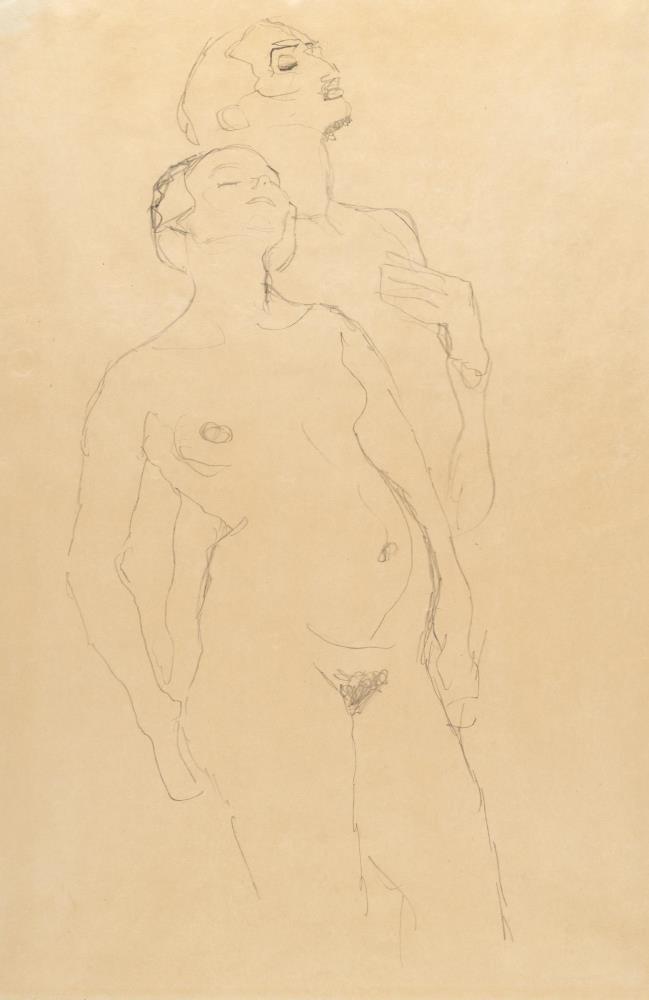
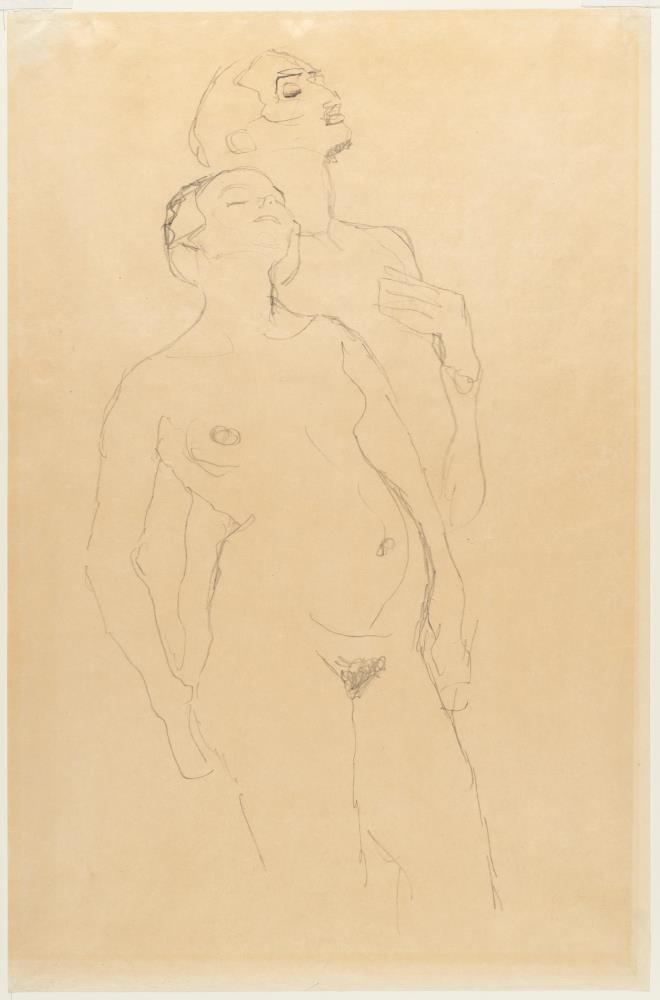
- The sketch shows Eve pregnant, an extremely rare depiction of the couple after the Fall of Man
It is not uncommon for KARL & FABER to offer depictions of Adam and Eve. This season alone, the prints department is offering interpretations of the couple by Albrecht Dürer and Rembrandt Harmensz. van Rijn. Both depict the moment of the Fall of Man. The story from the First Book of Moses has always fascinated: the serpent, a personification of the devil, succeeds in persuading Eve, Adam's second wife, to pluck a fruit from the tree of knowledge, eat it, give Adam a portion - and thus ultimately condemn mankind to mortality, misery and sinfulness. Over time, the story has been used as a basis for misogyny, degrading the woman to a malicious temptress or a compliant tool of the devil.
Gustav Klimt (who otherwise never deals with biblical material) approaches the subject differently. In an unfinished painting from 1917/18, he depicts the couple at the moment of Eve's creation. Adam can be seen sleeping in the background; Eve must have sprung from his rib a moment earlier. Although it is possible to recognize borrowings from art history, such as Hans Baldung Grien's version of the Fall of Man, Klimt is showing something extremely unusual here: not the Fall of Man, not a legitimation for the oppression of women. On the contrary, he illustrates the intimate relationship between the two figures! He understands Eve and Adam as two parts of a whole. Adam, who only becomes a man (Adam = man) through the creation of Eve, always needs his counterpart, his Eve, in order to be complete again. Klimt, who for his time had a progressive view of the relationship between men and women, uses the theme to illustrate the unconditional togetherness of Eve and her Adam.
As is typical for Klimt, the painting is preceded by numerous sketches. Sometimes he shows Eve in ecstasy, sometimes he works on Adam's ideal body. He tests various positions of the two in relation to each other; facing away, facing towards each other, in profile, en face ... Our version no longer has anything to do with the final version of the painting, but it shows all the more fascinatingly an aspect that Klimt apparently quickly discards: Eve is pregnant! Klimt was evidently toying with the idea of depicting a completely different and even rarer part of the story. In this version, the couple would be expelled from paradise, they are mortal, they work the fields with sweat and toil. And finally, Eve will give birth to her first son Cain under the curse of painful childbirth.
Strobl 2864.
- Sketch for Klimt's only Christian motif, a depiction of Adam and Eve
- The sketch shows Eve pregnant, an extremely rare depiction of the couple after the Fall of Man
It is not uncommon for KARL & FABER to offer depictions of Adam and Eve. This season alone, the prints department is offering interpretations of the couple by Albrecht Dürer and Rembrandt Harmensz. van Rijn. Both depict the moment of the Fall of Man. The story from the First Book of Moses has always fascinated: the serpent, a personification of the devil, succeeds in persuading Eve, Adam's second wife, to pluck a fruit from the tree of knowledge, eat it, give Adam a portion - and thus ultimately condemn mankind to mortality, misery and sinfulness. Over time, the story has been used as a basis for misogyny, degrading the woman to a malicious temptress or a compliant tool of the devil.
Gustav Klimt (who otherwise never deals with biblical material) approaches the subject differently. In an unfinished painting from 1917/18, he depicts the couple at the moment of Eve's creation. Adam can be seen sleeping in the background; Eve must have sprung from his rib a moment earlier. Although it is possible to recognize borrowings from art history, such as Hans Baldung Grien's version of the Fall of Man, Klimt is showing something extremely unusual here: not the Fall of Man, not a legitimation for the oppression of women. On the contrary, he illustrates the intimate relationship between the two figures! He understands Eve and Adam as two parts of a whole. Adam, who only becomes a man (Adam = man) through the creation of Eve, always needs his counterpart, his Eve, in order to be complete again. Klimt, who for his time had a progressive view of the relationship between men and women, uses the theme to illustrate the unconditional togetherness of Eve and her Adam.
As is typical for Klimt, the painting is preceded by numerous sketches. Sometimes he shows Eve in ecstasy, sometimes he works on Adam's ideal body. He tests various positions of the two in relation to each other; facing away, facing towards each other, in profile, en face ... Our version no longer has anything to do with the final version of the painting, but it shows all the more fascinatingly an aspect that Klimt apparently quickly discards: Eve is pregnant! Klimt was evidently toying with the idea of depicting a completely different and even rarer part of the story. In this version, the couple would be expelled from paradise, they are mortal, they work the fields with sweat and toil. And finally, Eve will give birth to her first son Cain under the curse of painful childbirth.
Strobl 2864.