Arnold Topp
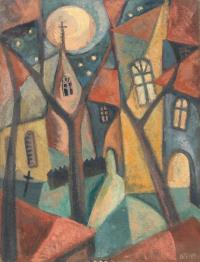
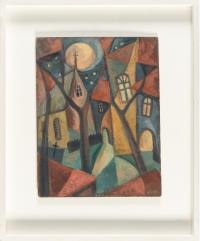
Nocturnal cityscape with church and cemetery




Artist
Arnold Topp
1887 Soest - Ostfront (verschollen) 1945
Further information
Es ist nicht völlig auszuschließen, dass das Bild identisch ist mit "Nächtliches Bild" (WVZ Enders 17.Oe.18.), das 1917 auf der 51. Ausstellung der Galerie Der Sturm in Berlin ausgestellt war.
Enders 17.Oe.35.
Dr. Rainer Enders, Frankfurt/Oder, hat die Echtheit des Werkes bestätigt. Es wird in der nächstfolgenden Überarbeitung des Werkverzeichnisses aufgenommen.
Enders 17.Oe.35.
Dr. Rainer Enders, Frankfurt/Oder, hat die Echtheit des Werkes bestätigt. Es wird in der nächstfolgenden Überarbeitung des Werkverzeichnisses aufgenommen.
Exhibition
Location unknown. 150 Years of Brandenburg in Pictures, Museum im Frey Haus, Brandenburg State Museum, Brandenburg/Havel 2015/16, colour ill. p. 85;
Provenance
Erwin Wilhelm Collection, Stuttgart, acquired in Berlin in the early 1930s, in the family’s possession ever since;
Nagel, Stuttgart 17 October 2009, lot 772;
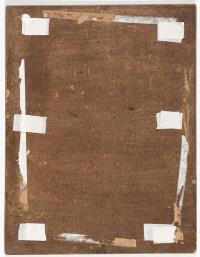
Galerie Thomas, Munich (on consignment), with label on the reverse of the frame;
Private collection, Hamburg.
Nagel, Stuttgart 17 October 2009, lot 772;
Galerie Thomas, Munich (on consignment), with label on the reverse of the frame;
Private collection, Hamburg.
Share


Description
• Expressive nocturnal motif by Arnold Topp
• Characteristic composition with strikingly cubist diagonal lines and a harmoniously subdued colour palette
• The church depicted is very likely St Peter’s Chapel on the Brandenburg Cathedral Island
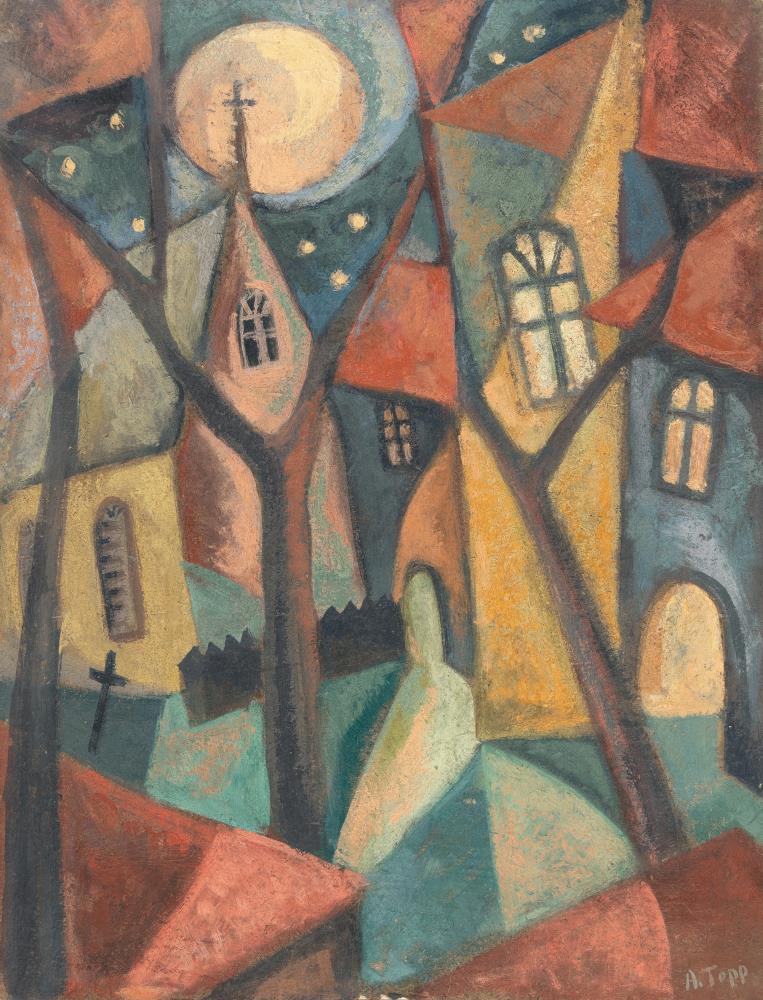
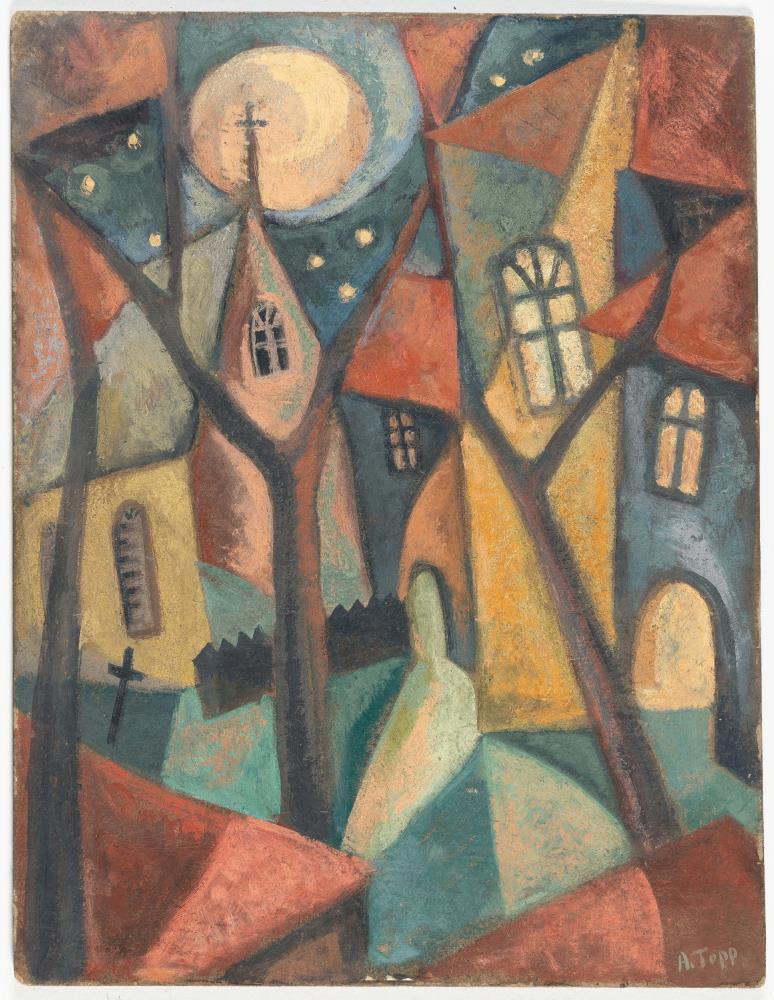
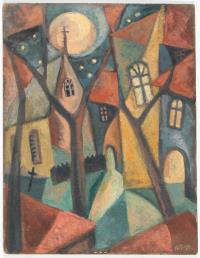
The painting is imbued with a comparatively peaceful atmosphere. It is midnight and a clear sky allows the pale full moon and the stars to shine brightly. On the left-hand side of the composition stands a church, whose proudly raised cross uses the moon as a halo. Adjacent to it is an old churchyard, marked by a leaning grave cross. Next to it stand three houses, huddled close together, their lit windows peering down curiously. And at this moment we realise that the stars, too, are nothing other than eyes in the sky, gazing spellbound at the circle in the courtyard, bathed in the same pale light by the moon. For something is happening down there. From the moon’s reflection, a pale figure seems to materialise as its creation. Like a palisade wall, a fence shields the church from this eerie goings-on.
Arnold Topp, in whose work the narrative element is often strongly pronounced, tells a story here too, drawing the viewer repeatedly into the spell of the depiction and leading them to discover previously unnoticed details anew each time. It is a fascinating Cubist depiction in which the plunging prismatic forms that would later become so dominant appear only marginally. The picture is clearly structured, with the branches of the trees playing a structuring role. It should not be overlooked that the artist loved the night. He was often out and about at that time, experienced many an adventure, and depicted the night in several works.
The tense calm inherent in the composition, the falling elements kept within bounds, and the upright cross of the church suggest that the painting was created in 1917, after Topp had overcome the traumatic consequences of the war and his injury—which are also visible in his work—and before the German surrender, the abdication of the Kaiser and the revolution, including the ensuing fighting, once again filled him with hopes, fears and compassion, and also transformed his work.
Dr Rainer Enders
• Characteristic composition with strikingly cubist diagonal lines and a harmoniously subdued colour palette
• The church depicted is very likely St Peter’s Chapel on the Brandenburg Cathedral Island
The painting is imbued with a comparatively peaceful atmosphere. It is midnight and a clear sky allows the pale full moon and the stars to shine brightly. On the left-hand side of the composition stands a church, whose proudly raised cross uses the moon as a halo. Adjacent to it is an old churchyard, marked by a leaning grave cross. Next to it stand three houses, huddled close together, their lit windows peering down curiously. And at this moment we realise that the stars, too, are nothing other than eyes in the sky, gazing spellbound at the circle in the courtyard, bathed in the same pale light by the moon. For something is happening down there. From the moon’s reflection, a pale figure seems to materialise as its creation. Like a palisade wall, a fence shields the church from this eerie goings-on.
Arnold Topp, in whose work the narrative element is often strongly pronounced, tells a story here too, drawing the viewer repeatedly into the spell of the depiction and leading them to discover previously unnoticed details anew each time. It is a fascinating Cubist depiction in which the plunging prismatic forms that would later become so dominant appear only marginally. The picture is clearly structured, with the branches of the trees playing a structuring role. It should not be overlooked that the artist loved the night. He was often out and about at that time, experienced many an adventure, and depicted the night in several works.
The tense calm inherent in the composition, the falling elements kept within bounds, and the upright cross of the church suggest that the painting was created in 1917, after Topp had overcome the traumatic consequences of the war and his injury—which are also visible in his work—and before the German surrender, the abdication of the Kaiser and the revolution, including the ensuing fighting, once again filled him with hopes, fears and compassion, and also transformed his work.
Dr Rainer Enders