Max Ernst
La Nuit
Artist
Max Ernst
Ausstellung
Max Ernst – Yves Tanguy: Deux vision du surréalisme, Musée Paul Valéry, Sète 2016, Kat.-Nr. 61, farb. Abb. S. 199.
Provenance
Alexander Iolas Gallery, New York; Christie's, London 2.7.1998, Los 268; Privatsammlung, Europa.
Share


Description
- Work full of associative depth and narrative joy
- Ernst demonstrates his painting techniques such as grattage to perfection here
- Late work of Ernst's surrealism
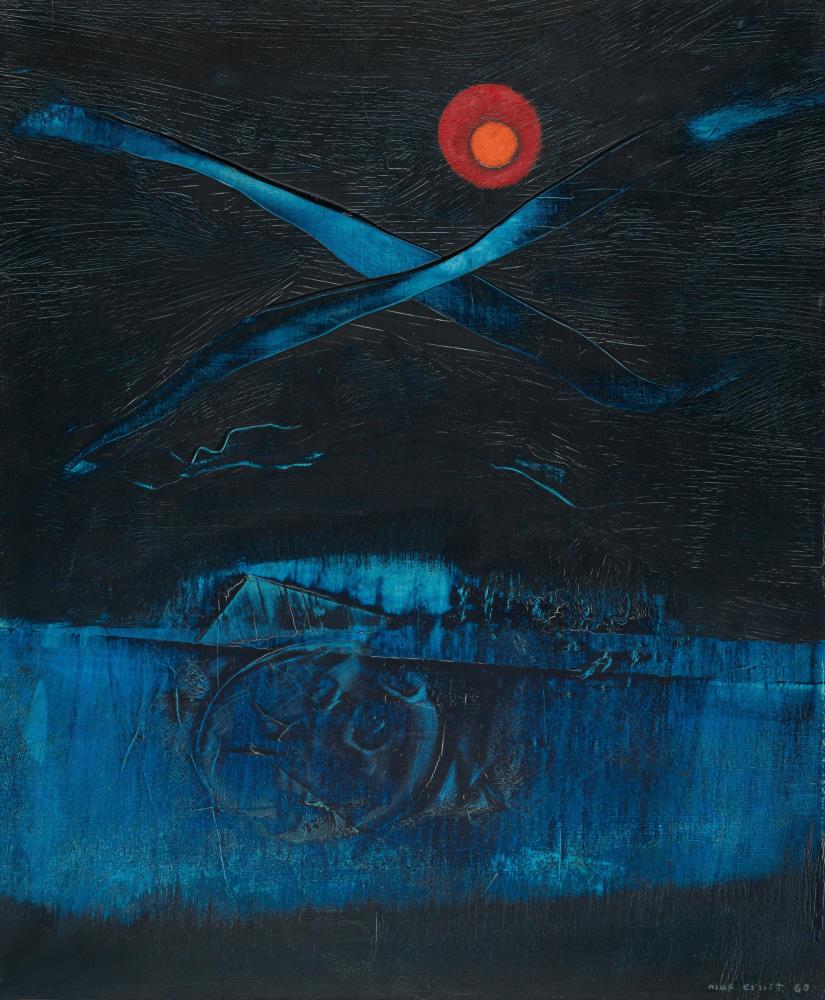
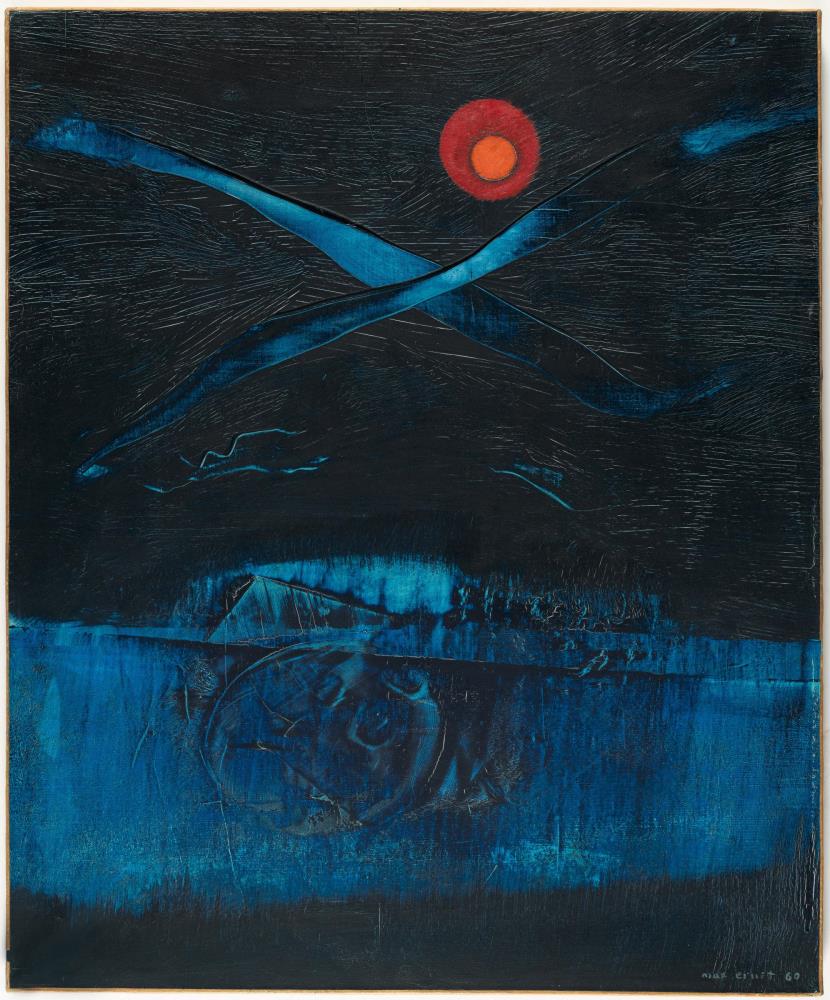
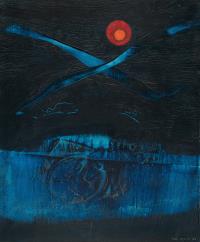
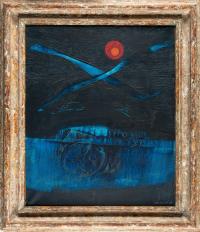
The blood moon shines silently over the blue of the deepest night. Nothing moves, the world sleeps, everything rests. Amorphous visions emerge from this darkness, observed only by the red of the moon, weaving their way through the pictorial space, allowing us (alpine) dreamlike associations.
Decades earlier, Max Ernst had developed a completely new means of finding and creating images with frottage. By rubbing found patterns onto a picture support, structures are created that can only be partially influenced. In the spirit of surrealism, the artist bypasses his own conscious control and relies on the power of the subconscious, the predetermined and fate. Transferred to painting with oil on canvas, this became grattage, a form of scraping and scratching that arbitrarily changes the surface, creates elevations with the help of underlying objects and, like frottage, allows the unconscious forms to emerge spontaneously and evocatively. Now, in 1960, Ernst has perfected these techniques of production, of pictorial dreaming. The artist can already look back on an eventful life and an extensive body of work, even if he is still far from reaching the end of his days.
In "La Nuit", Ernst combines technical mastery with associative and narrative skill. Unlike the many old masters before him, his night is not associated with a clear message. Do we see the mountains here, a hazy memory of Sedona? Is it the vastness of the ocean, a nocturnal mirage on the open sea? In 1960, Ernst was living in France again, having just settled a dispute with his home town of Brühl in a media-effective manner. So is it the succubi of public pressure that sit on the artist's chest at night?
In his painting, Ernst knows how to work out the night as a canvas for human longings and fears. What you see, only you see, the darkness offers itself to you.
Spies/Metken 3503a.
- Ernst demonstrates his painting techniques such as grattage to perfection here
- Late work of Ernst's surrealism
The blood moon shines silently over the blue of the deepest night. Nothing moves, the world sleeps, everything rests. Amorphous visions emerge from this darkness, observed only by the red of the moon, weaving their way through the pictorial space, allowing us (alpine) dreamlike associations.
Decades earlier, Max Ernst had developed a completely new means of finding and creating images with frottage. By rubbing found patterns onto a picture support, structures are created that can only be partially influenced. In the spirit of surrealism, the artist bypasses his own conscious control and relies on the power of the subconscious, the predetermined and fate. Transferred to painting with oil on canvas, this became grattage, a form of scraping and scratching that arbitrarily changes the surface, creates elevations with the help of underlying objects and, like frottage, allows the unconscious forms to emerge spontaneously and evocatively. Now, in 1960, Ernst has perfected these techniques of production, of pictorial dreaming. The artist can already look back on an eventful life and an extensive body of work, even if he is still far from reaching the end of his days.
In "La Nuit", Ernst combines technical mastery with associative and narrative skill. Unlike the many old masters before him, his night is not associated with a clear message. Do we see the mountains here, a hazy memory of Sedona? Is it the vastness of the ocean, a nocturnal mirage on the open sea? In 1960, Ernst was living in France again, having just settled a dispute with his home town of Brühl in a media-effective manner. So is it the succubi of public pressure that sit on the artist's chest at night?
In his painting, Ernst knows how to work out the night as a canvas for human longings and fears. What you see, only you see, the darkness offers itself to you.
Spies/Metken 3503a.