Bruno Goller
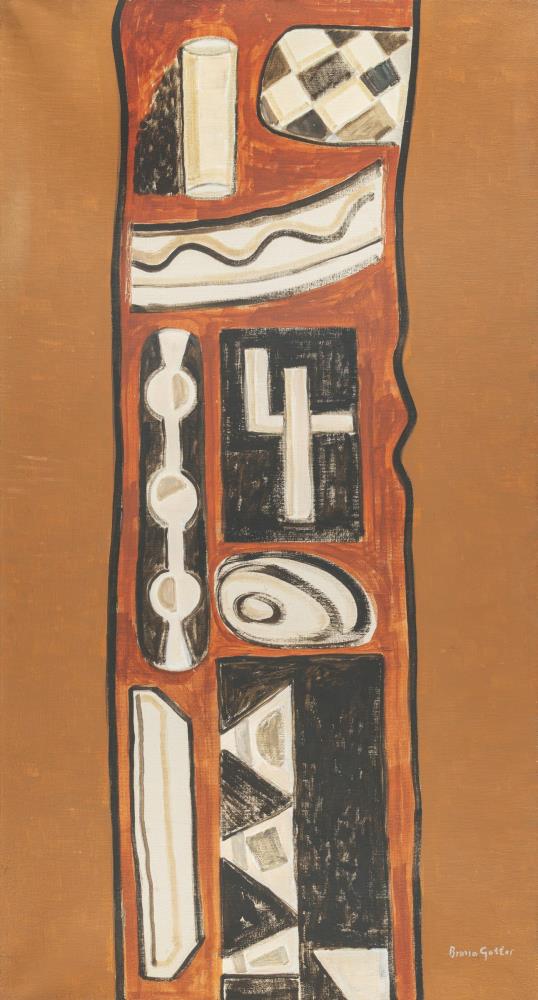
Stillleben mit der 4
Artist
Bruno Goller
Ausstellung
Bruno Goller. Exposicão alemã, Bienal de São Paulo 1965, Kat.-Nr. 28, verso auf dem Keilrahmen mit Etikettfragment ; Bruno Goller. Retrospektive 1922-1992, Kunstmuseum, Bonn 2024/25, o. Kat.-Nr., farb. Abb. 78.
Provenance
Sammlung Dr. Volker Kahmen (1939-2017), Museum Insel Hombroich, seit den 1970er Jahren, per Erbgang an seine Witwe Lisa Kleine; Galerie Haus Schlangeneck, Euskirchen; Sammlung Olbricht, Deutschland, 2019 bei Vorgenannter erworben.
Share


Description
- Characteristic work from Goller's mature late work, 1962
- Combination of symbol, structure and poetic objectivity
- The number "4" as a central organizing principle - symbol of measure and balance
Bruno Goller is one of those quiet, idiosyncratic artistic personalities who eluded the major trends of the 20th century and thus maintained an unmistakable position. Born in Gummersbach in 1901, he has lived in Düsseldorf since 1927, where he has developed a highly individual, almost hermetic visual language over the decades. His painting stands in the field of tension between New Objectivity, Surrealism and a poetic-symbolic representationalism.
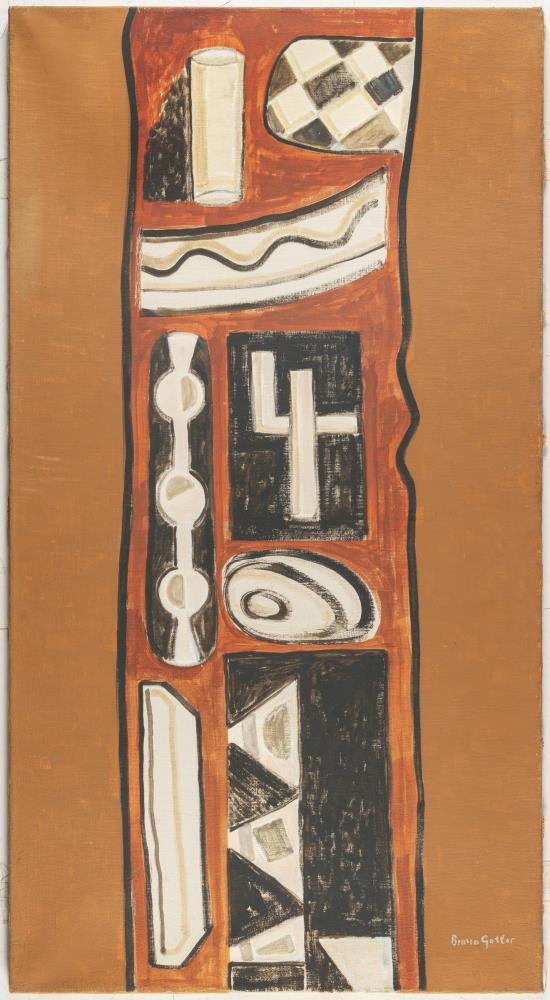
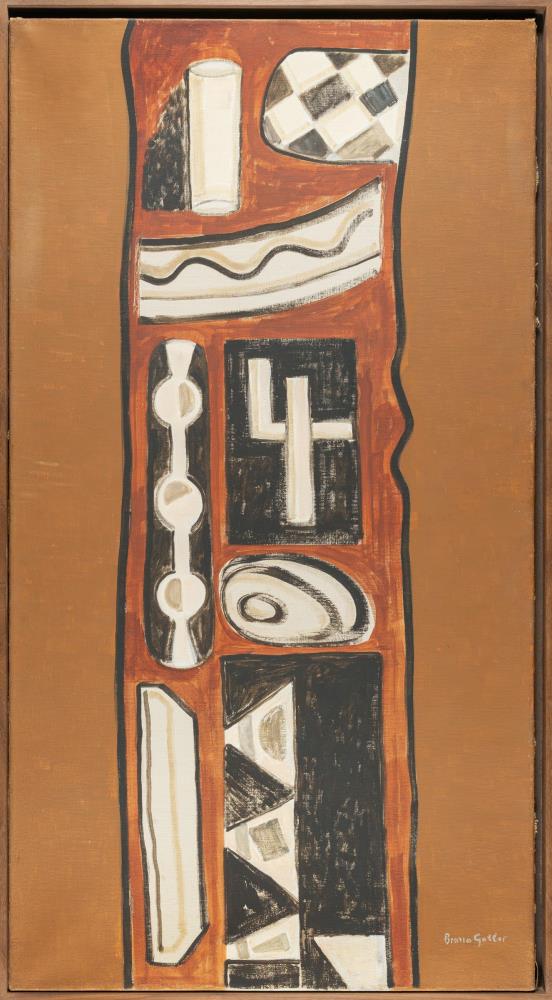
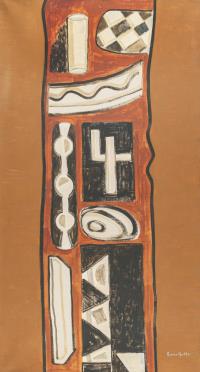
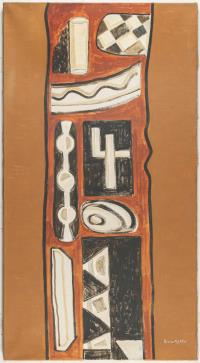
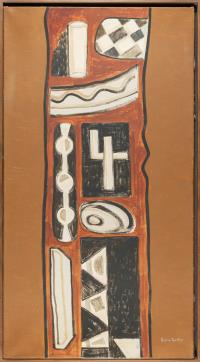
The "Still Life with the Number 4" from 1962 is one of the key works of his late period. In a strictly vertical arrangement, Goller lines up geometrically stylized forms - circle, cross, oval and number - in an architecturally structured field. The composition appears clear and mysterious at the same time. The warm, earthy red contrasts with black, white and gray; the forms appear familiar and yet enraptured, as if they were signs of a hidden order.
As in many of his works, what is depicted remains ambiguous. Goller does not create still lifes in the traditional sense, but visual systems in which things become symbols and forms become carriers of inner meaning. The number "4" functions both as a pictorial motif and as a principle of order - a symbol of stability, measure and structure, central themes of his late work.
His pictures defy any clear interpretation and develop their effect from the magic of the enigmatic. In the clear form, the subdued color tone and the poetic tension between surface and space, an artist is revealed who never joins the noise of the avant-garde - and remains timelessly modern precisely because of this.
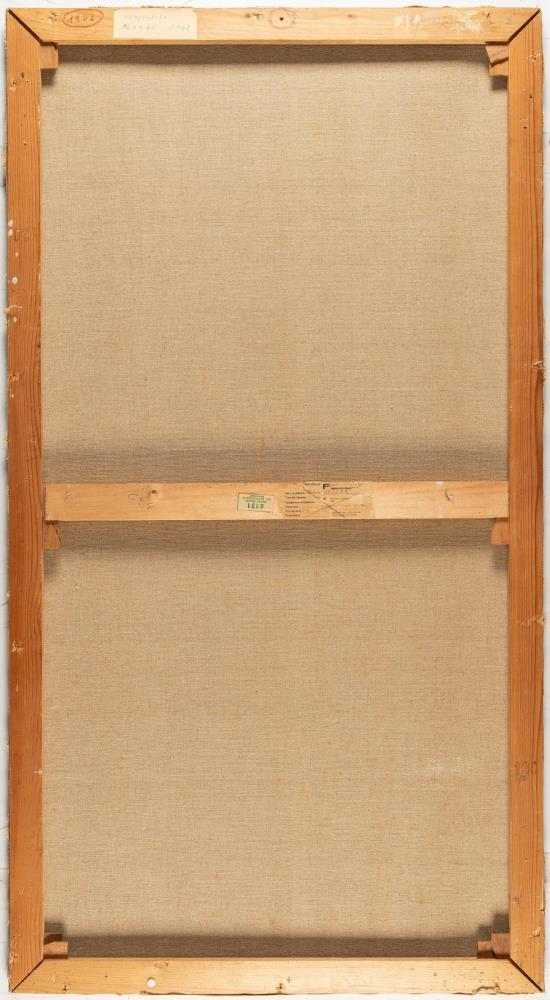
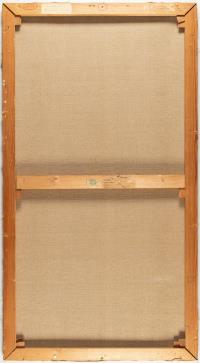
Handwritten inscription "Komposition" and dated on old stretcher label on the reverse and dated on the stretcher.
- Combination of symbol, structure and poetic objectivity
- The number "4" as a central organizing principle - symbol of measure and balance
Bruno Goller is one of those quiet, idiosyncratic artistic personalities who eluded the major trends of the 20th century and thus maintained an unmistakable position. Born in Gummersbach in 1901, he has lived in Düsseldorf since 1927, where he has developed a highly individual, almost hermetic visual language over the decades. His painting stands in the field of tension between New Objectivity, Surrealism and a poetic-symbolic representationalism.
The "Still Life with the Number 4" from 1962 is one of the key works of his late period. In a strictly vertical arrangement, Goller lines up geometrically stylized forms - circle, cross, oval and number - in an architecturally structured field. The composition appears clear and mysterious at the same time. The warm, earthy red contrasts with black, white and gray; the forms appear familiar and yet enraptured, as if they were signs of a hidden order.
As in many of his works, what is depicted remains ambiguous. Goller does not create still lifes in the traditional sense, but visual systems in which things become symbols and forms become carriers of inner meaning. The number "4" functions both as a pictorial motif and as a principle of order - a symbol of stability, measure and structure, central themes of his late work.
His pictures defy any clear interpretation and develop their effect from the magic of the enigmatic. In the clear form, the subdued color tone and the poetic tension between surface and space, an artist is revealed who never joins the noise of the avant-garde - and remains timelessly modern precisely because of this.
Handwritten inscription "Komposition" and dated on old stretcher label on the reverse and dated on the stretcher.