Andy Warhol
Toy Painting, Parrot
Artist
Andy Warhol
Exhibition
Painting for children. Galerie Bruno Bischofberger, Zurich 1983/1984 (no cat.) ;
Children's Paintings. Art Now Gallery, Stockholm 1984 (no cat.) ;
The Legacy of Andy Warhol. Artipelag, Stockholm 2016 (no cat.).
Children's Paintings. Art Now Gallery, Stockholm 1984 (no cat.) ;
The Legacy of Andy Warhol. Artipelag, Stockholm 2016 (no cat.).
Provenance
Bruno Bischofberger Gallery, Zurich (1983);
Fabian Carlsson Collection, Gothenburg/Sweden;
Art Now Gallery, Stockholm/Sweden;
Private collection, Sweden, acquired from the aforementioned in 1984;
Bukowskis, Stockholm/Sweden 12.11.2014;
Galerie Thomas, Munich;
Private collection, Southern Germany, acquired from the aforementioned in 2021.
Fabian Carlsson Collection, Gothenburg/Sweden;
Art Now Gallery, Stockholm/Sweden;
Private collection, Sweden, acquired from the aforementioned in 1984;
Bukowskis, Stockholm/Sweden 12.11.2014;
Galerie Thomas, Munich;
Private collection, Southern Germany, acquired from the aforementioned in 2021.
Share


Description
- One of the legendary "Toy Paintings", shown in 1983/84 in the exhibition "Painting for children" at Galerie Bruno Bischofberger, Zurich
- Particularly concise and appealing color scheme
- The aesthetics and motifs of mass media are transferred to the visual arts for the first time by Andy Warhol; he is one of the most influential artists of the 20th century
In 1982, Bruno Bischofberger, Warhol's friend and gallery owner, commissioned the artist to create a series of paintings for children. The result was the Toy Paintings, a series of screen prints, each depicting a wind-up tin toy from Warhol's large toy collection. When the works were shown at Bruno Bischofberger in Zurich in 1983, the gallery space was transformed into a kind of giant children's room: On blue walls adorned with silver fish, the works hang close to the floor, placing them perfectly in the field of vision of small children. All adults, on the other hand, have to bend down or squat to look at the works. A humorous act of sabotage by Warhol against artistic dogma and elitist views in the art world.
Warhol creates a series of 128 canvases depicting parrots, dogs, pandas, monkeys, clowns and robots, among others.
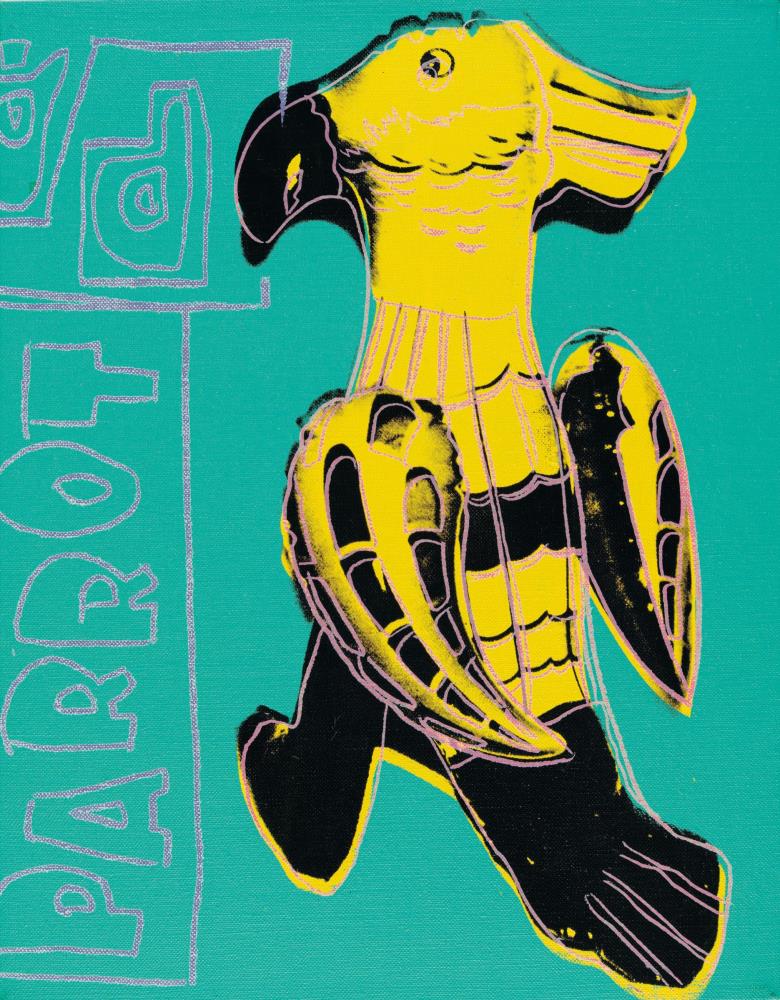
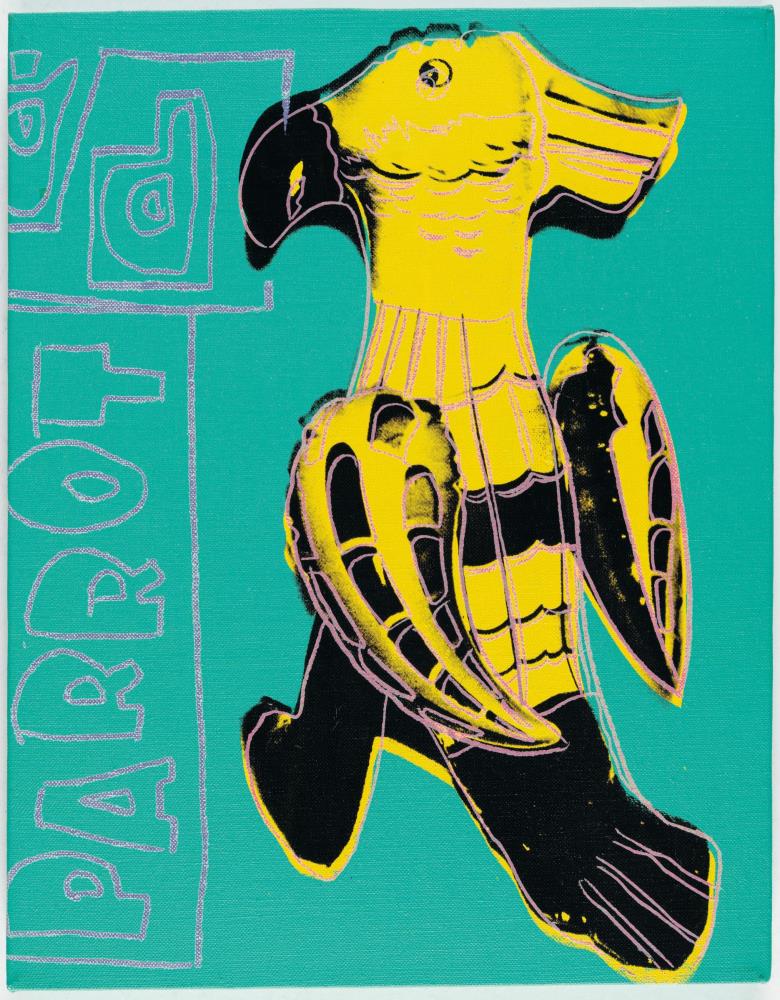
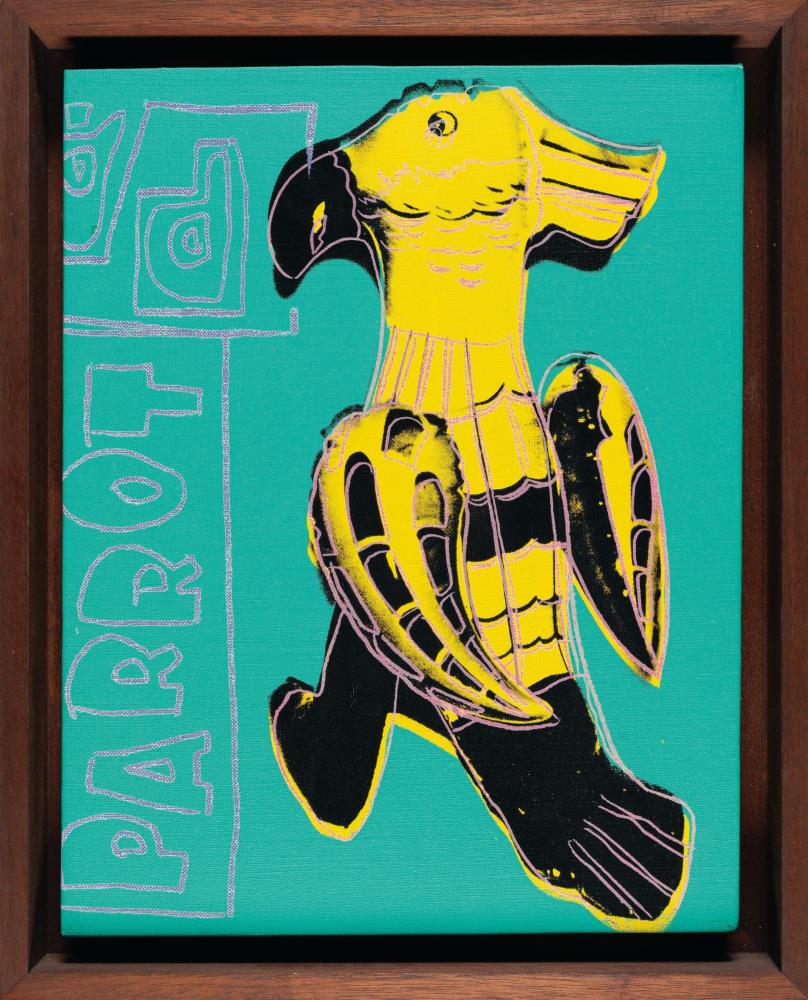
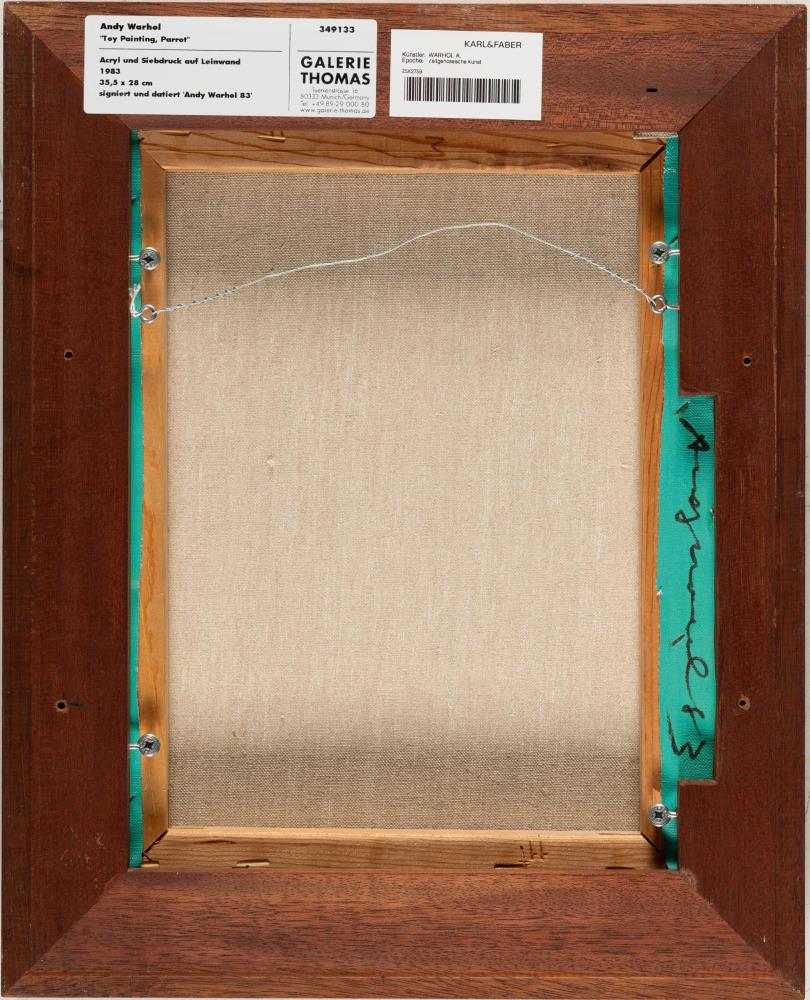
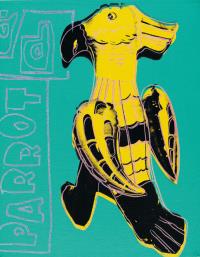
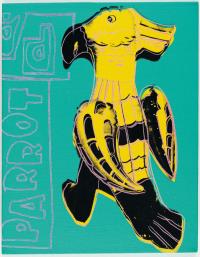
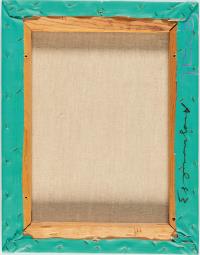
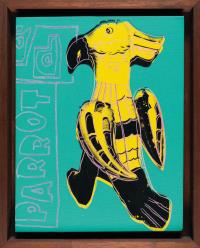
The present work "Parrot" shows not only the toy itself, but also its packaging with the corresponding inscription. Warhol gives us his version of this small, cheap toy in his typical silkscreen style in contrasting turquoise and yellow. In its everyday banality, it recalls his early paintings in which he celebrated the visual aesthetic of Campbell's soup cans and Coca-Cola bottles, paintings that sparked the Pop Art revolution. The same simplified visual language that launched Warhol's career as one of the most innovative artists of his generation resonates here.
When Warhol is asked about this new idea of pop, he remarks: "once you 'got' pop, you could never see a sign the same way again. And once you thought pop, you could never see America the same way again. The mystery was gone, but the amazement was just starting" (P. Hackett, Popism: the Warhol '60s, New York, 1980, pp. 39-40).
Literature. Francis, Mark. Andy Warhol: The Late Work. Munich 2004
- Particularly concise and appealing color scheme
- The aesthetics and motifs of mass media are transferred to the visual arts for the first time by Andy Warhol; he is one of the most influential artists of the 20th century
In 1982, Bruno Bischofberger, Warhol's friend and gallery owner, commissioned the artist to create a series of paintings for children. The result was the Toy Paintings, a series of screen prints, each depicting a wind-up tin toy from Warhol's large toy collection. When the works were shown at Bruno Bischofberger in Zurich in 1983, the gallery space was transformed into a kind of giant children's room: On blue walls adorned with silver fish, the works hang close to the floor, placing them perfectly in the field of vision of small children. All adults, on the other hand, have to bend down or squat to look at the works. A humorous act of sabotage by Warhol against artistic dogma and elitist views in the art world.
Warhol creates a series of 128 canvases depicting parrots, dogs, pandas, monkeys, clowns and robots, among others.
The present work "Parrot" shows not only the toy itself, but also its packaging with the corresponding inscription. Warhol gives us his version of this small, cheap toy in his typical silkscreen style in contrasting turquoise and yellow. In its everyday banality, it recalls his early paintings in which he celebrated the visual aesthetic of Campbell's soup cans and Coca-Cola bottles, paintings that sparked the Pop Art revolution. The same simplified visual language that launched Warhol's career as one of the most innovative artists of his generation resonates here.
When Warhol is asked about this new idea of pop, he remarks: "once you 'got' pop, you could never see a sign the same way again. And once you thought pop, you could never see America the same way again. The mystery was gone, but the amazement was just starting" (P. Hackett, Popism: the Warhol '60s, New York, 1980, pp. 39-40).
Literature. Francis, Mark. Andy Warhol: The Late Work. Munich 2004