Rembrandt Harmensz. van Rijn
Die große Löwenjagd
Artista
Rembrandt Harmensz. van Rijn
1606 Leiden - Amsterdam 1669
Ulteriori informazioni
Bartsch 114; White/Boon 114 II (of II); Hinterding/Rutgers (The New Hollstein) 187 II (of II).
Share


Descrizione
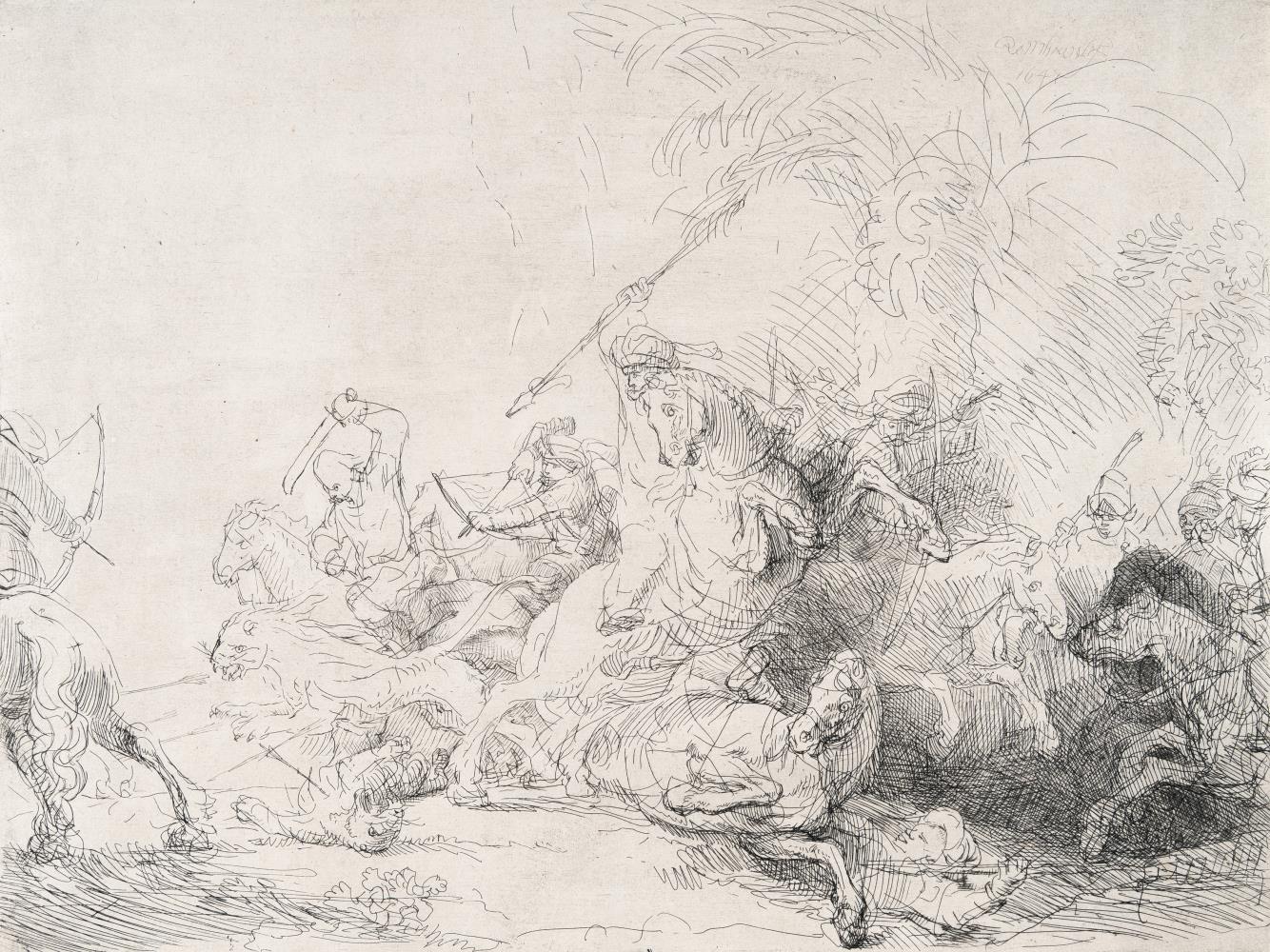
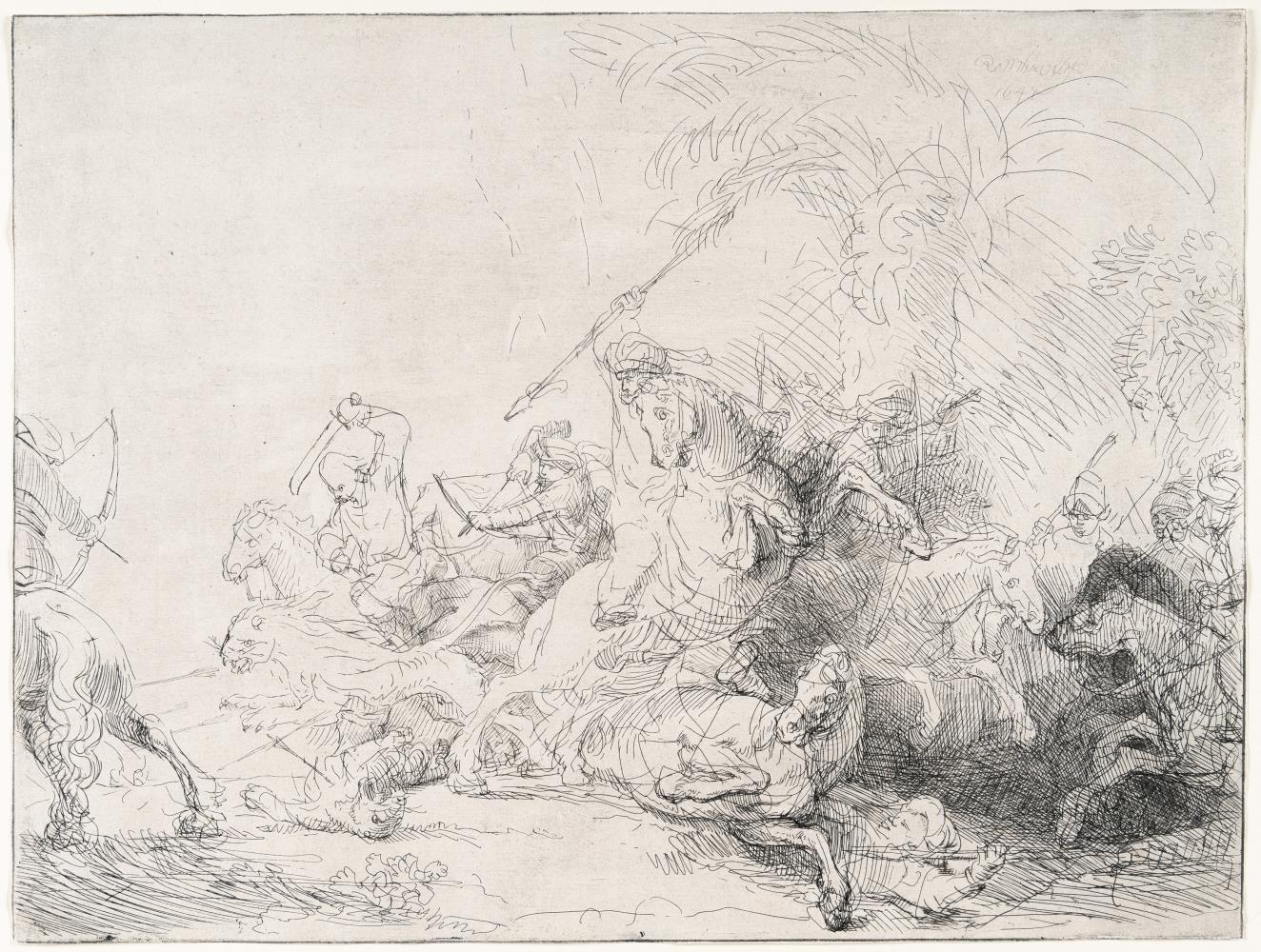
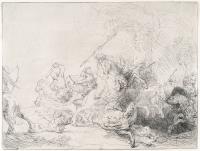
A very fine impression of New Hollstein's rare second state, with burr on the lines of the archer at the left edge, on the fallen rider at the lower right edge and in the cross-hatched areas at the lower right; printed with plate tone. Trimmed on or just outside the platemarks, which are outlined with grey ink. According to Hollstein, only three copies of the first state are known to exist: one in Cambridge, one in the Bibliothèque Nationale in Paris, and one in the Dutuit Collection in Paris. The printing plate was lost early on; prints are very rarely found on the auction market.
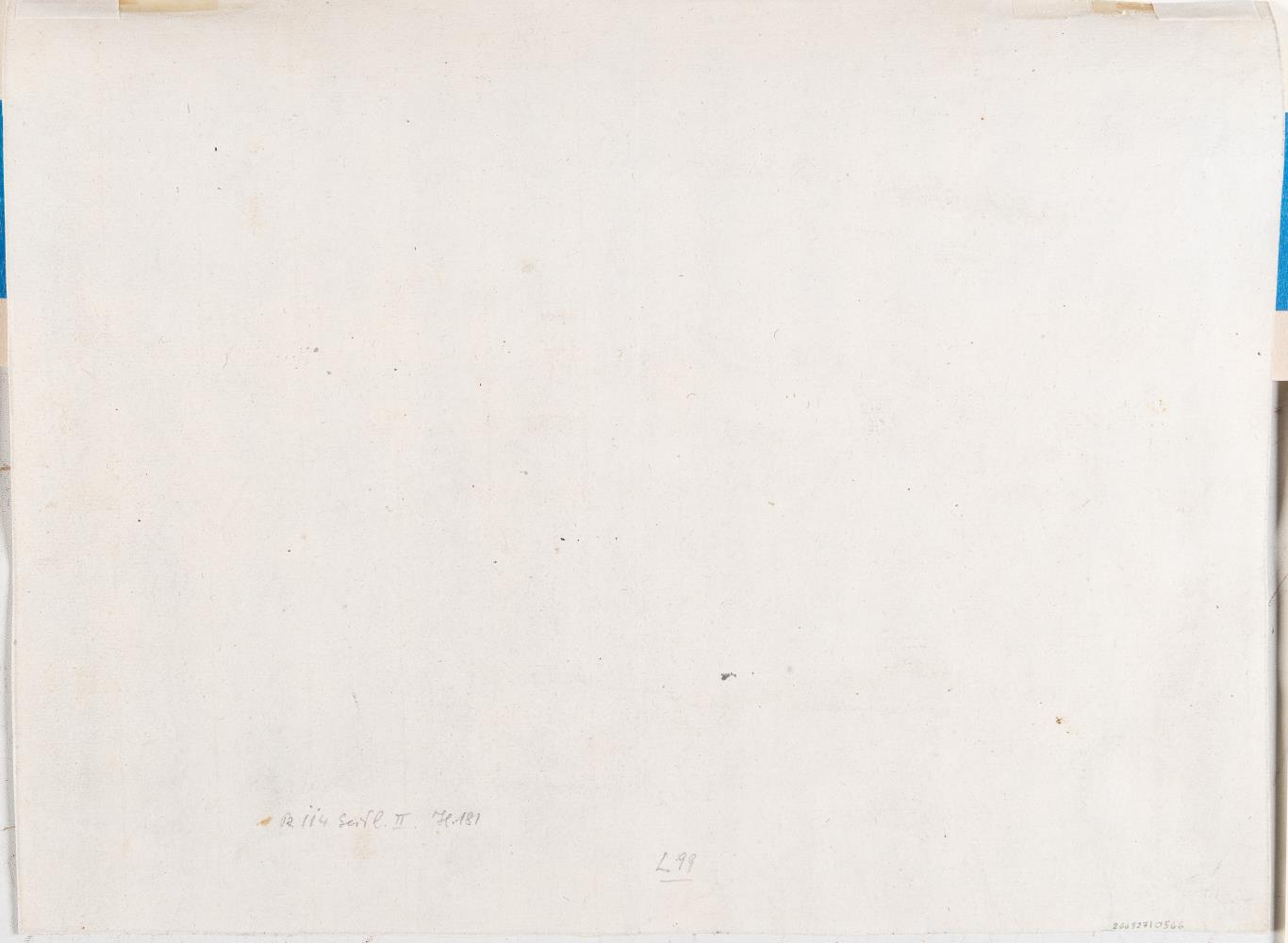
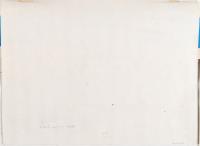
The hunting scene, executed in a large format, is a compositional masterpiece. People, horses and lions are in dramatic motion and, coming from the right, dominate the picture plane. The figures are outlined in a loose, sketch-like line, creating the impression that the depiction is still unfinished. In contrast to the smaller early hunting scene, created around 1629, in this depiction the heroic hunters prevail over their prey. Here, Rembrandt takes up the theme of hunting scenes by the Italian engraver Antonio Tempesta. Dutuit and Hofstede de Groot also consider it possible that Rubens’s oil sketches, which resemble this etching in their sketch-like quality, may have exerted an influence. – Verso with slight paper thinning at the corners of the upper edge, due to a former mount; the mounting strips on the back, along the top edge, show through on the front. The tip of the lower right corner attached; otherwise in very good condition.
The hunting scene, executed in a large format, is a compositional masterpiece. People, horses and lions are in dramatic motion and, coming from the right, dominate the picture plane. The figures are outlined in a loose, sketch-like line, creating the impression that the depiction is still unfinished. In contrast to the smaller early hunting scene, created around 1629, in this depiction the heroic hunters prevail over their prey. Here, Rembrandt takes up the theme of hunting scenes by the Italian engraver Antonio Tempesta. Dutuit and Hofstede de Groot also consider it possible that Rubens’s oil sketches, which resemble this etching in their sketch-like quality, may have exerted an influence. – Verso with slight paper thinning at the corners of the upper edge, due to a former mount; the mounting strips on the back, along the top edge, show through on the front. The tip of the lower right corner attached; otherwise in very good condition.