Le Corbusier
Taureau VIII (Bull VIII)
Artista
Le Corbusier
1887 La Chaux-de-Fonds - Roquebrune 1965
Ulteriori informazioni
Mit einer Bestätigung von Eric Mouchet, Paris, vom 6.6.2019 (in Kopie).
Provenienza
Private collection, France;
Private collection, Paris.
Private collection, Paris.
Share


Descrizione
• Significant work from Le Corbusier’s late ‘Taureau’ series
• Characteristic combination of free ink drawing and coloured paper collage
• Created during the final decade of the artist’s life, in which his oeuvre was increasingly defined by organic and symbolic forms
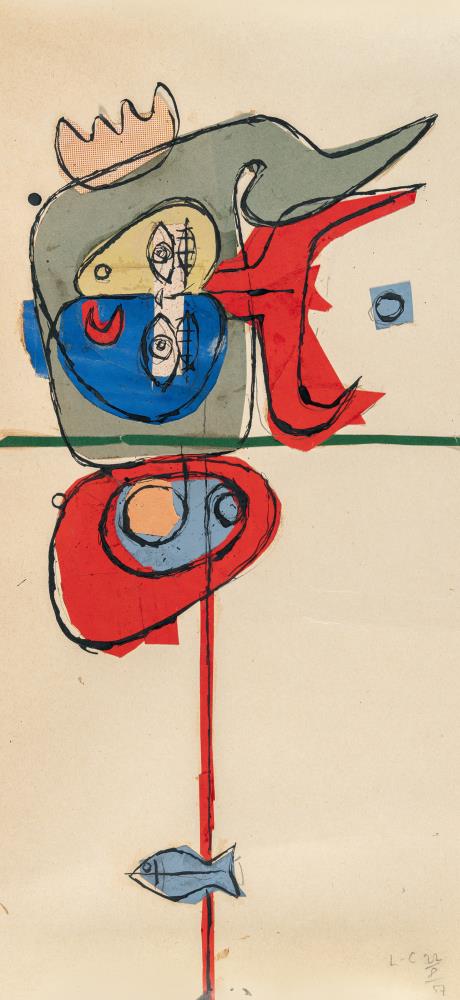
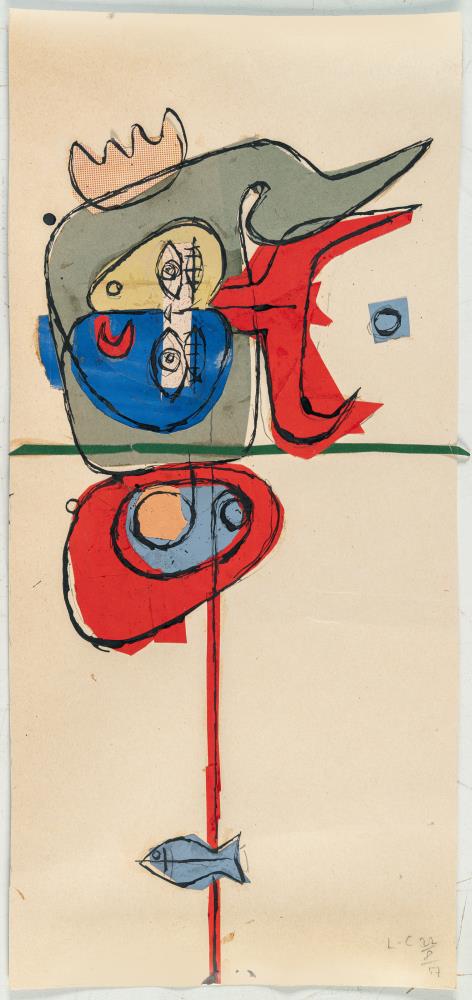
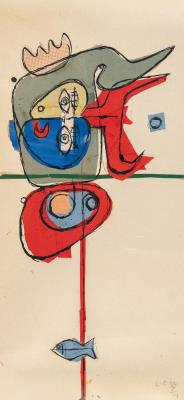
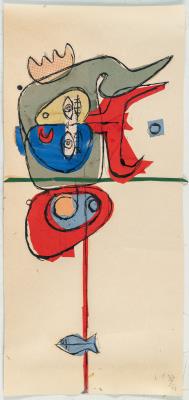
With the "Taureau" compositions created from the 1950s onwards, Le Corbusier developed a visual language situated between sign, figure and abstraction. The bull appears here less as a naturalistic motif than as an archetypal symbol of strength, vitality and creative energy. In "Taureau VIII", this concept crystallises into a rhythmically structured composition of free-flowing black lines, coloured paper forms and floating symbolic motifs.
The combination of indian ink, collage and colour-accented areas reflects Le Corbusier’s intense preoccupation with the relationship between line, colour and space, which shapes his painterly and architectural work in equal measure. The vertical axis of the composition simultaneously lends the sheet an almost totemic presence. Works from this group are among the artist’s most sought-after autonomous works on paper and impressively document the expressive freedom of his late work.
• Characteristic combination of free ink drawing and coloured paper collage
• Created during the final decade of the artist’s life, in which his oeuvre was increasingly defined by organic and symbolic forms
With the "Taureau" compositions created from the 1950s onwards, Le Corbusier developed a visual language situated between sign, figure and abstraction. The bull appears here less as a naturalistic motif than as an archetypal symbol of strength, vitality and creative energy. In "Taureau VIII", this concept crystallises into a rhythmically structured composition of free-flowing black lines, coloured paper forms and floating symbolic motifs.
The combination of indian ink, collage and colour-accented areas reflects Le Corbusier’s intense preoccupation with the relationship between line, colour and space, which shapes his painterly and architectural work in equal measure. The vertical axis of the composition simultaneously lends the sheet an almost totemic presence. Works from this group are among the artist’s most sought-after autonomous works on paper and impressively document the expressive freedom of his late work.