Römisch
Birth of Bacchus
Artista
Römisch
Provenienza
International private collection.
Share


Descrizione
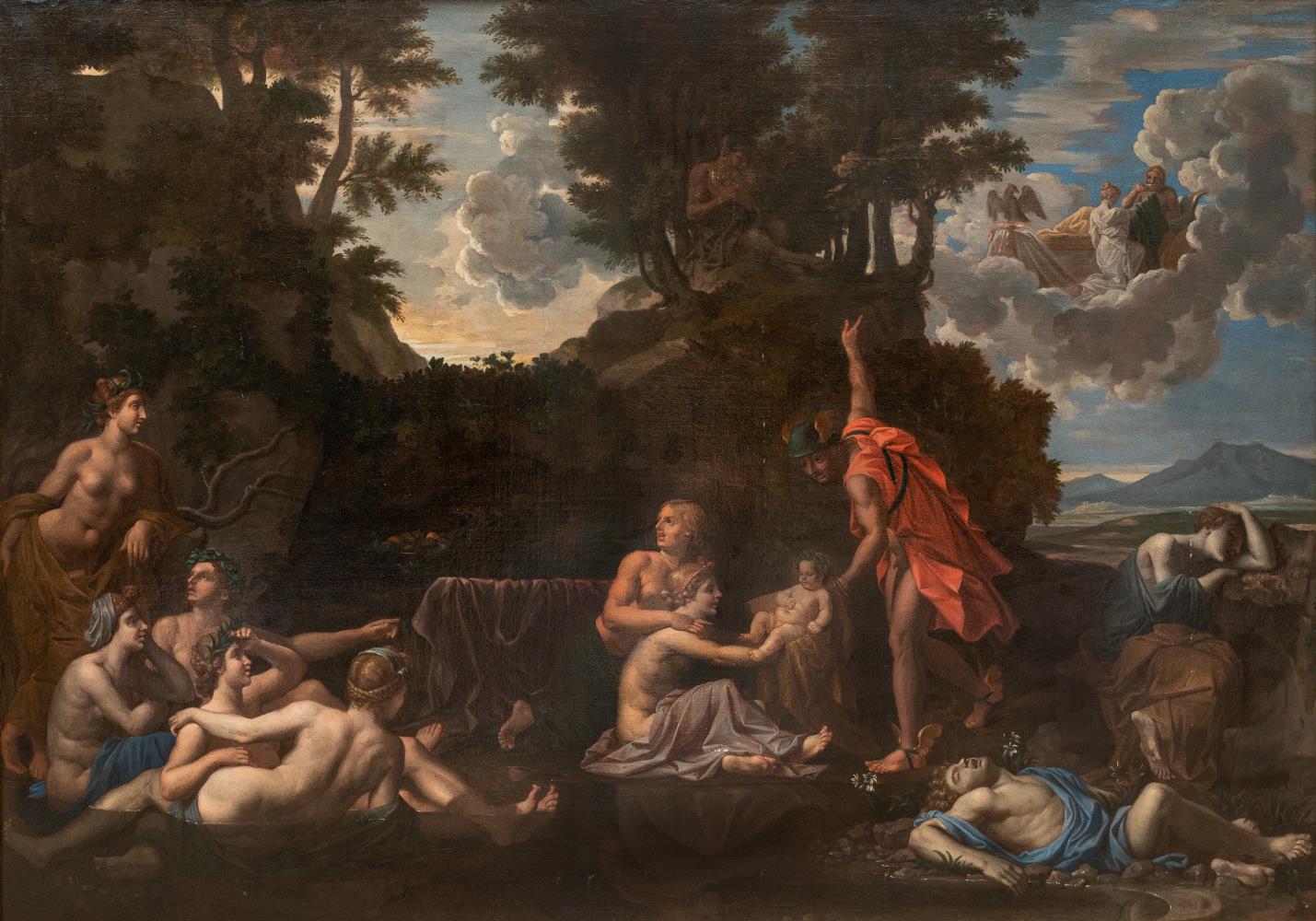
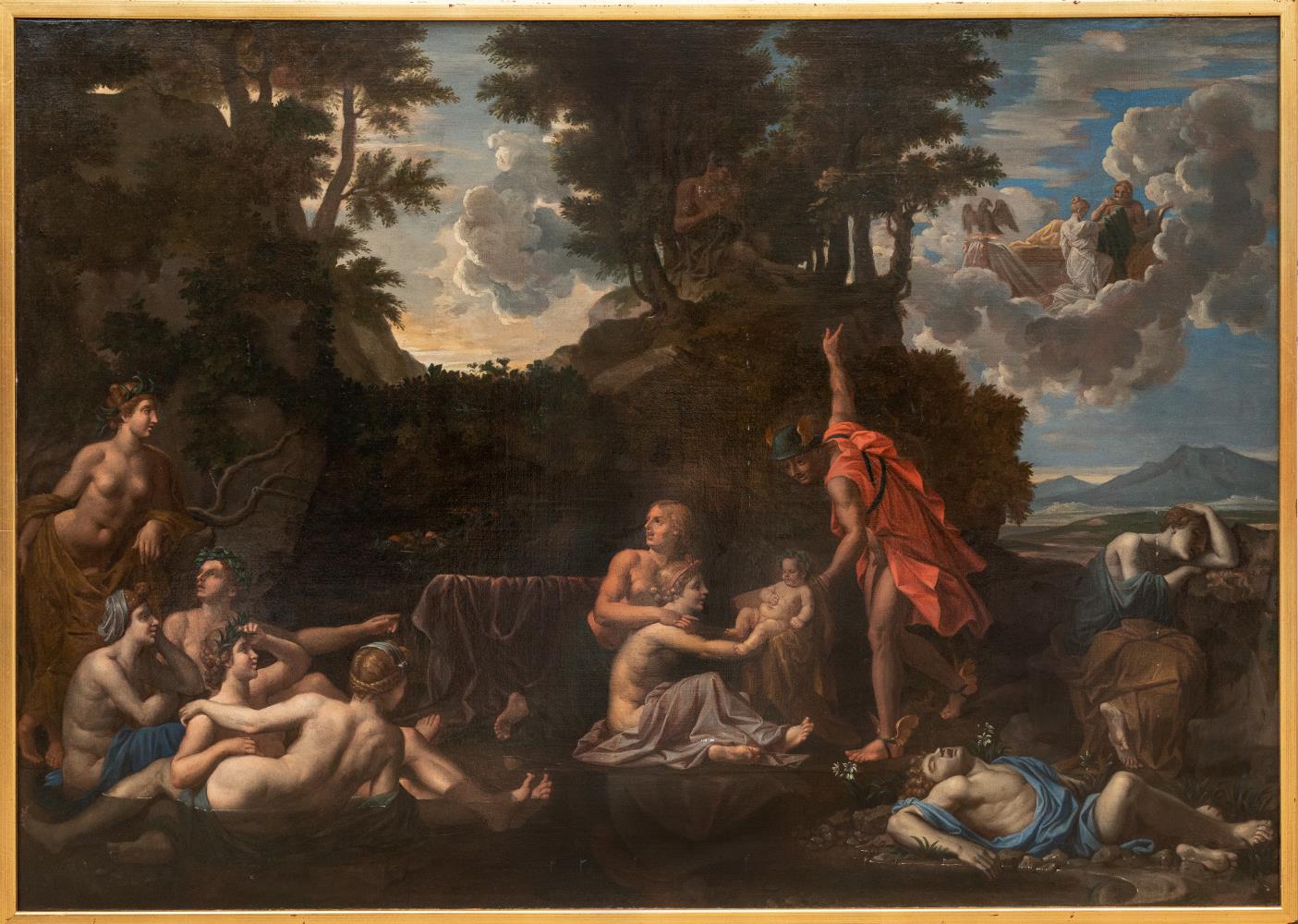
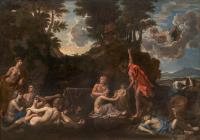
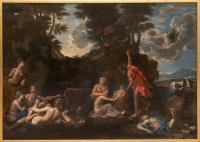
This composition is based on ‘The Birth of Bacchus’ by Nicolas Poussin, which is now in the Fogg Art Museum/The Harvard Art Museums in Cambridge, USA. This version was created towards the end of the 17th century in the Roman milieu and follows Poussin’s composition in its essential features, yet – in keeping with the spirit of the age – takes liberties with the literary sources. The focus is less on a strict narrative and more on the symbolic distillation of a theme: the idea of fertility and renewal. At the centre of the depiction is the newborn child, who is handed over by Apollo to the Nymphs of Nysa, a mythically ethereal place without a definable geographical location. Above the scene appears Jupiter, the divine father, enthroned upon clouds. The common title ‘The Birth of Bacchus’ proves to be only partially accurate, as it is not the actual moment of birth that is depicted, but rather the subsequent rescue and handover of the child. The ancient tradition regarding the god’s origins is multifaceted. In the most common version, Semele, a mortal and the child’s mother, meets her death through the intervention of the jealous Juno. Jupiter then saves the unborn Bacchus by carrying him in his thigh and giving birth to him a second time – a motif that lies at the heart of the Greek name Dionysus (‘the twice-born’). In the care of the nymphs, the child eventually grows up, protected from Juno’s wrath, and later becomes the god of wine, ecstasy and creative vitality. Poussin, however, expands this scene with a deliberately contrasting subplot: on the right-hand edge of the picture, Echo and Narcissus appear as counter-figures. Their story stands not for procreation and continuity, but for futility and self-loss. Echo, punished by Juno, is condemned to merely repeat the words of others; her unrequited love for Narcissus leads to the gradual dissolution of her body. Narcissus, in turn – punished by Nemesis – becomes obsessed with gazing at his own reflection and perishes as a result. In the juxtaposition of these two pictorial spheres, a multi-layered narrative unfolds: The rescued Bacchus embodies the promise of growth, fertility and vital energy, whilst Echo and Narcissus represent the flip side – a self-circling existence that ends in isolation and transience. Thus, the composition transcends the mere mythological narrative to take on the character of an allegorical reflection on becoming and passing away.