Gustav Klimt
Vienna Secession I. Exhibition
Artist
Gustav Klimt
1862 Baumgarten bei Wien - Wien 1918
Further information
Rechts unten über der Schrift mit dem Stempel "Werbe-Archiv, Direktor Th. Lach" und der handschriftlichen Nummer "50.219".
Provenance
Collection/Estate of Serge Sabarsky, New York;
Collection/Foundation of Vally Sabarsky, New York.
Share


Description
• First poster of the Vienna Secession
• Klimt grapples with the motif of freedom in (young) art
• From the collection of the renowned collector Serge Sabarsky
3 April 1897: The ‘Association of Fine Artists of Austria’, the Secession, is founded with 23 members. When it split from the "Society of Fine Artists" in May of that year, its membership fell to 13, yet these were among the most renowned young artists Austria had to offer at the time. Alongside Koloman Moser and Josef Hoffmann, Gustav Klimt stood out in particular.
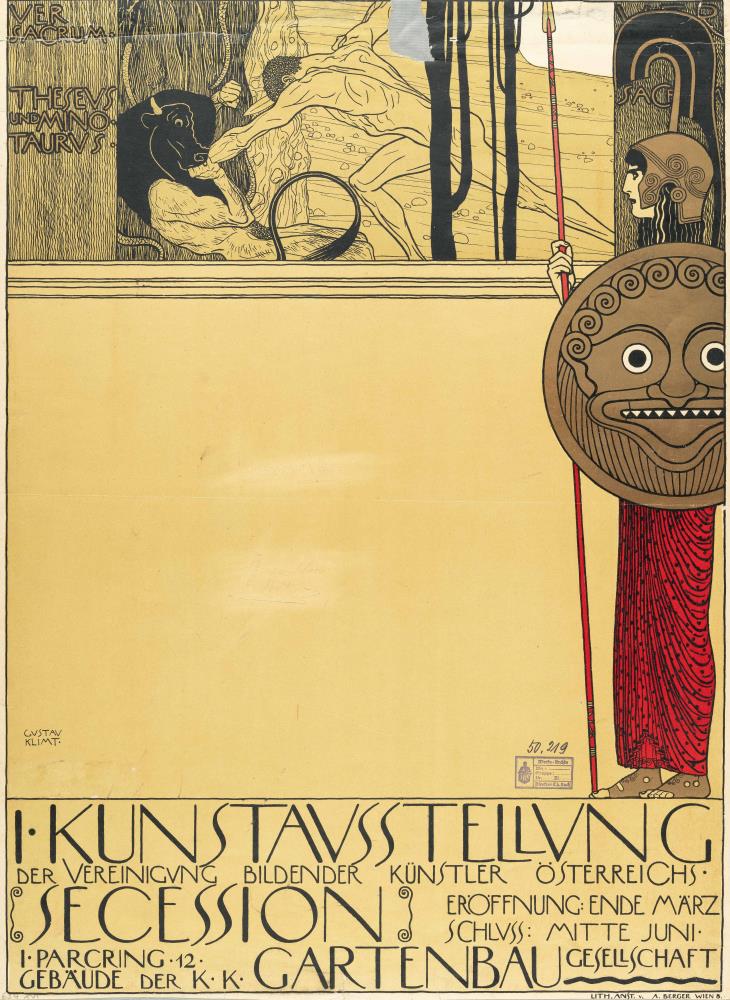
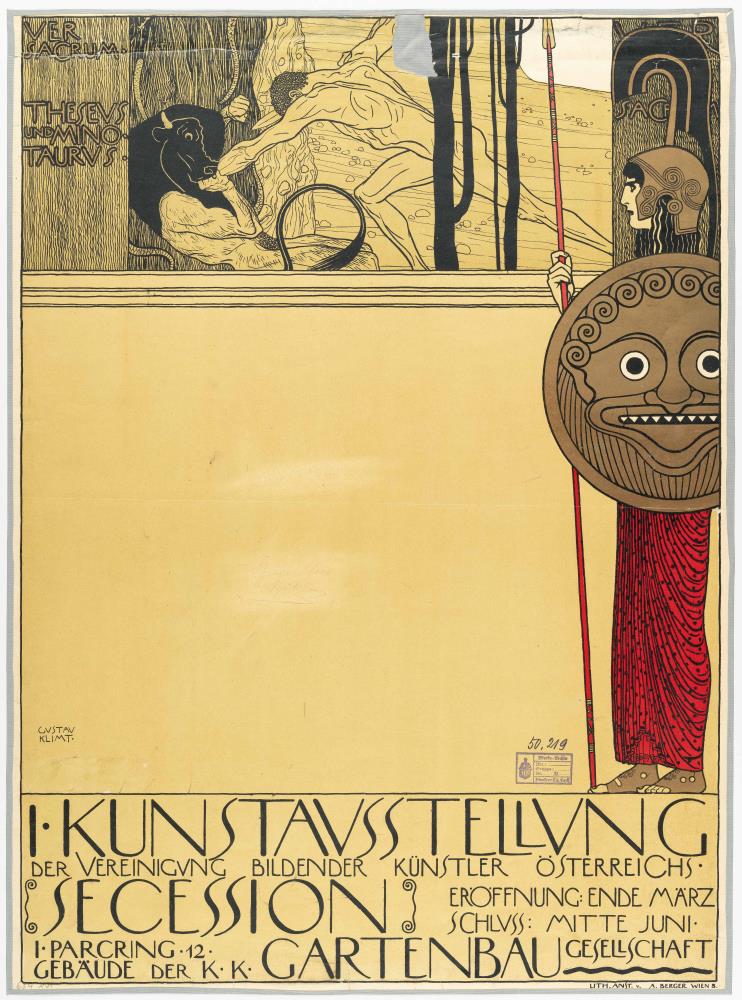
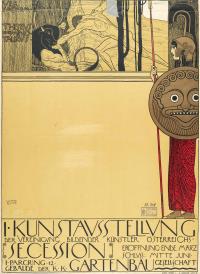
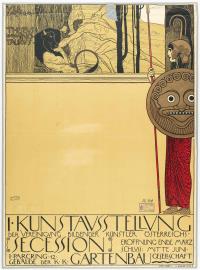
When the group organised its first exhibition a year later, Klimt designed the poster. In a typeface that has since become iconic, the poster announces in large letters the "I. KUNSTAVSSTELLUNG (...) SECESSION" from the end of March. The motif is divided into three parts: on the right, the only part rendered in colour, stands Pallas Athena in profile. Armed with a helmet, a lance and the shield of Medusa, Klimt depicts her as the patron goddess of freedom. This motif of the ancient Athena would recur repeatedly in Klimt’s work for the Secession in the years that followed. In this figure, he visualises one of the core concerns of the young association. The artists around Klimt had taken up the noble cause of freedom of art.
Behind Athena rises a large empty wall. Klimt deliberately designs the poster motif to be flat, creating no sense of perspective whatsoever. The wall simultaneously becomes an open space that opens up possibilities for discourse. Perhaps, much like the Secession itself, the surface represents a yet-unknown expanse that is to be filled. In the upper part of the wall, then, demarcated by a cornice, Klimt revisits the classical theme in the style of a mural. Recalling a sgraffito, the hero Theseus is seen here battling the Minotaur. Above this, one of the Vereinigung’s mottos can be read – ‘Ver Sacrum’, sacred sacrifice. In an early version, both figures are completely naked. The homoeroticism seems to be too much: whilst in the new Association there is no ‘old guard’ pushing for a change in the radical expression, it is the Viennese authorities themselves who order censorship here. At the very least, the combatants’ genitals must now be covered; Klimt’s ideal of artistic freedom fails in the face of public decency.
Nevertheless, the exhibition is a resounding success! Even Emperor Franz Joseph drops by on 6 April and, accompanied by the artists, views the exhibition. The success of this first exhibition is to endure. In the very same year, a dedicated building is erected for the Association and its exhibitions: the Secession, still known by that name today, situated between the Vienna State Opera and St. Charles’s Church.
• Klimt grapples with the motif of freedom in (young) art
• From the collection of the renowned collector Serge Sabarsky
3 April 1897: The ‘Association of Fine Artists of Austria’, the Secession, is founded with 23 members. When it split from the "Society of Fine Artists" in May of that year, its membership fell to 13, yet these were among the most renowned young artists Austria had to offer at the time. Alongside Koloman Moser and Josef Hoffmann, Gustav Klimt stood out in particular.
When the group organised its first exhibition a year later, Klimt designed the poster. In a typeface that has since become iconic, the poster announces in large letters the "I. KUNSTAVSSTELLUNG (...) SECESSION" from the end of March. The motif is divided into three parts: on the right, the only part rendered in colour, stands Pallas Athena in profile. Armed with a helmet, a lance and the shield of Medusa, Klimt depicts her as the patron goddess of freedom. This motif of the ancient Athena would recur repeatedly in Klimt’s work for the Secession in the years that followed. In this figure, he visualises one of the core concerns of the young association. The artists around Klimt had taken up the noble cause of freedom of art.
Behind Athena rises a large empty wall. Klimt deliberately designs the poster motif to be flat, creating no sense of perspective whatsoever. The wall simultaneously becomes an open space that opens up possibilities for discourse. Perhaps, much like the Secession itself, the surface represents a yet-unknown expanse that is to be filled. In the upper part of the wall, then, demarcated by a cornice, Klimt revisits the classical theme in the style of a mural. Recalling a sgraffito, the hero Theseus is seen here battling the Minotaur. Above this, one of the Vereinigung’s mottos can be read – ‘Ver Sacrum’, sacred sacrifice. In an early version, both figures are completely naked. The homoeroticism seems to be too much: whilst in the new Association there is no ‘old guard’ pushing for a change in the radical expression, it is the Viennese authorities themselves who order censorship here. At the very least, the combatants’ genitals must now be covered; Klimt’s ideal of artistic freedom fails in the face of public decency.
Nevertheless, the exhibition is a resounding success! Even Emperor Franz Joseph drops by on 6 April and, accompanied by the artists, views the exhibition. The success of this first exhibition is to endure. In the very same year, a dedicated building is erected for the Association and its exhibitions: the Secession, still known by that name today, situated between the Vienna State Opera and St. Charles’s Church.