August Macke
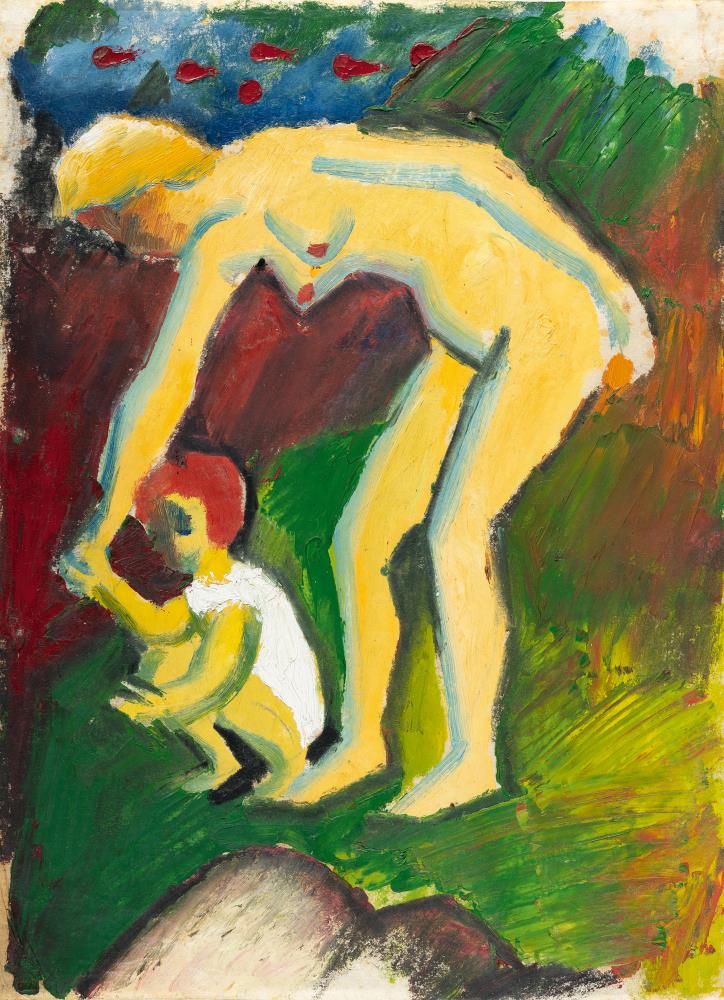
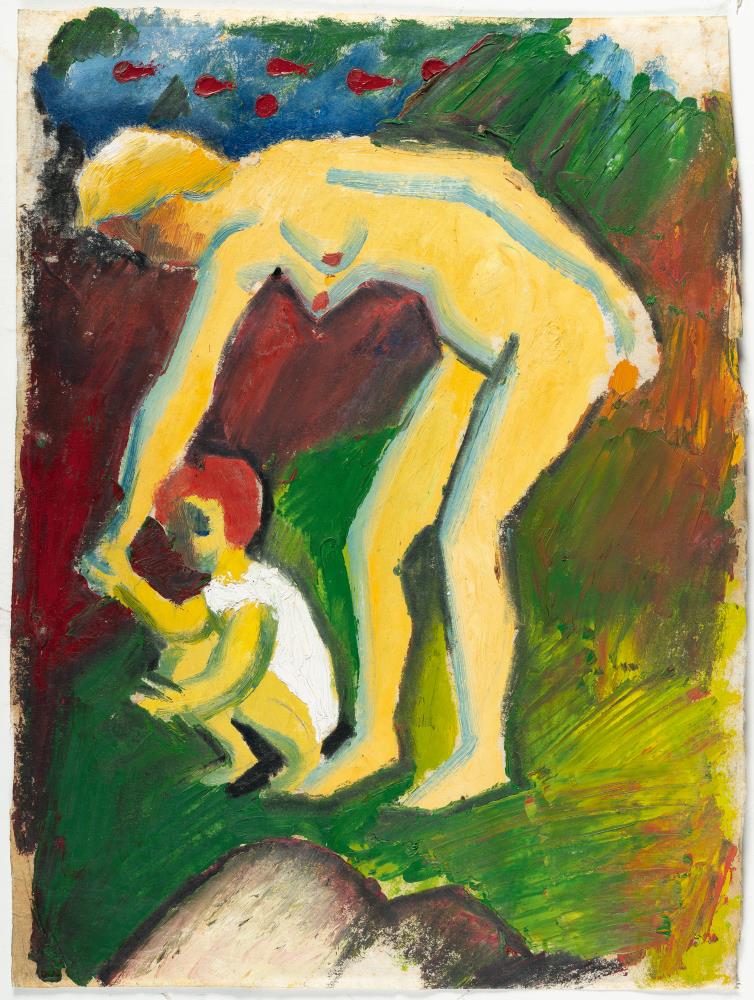
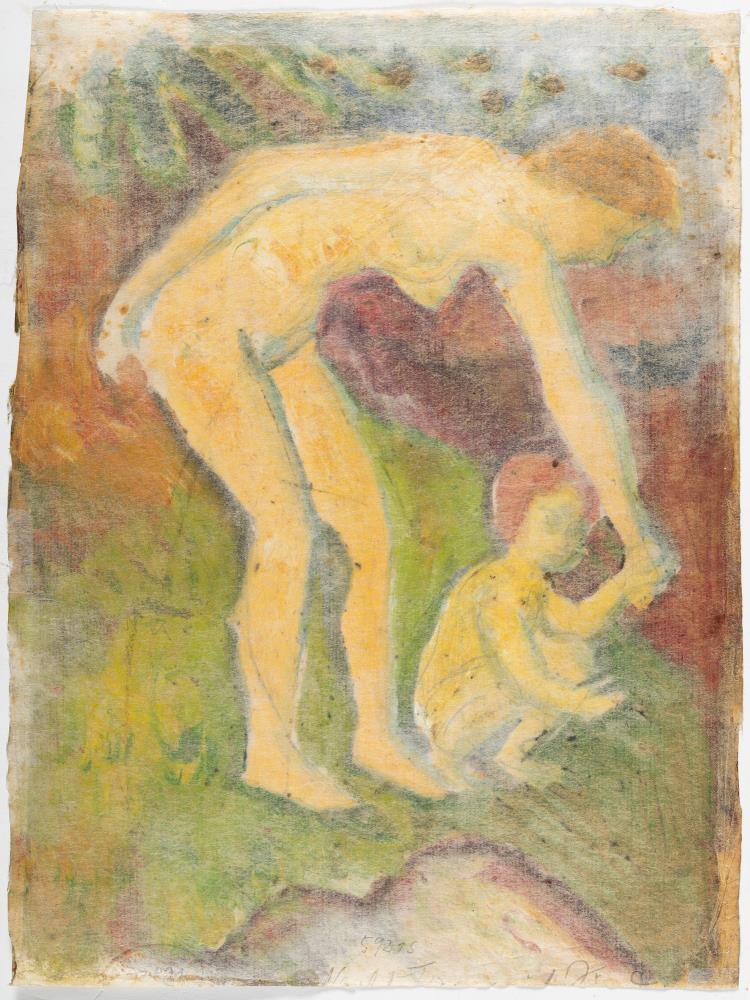
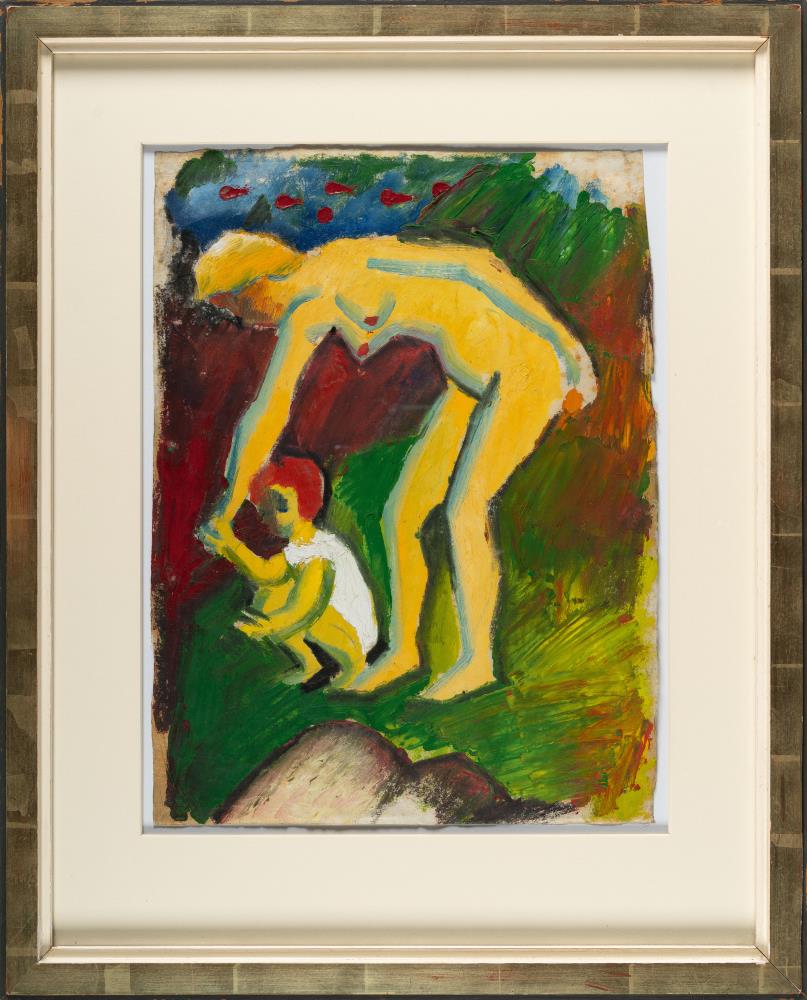
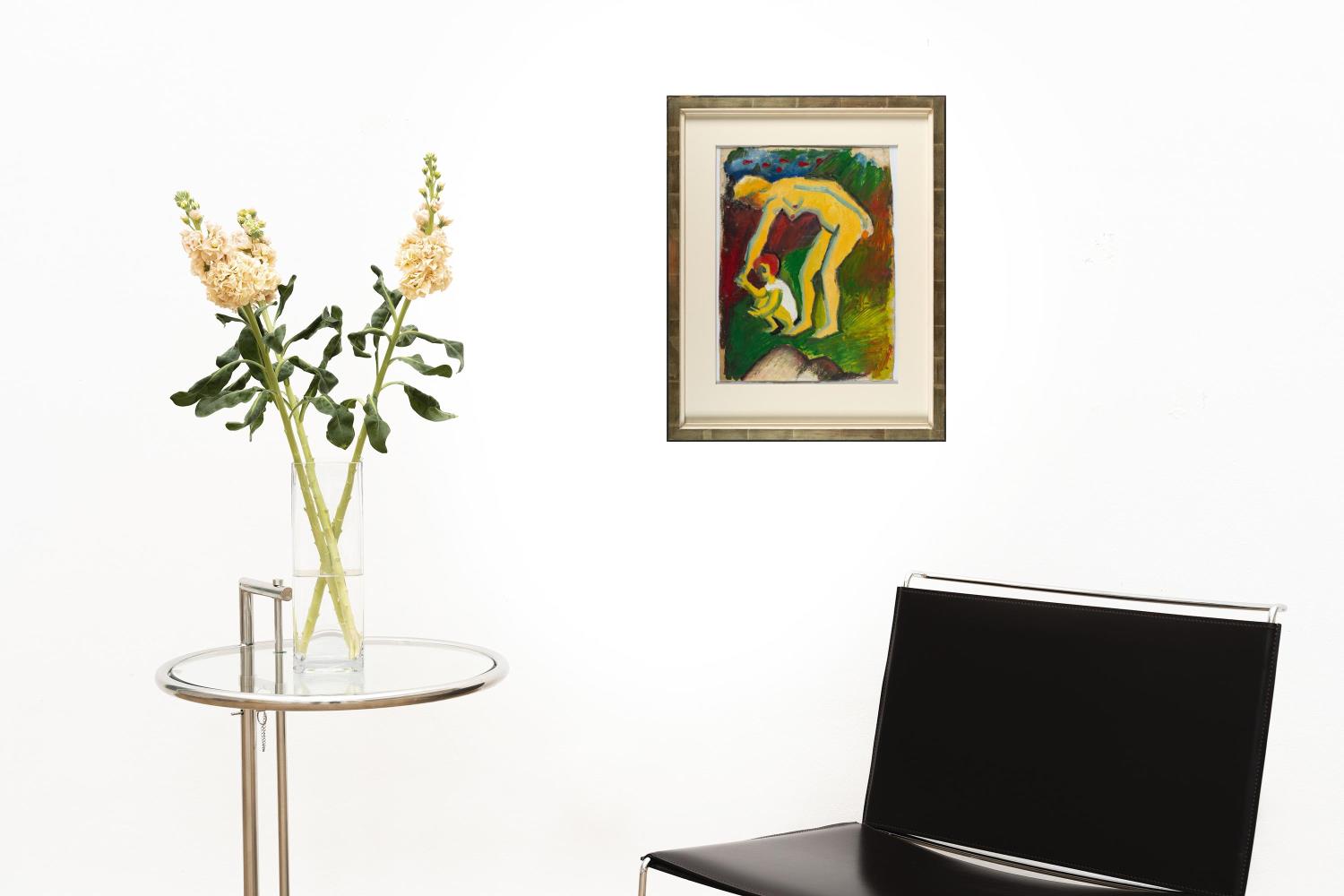
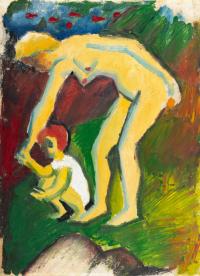
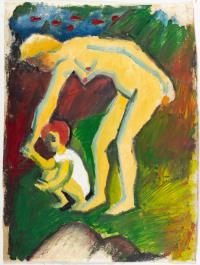
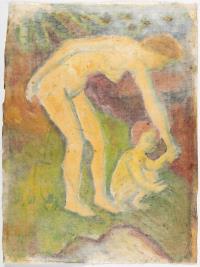
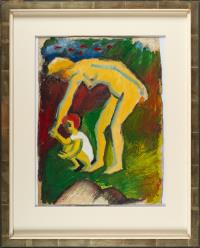
Naked woman with child
Artist
August Macke
1887 Meschede - Perthes-lès-Hurlus 1914
Further information
Verso am unteren Blattrand mit unleserlichen handschriftlichen Bezeichnungen.
Vriesen 361; Heiderich 373.
Vriesen 361; Heiderich 373.
Provenance
The artist’s estate, on the reverse and on the backing board of the frame with the partially cut-off stamp (Lugt 1775b);
Galerie Vömel, Düsseldorf;
Private collection, Essen, acquired from the aforementioned in 1958, passed to the current owner by inheritance in 1981;
Private collection, Southern Germany.
Galerie Vömel, Düsseldorf;
Private collection, Essen, acquired from the aforementioned in 1958, passed to the current owner by inheritance in 1981;
Private collection, Southern Germany.
Share


Description
• Expressive, spontaneous oil sketch with luminous colours
• Rare combination of the thematic areas of children’s and nude depictions
• Created at the height of August Macke’s artistic career in 1912
The Bonn years 1911–1913 were a particularly successful period for August Macke. They were marked by intensive exhibition activities with the Blue Rider, the Rhenish Expressionists, the Cologne Gereonsklub and the Sonderbund, where, as a gifted networker, he often pulled the organisational strings. Furthermore, Macke was also well-connected internationally, maintaining contacts in Scandinavia and Russia, Switzerland and, above all, France. Alongside his active professional life, Macke was also a devoted family man. His body of work includes numerous portraits of his wife Elisabeth, depictions of his two sons Walter and Wolfgang, born in 1910 and 1913 respectively, and scenes from his own home or garden. The oil sketch ‘Naked Woman with Child’, with its unusual combination of a nude and a child, presumably depicts not a real but rather a fictional situation that combines the two themes of children and nudes. It is tempting to see Elisabeth and their first son Walter, born in 1910, in the motif. However, this is rather unlikely, as Elisabeth had dark hair and Walter only had a light reddish-brown head of hair. Nevertheless, this work ranks among August Macke’s popular intimate family scenes.
"Macke regarded life within the family circle with his wife and two sons as happiness, and art and life as ‘rejoicing in nature’. This positive outlook on life found its very own artistic expression above all during his years in Bonn from 1911 to 1913. In his pictorial worlds, he creates varied and multifaceted depictions of an earthly paradise. His works prove to be a vision of a harmonious world order and are (…) at the same time a counter-concept to his era, which was shaped by technical innovations and industrialisation. Whilst the great world exhibitions of the 19th century in Paris and London situated the South Seas or the Orient as distant places of longing, Macke locates his earthly paradise in the here and now of the real world. (…) In intimate, everyday scenes, Macke depicts the world of children, who appear naturally and uninhibitedly absorbed in their play. (…) (Ina Ewers-Schultz, August Macke 1887–1914. Life and Work, online text August Macke Haus, Bonn, Chapter VIII. Earthly Paradise: https://www.august-macke-haus.de/august-macke/leben-und-werk.html).
• Rare combination of the thematic areas of children’s and nude depictions
• Created at the height of August Macke’s artistic career in 1912
The Bonn years 1911–1913 were a particularly successful period for August Macke. They were marked by intensive exhibition activities with the Blue Rider, the Rhenish Expressionists, the Cologne Gereonsklub and the Sonderbund, where, as a gifted networker, he often pulled the organisational strings. Furthermore, Macke was also well-connected internationally, maintaining contacts in Scandinavia and Russia, Switzerland and, above all, France. Alongside his active professional life, Macke was also a devoted family man. His body of work includes numerous portraits of his wife Elisabeth, depictions of his two sons Walter and Wolfgang, born in 1910 and 1913 respectively, and scenes from his own home or garden. The oil sketch ‘Naked Woman with Child’, with its unusual combination of a nude and a child, presumably depicts not a real but rather a fictional situation that combines the two themes of children and nudes. It is tempting to see Elisabeth and their first son Walter, born in 1910, in the motif. However, this is rather unlikely, as Elisabeth had dark hair and Walter only had a light reddish-brown head of hair. Nevertheless, this work ranks among August Macke’s popular intimate family scenes.
"Macke regarded life within the family circle with his wife and two sons as happiness, and art and life as ‘rejoicing in nature’. This positive outlook on life found its very own artistic expression above all during his years in Bonn from 1911 to 1913. In his pictorial worlds, he creates varied and multifaceted depictions of an earthly paradise. His works prove to be a vision of a harmonious world order and are (…) at the same time a counter-concept to his era, which was shaped by technical innovations and industrialisation. Whilst the great world exhibitions of the 19th century in Paris and London situated the South Seas or the Orient as distant places of longing, Macke locates his earthly paradise in the here and now of the real world. (…) In intimate, everyday scenes, Macke depicts the world of children, who appear naturally and uninhibitedly absorbed in their play. (…) (Ina Ewers-Schultz, August Macke 1887–1914. Life and Work, online text August Macke Haus, Bonn, Chapter VIII. Earthly Paradise: https://www.august-macke-haus.de/august-macke/leben-und-werk.html).