Wassily Kandinsky
Ohne Titel

Artist
Wassily Kandinsky
Exhibition
The garden of the avant-garde. Heinrich Kirchhoff. A collector of Jawlensky, Klee, Nolde, Museum Wiesbaden, 2017/18, col. Ill. p. 362.
Provenance
Heinrich Kirchhoff Collection, Wiesbaden, received as a gift from the artist in 1930/31;
Private collection, USA;
Christie's, New York 5.11.1981, lot 401;
Hauswedell & Nolte, Hamburg 9.6.1984, lot 813;
Christie's, New York 7.5.2008, lot 172;
Private collection, Rhineland;
Private collection, Berlin.
Private collection, USA;
Christie's, New York 5.11.1981, lot 401;
Hauswedell & Nolte, Hamburg 9.6.1984, lot 813;
Christie's, New York 7.5.2008, lot 172;
Private collection, Rhineland;
Private collection, Berlin.
Share


Description
- Outstanding example of geometric abstraction from the Bauhaus period
- Rare dedication and first-class historical provenance
- Important comparative work exists in a museum context
Wassily Kandinsky was fascinated by the artistic innovations from Russia and Europe. Inspired by the advanced technologies and theories of his time, he devoted himself to geometric abstraction and created works that are reminiscent of constructivist compositions and are characterized by a remarkable reduction and austerity.
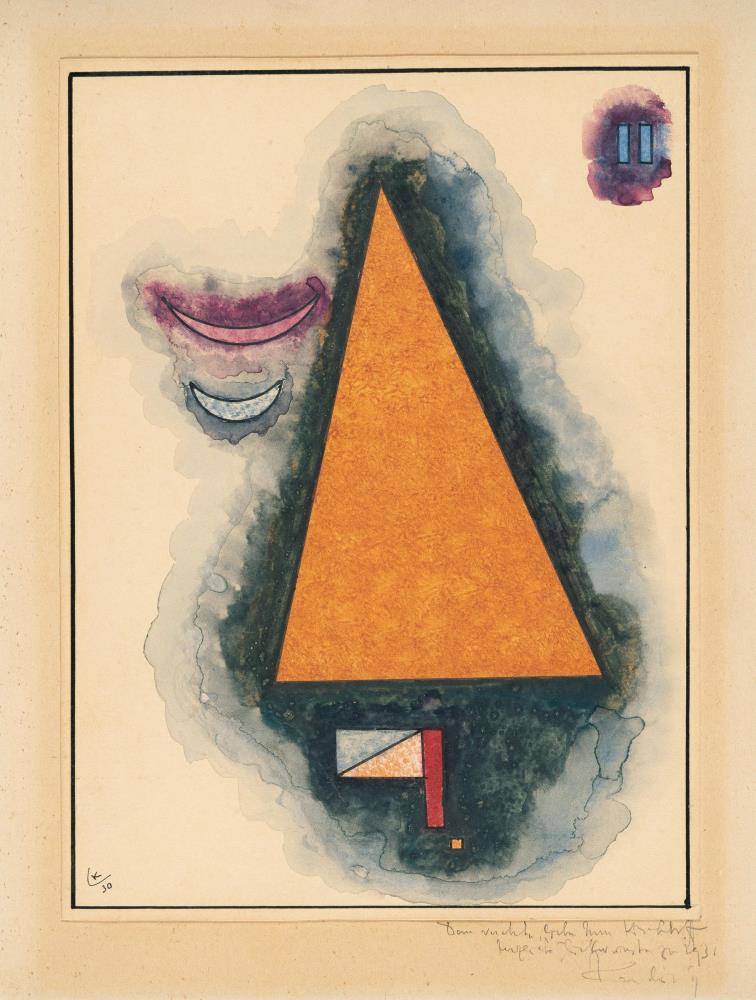
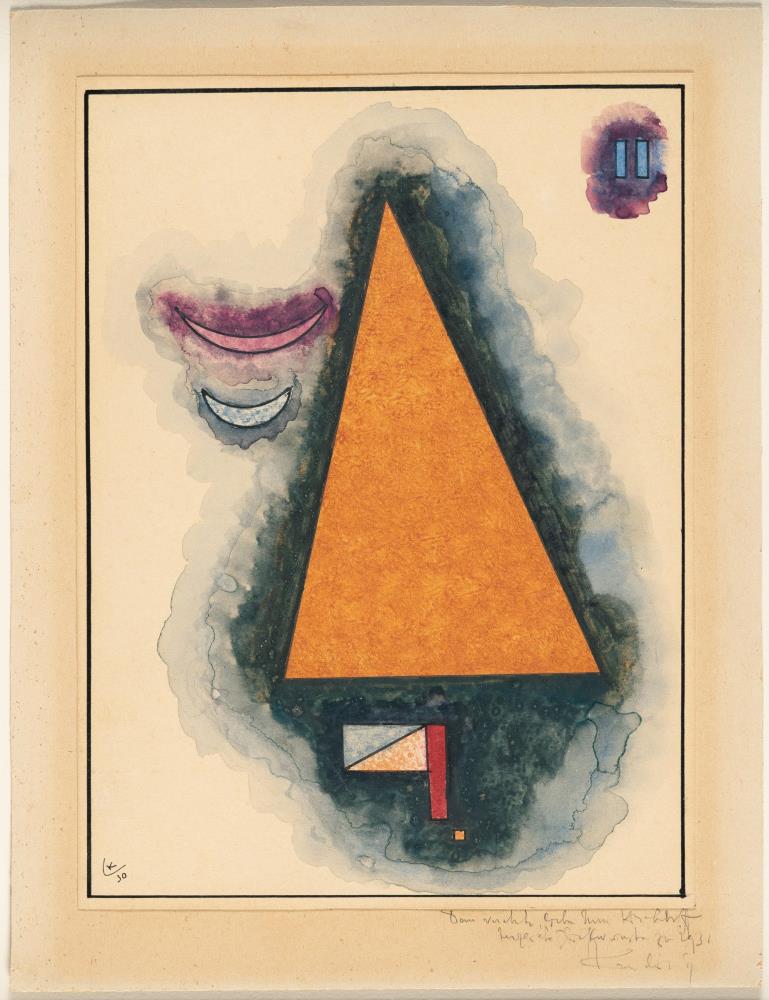
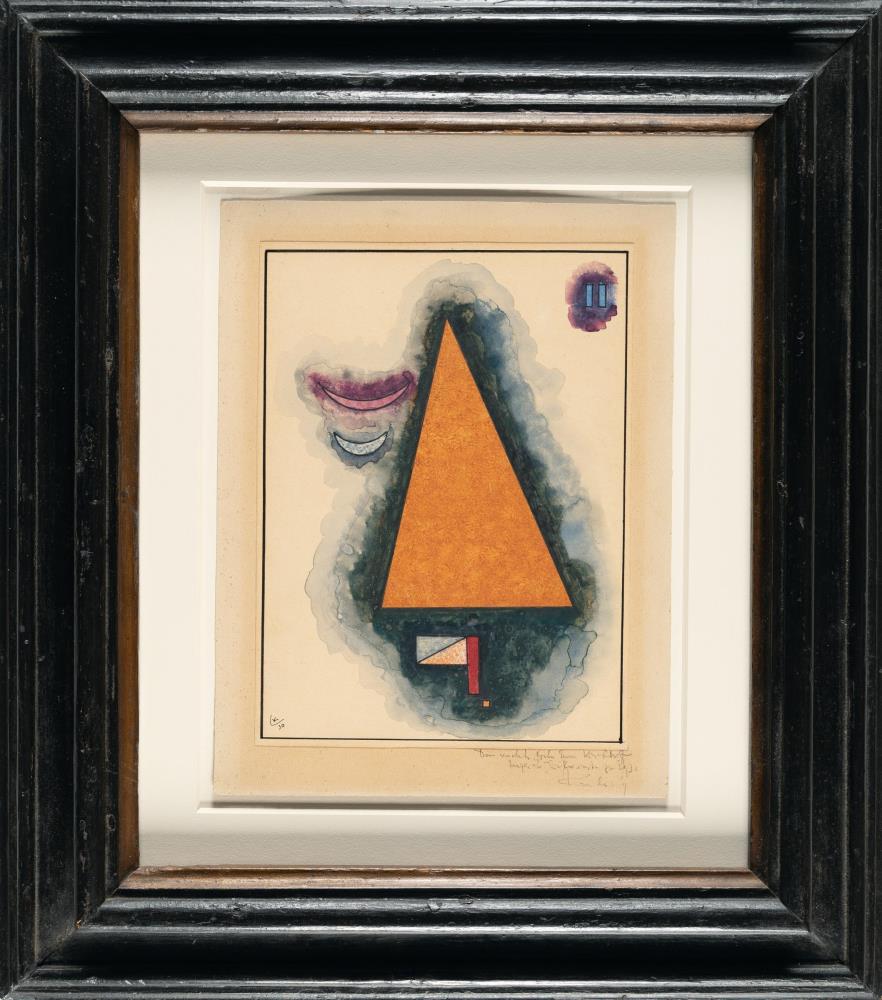
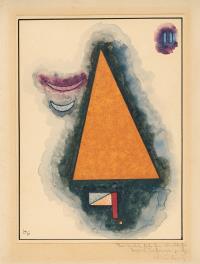
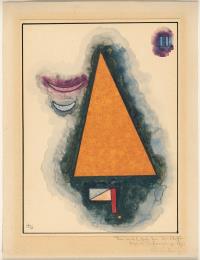
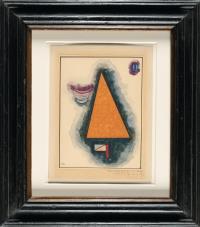
The present untitled work has an abbreviated and calming visual language and appears less expressive than earlier works. Schematized individual forms determine the composition. An orange, slightly asymmetrical triangle dominates the center. Other geometric shapes - triangle, rectangle and crescent - float isolated on a dark watercolor cloud in dark green, blue and violet, which contrasts with the light shade of the paper. By using the complementary contrast of orange and blue, Kandinsky achieves an effect rich in tension and contrast that lends the sheet an inner vitality.
In his writings on abstract art, Kandinsky develops his ideas on the theory of color and form, color psychology and the connection between painting and music. As a synaesthete, he experienced colors not only as visual but also as acoustic stimuli. His theoretical texts act as a key to his thinking about the emotional and psychological effects of color and form and explain the concept of "color sound" or "color symphony" as a central artistic principle.
His programmatic essay "On the Spiritual in Art" (1912) was followed from 1921 by what he himself called the "cool" period, although this was characterized by emotional depth. When Kandinsky speaks of "coolness" and "ice", he means this in an existential sense: "that the highest coolness is the highest tragedy". In a letter to the art critic Will Grohmann in 1930, he formulated it almost visionarily: "Thus the coming Romanticism will be a piece of ice in which a flame burns. If people only feel the ice and not the flame, so much the worse for them."
In 1922, following Walter Gropius' call, Kandinsky took up a professorship at the State Bauhaus in Weimar, where he taught for eleven years in an environment characterized by international exchange and creative diversity. His colleagues included Josef Albers, Marcel Breuer, Lyonel Feininger, Johannes Itten, Paul Klee, László Moholy-Nagy and Oskar Schlemmer. The dialog between fine and applied arts, which transcends the boundaries of disciplines, enriches his painting considerably.
When the Bauhaus moved to Dessau in 1925, Kandinsky's formal language underwent further reduction and simplification, characterized by the play of geometric elements. Instead of the dominant diagonals, he increasingly opted for the orthogonal and planimetric arrangement of pictorial elements, as shown in the present watercolor. It is also closely related to the painting "Weisse Schärfe" (November 1930), created in the same year, for which Kandinsky chose a similar composition (cf. WVZ Roethel/Benjamin 975). Remarkable is the use of the same, only slightly altered geometric forms and their arrangement as well as the different color execution, which is characterized above all by a black and white contrast. A large, white marbled triangle rests in the center, surrounded by a dark, amorphous form. The composition evokes associations with an abstract portrait. The work has been in the Museum Boijmans van Beuningen in Rotterdam since 1964.
Kandinsky dedicated the sheet to the Wiesbaden art collector and patron Heinrich Kirchhoff (1874-1934) at the turn of the year 1931. Kirchhoff, one of the most important collectors of modern art in Germany, cultivated close contacts with numerous artists of his time and owned works by Wassily Kandinsky, Paul Klee, Oskar Kokoschka, Franz Marc, Emil Nolde, George Grosz, Conrad Felixmüller and Alexej von Jawlensky, whose most important patron he became. After Kirchhoff's death in 1934, his outstanding collection was broken up and sold.
Noteworthy is the formal similarity to another work by Kandinsky, the square oil painting "Calm" (1930), which was created at the Bauhaus in the same year and is being offered in this auction at Karl & Faber (lot 569).
Barnett 1005.
- Rare dedication and first-class historical provenance
- Important comparative work exists in a museum context
Wassily Kandinsky was fascinated by the artistic innovations from Russia and Europe. Inspired by the advanced technologies and theories of his time, he devoted himself to geometric abstraction and created works that are reminiscent of constructivist compositions and are characterized by a remarkable reduction and austerity.
The present untitled work has an abbreviated and calming visual language and appears less expressive than earlier works. Schematized individual forms determine the composition. An orange, slightly asymmetrical triangle dominates the center. Other geometric shapes - triangle, rectangle and crescent - float isolated on a dark watercolor cloud in dark green, blue and violet, which contrasts with the light shade of the paper. By using the complementary contrast of orange and blue, Kandinsky achieves an effect rich in tension and contrast that lends the sheet an inner vitality.
In his writings on abstract art, Kandinsky develops his ideas on the theory of color and form, color psychology and the connection between painting and music. As a synaesthete, he experienced colors not only as visual but also as acoustic stimuli. His theoretical texts act as a key to his thinking about the emotional and psychological effects of color and form and explain the concept of "color sound" or "color symphony" as a central artistic principle.
His programmatic essay "On the Spiritual in Art" (1912) was followed from 1921 by what he himself called the "cool" period, although this was characterized by emotional depth. When Kandinsky speaks of "coolness" and "ice", he means this in an existential sense: "that the highest coolness is the highest tragedy". In a letter to the art critic Will Grohmann in 1930, he formulated it almost visionarily: "Thus the coming Romanticism will be a piece of ice in which a flame burns. If people only feel the ice and not the flame, so much the worse for them."
In 1922, following Walter Gropius' call, Kandinsky took up a professorship at the State Bauhaus in Weimar, where he taught for eleven years in an environment characterized by international exchange and creative diversity. His colleagues included Josef Albers, Marcel Breuer, Lyonel Feininger, Johannes Itten, Paul Klee, László Moholy-Nagy and Oskar Schlemmer. The dialog between fine and applied arts, which transcends the boundaries of disciplines, enriches his painting considerably.
When the Bauhaus moved to Dessau in 1925, Kandinsky's formal language underwent further reduction and simplification, characterized by the play of geometric elements. Instead of the dominant diagonals, he increasingly opted for the orthogonal and planimetric arrangement of pictorial elements, as shown in the present watercolor. It is also closely related to the painting "Weisse Schärfe" (November 1930), created in the same year, for which Kandinsky chose a similar composition (cf. WVZ Roethel/Benjamin 975). Remarkable is the use of the same, only slightly altered geometric forms and their arrangement as well as the different color execution, which is characterized above all by a black and white contrast. A large, white marbled triangle rests in the center, surrounded by a dark, amorphous form. The composition evokes associations with an abstract portrait. The work has been in the Museum Boijmans van Beuningen in Rotterdam since 1964.
Kandinsky dedicated the sheet to the Wiesbaden art collector and patron Heinrich Kirchhoff (1874-1934) at the turn of the year 1931. Kirchhoff, one of the most important collectors of modern art in Germany, cultivated close contacts with numerous artists of his time and owned works by Wassily Kandinsky, Paul Klee, Oskar Kokoschka, Franz Marc, Emil Nolde, George Grosz, Conrad Felixmüller and Alexej von Jawlensky, whose most important patron he became. After Kirchhoff's death in 1934, his outstanding collection was broken up and sold.
Noteworthy is the formal similarity to another work by Kandinsky, the square oil painting "Calm" (1930), which was created at the Bauhaus in the same year and is being offered in this auction at Karl & Faber (lot 569).
Barnett 1005.