Heinrich Campendonk
Virgin Annunciation



Artist
Heinrich Campendonk
Ausstellung
Heinrich Campendonk 1889-1957, Pfalzgalerie, Kaiserslautern 1982, cat. no. 53, col. illus. ;simple. magical. The pictorial worlds of Heinrich Campendonk, Museum Penzberg - Campendonk Collection, Penzberg 2018, special exhib. o. cat.
Provenance
Max Glaeser Collection (1871-1931), Eselsfürth near Kaiserslautern (until 1959);Private collection;Sotheby's, London 28.6.1995, lot 179;Galerie Cazeau-Béraudière, Paris;Private collection;Christie's, London 8.2.2012, lot 212;Galerie Salis & Vertes, Zurich/Salzburg;Private collection, Switzerland.
Share


Description
- Campendonk combines his characteristic geometric formal language with a dynamic composition characterized by seemingly floating figures
- Intensely luminous complementary contrasts create a lyrical, almost fairytale-like atmosphere
- From the important Max Glaeser collection near Kaiserslautern, which, in addition to Slevogt, Liebermann, Corinth, Munch and Hofer, primarily comprised Expressionist works
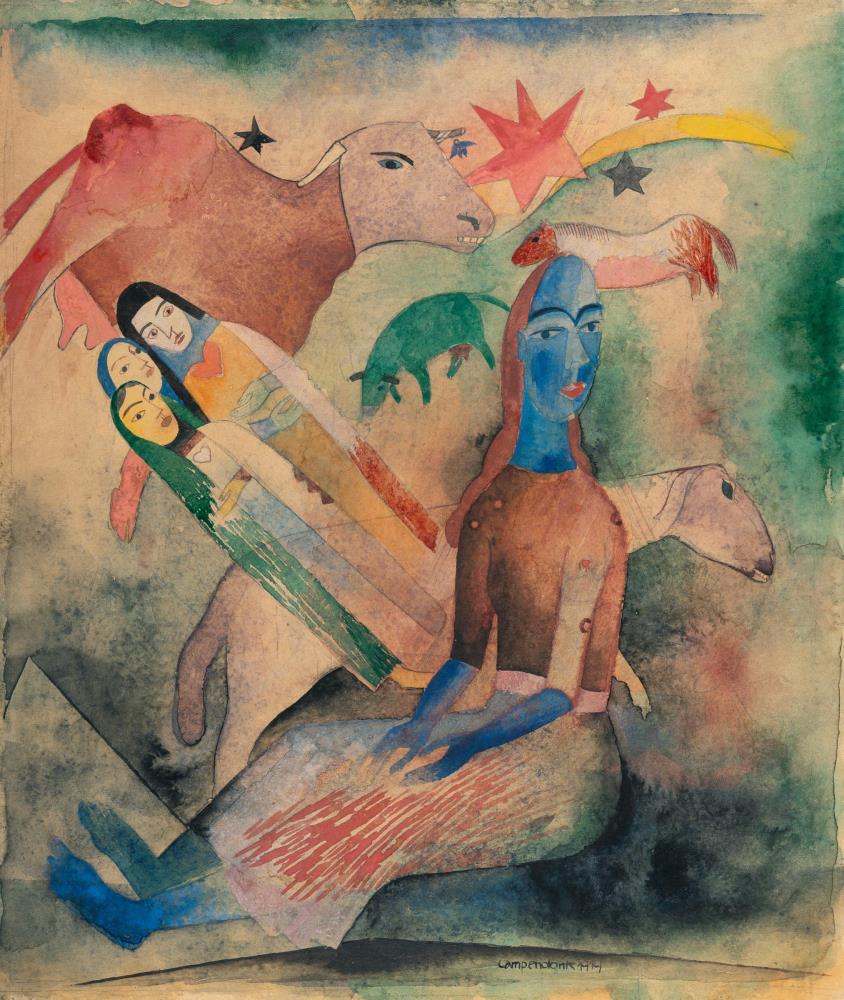
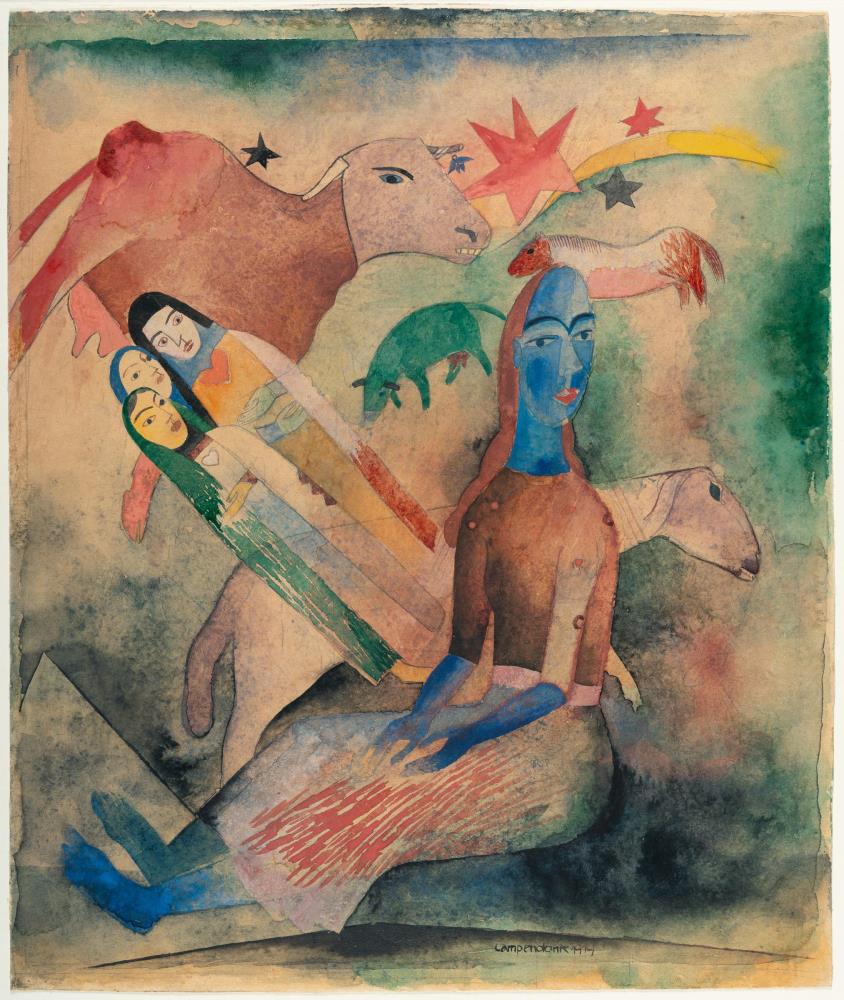
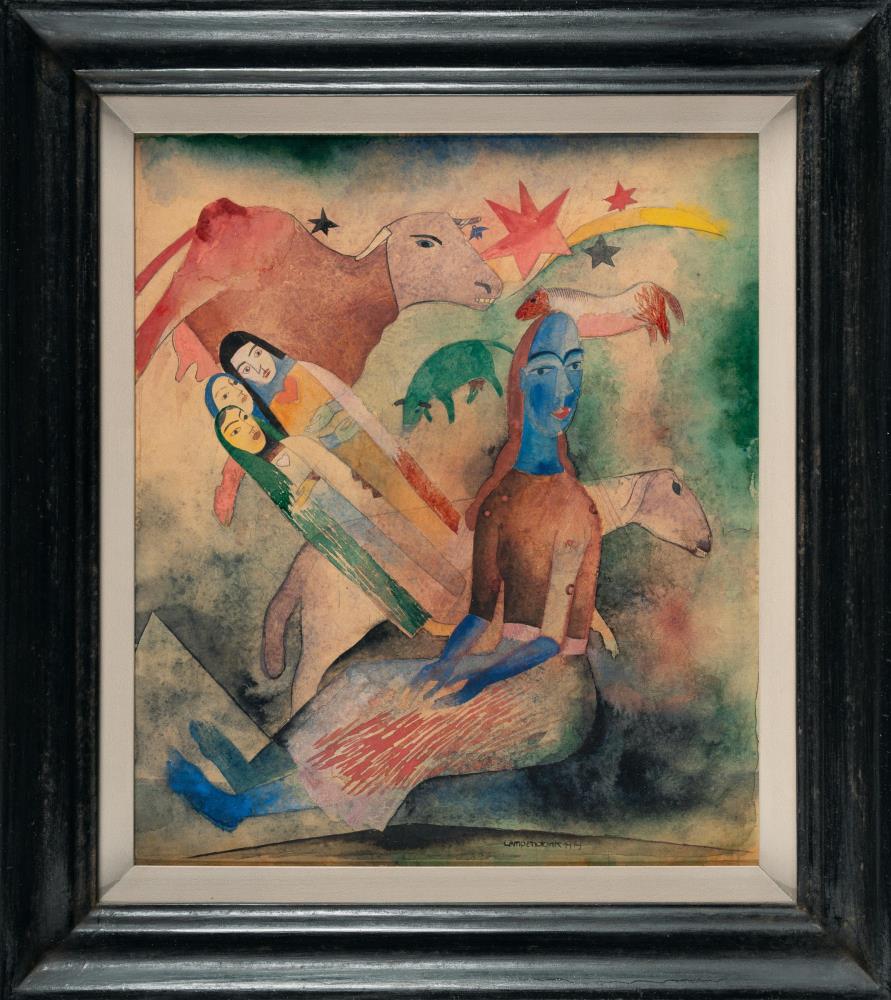
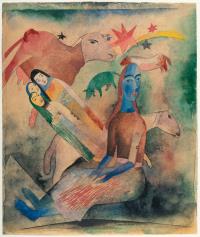
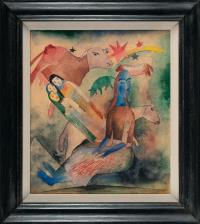
Campendonk himself evidently considered the sheet "Annunciation of the Virgin Mary" from 1919 to be particularly successful, as he signed it with his name written out in full. In it, he breaks with the traditional way of depicting the subject: the Annunciation does not take place in an interior space, but in nature expanded into the cosmic with animals, stars and the crescent moon. The message is not delivered by an angel, but by three women dressed in a strict habit, who wear their hearts on their chests but do not hand over a lily. It is remarkable that Mary is not clothed in a blue cloak, but is wearing a radiant blue incarnation.
What the picture is about is the heavenly greeting to Mary, which, depending on the translation language of the Gospel of Luke, reads: Rejoice (Greek), Peace be with you (Hebrew), Blessed are you (Latin), Hail Mary (Luther translation). In 1919, after four years of war, peace has finally come, a reason for vital joy. The grace of God is proclaimed here in a secularized form, the conception of the child is a sign of hope - and perhaps also a reference by Campendonk to the birth of his own daughter Gerda in May 1918.
Despite the still seated figure of the Virgin Mary, this is a very dynamic depiction. Several arches swinging horizontally are drawn as lines as well as being recognizable through changes in colour. They set the scene in motion: the curves at the lower and upper edges of the picture - the contour of the seated figure's knee - the curve around the tail and back of the sheep, which continues over the pig and horse - the line across the cow's back to the crescent moon. The swaying is intensified to the point of rotation by the actually very rigid group of three women, who are placed at an angle to the center of gravity of the Marian figure.
The highly stylized forms are carefully painted with a brush, while the background shows a completely different approach to the paint: Patches of very watery watercolor, applied in sections in several layers, provide both a light, transparent-looking pictorial space as well as carrying a dynamic of light and shadow, lightness and weighty materiality into the pictorial effect. The composition gains spatial depth precisely through areas where dark and light meet, such as above the feet of the figure of the Virgin Mary. The complementary colors green and the palette from ochre to rust to red on the one hand and the radiant blue and clear yellow of the crescent moon on the other determine the color effect - as does the contrast of cold against warm colors typical of Campendonk's perception of color. Gisela Geiger
Firmenich 809 A.
A loan request has been submitted for the work for a small intervention in the permanent exhibition at the Museum Penzberg. The exhibition ‘...and Isaiah spoke!’ will run until the end of February 2026.
- Intensely luminous complementary contrasts create a lyrical, almost fairytale-like atmosphere
- From the important Max Glaeser collection near Kaiserslautern, which, in addition to Slevogt, Liebermann, Corinth, Munch and Hofer, primarily comprised Expressionist works
Campendonk himself evidently considered the sheet "Annunciation of the Virgin Mary" from 1919 to be particularly successful, as he signed it with his name written out in full. In it, he breaks with the traditional way of depicting the subject: the Annunciation does not take place in an interior space, but in nature expanded into the cosmic with animals, stars and the crescent moon. The message is not delivered by an angel, but by three women dressed in a strict habit, who wear their hearts on their chests but do not hand over a lily. It is remarkable that Mary is not clothed in a blue cloak, but is wearing a radiant blue incarnation.
What the picture is about is the heavenly greeting to Mary, which, depending on the translation language of the Gospel of Luke, reads: Rejoice (Greek), Peace be with you (Hebrew), Blessed are you (Latin), Hail Mary (Luther translation). In 1919, after four years of war, peace has finally come, a reason for vital joy. The grace of God is proclaimed here in a secularized form, the conception of the child is a sign of hope - and perhaps also a reference by Campendonk to the birth of his own daughter Gerda in May 1918.
Despite the still seated figure of the Virgin Mary, this is a very dynamic depiction. Several arches swinging horizontally are drawn as lines as well as being recognizable through changes in colour. They set the scene in motion: the curves at the lower and upper edges of the picture - the contour of the seated figure's knee - the curve around the tail and back of the sheep, which continues over the pig and horse - the line across the cow's back to the crescent moon. The swaying is intensified to the point of rotation by the actually very rigid group of three women, who are placed at an angle to the center of gravity of the Marian figure.
The highly stylized forms are carefully painted with a brush, while the background shows a completely different approach to the paint: Patches of very watery watercolor, applied in sections in several layers, provide both a light, transparent-looking pictorial space as well as carrying a dynamic of light and shadow, lightness and weighty materiality into the pictorial effect. The composition gains spatial depth precisely through areas where dark and light meet, such as above the feet of the figure of the Virgin Mary. The complementary colors green and the palette from ochre to rust to red on the one hand and the radiant blue and clear yellow of the crescent moon on the other determine the color effect - as does the contrast of cold against warm colors typical of Campendonk's perception of color. Gisela Geiger
Firmenich 809 A.
A loan request has been submitted for the work for a small intervention in the permanent exhibition at the Museum Penzberg. The exhibition ‘...and Isaiah spoke!’ will run until the end of February 2026.