Albrecht Dürer
The Sea Monster
Künstler
Albrecht Dürer
1471 - Nuremberg - 1528
Weitere Informationen
Bartsch 71; Meder 66 a (of k); Schoch/Mende/Scherbaum 21 a (of k).
Provenienz
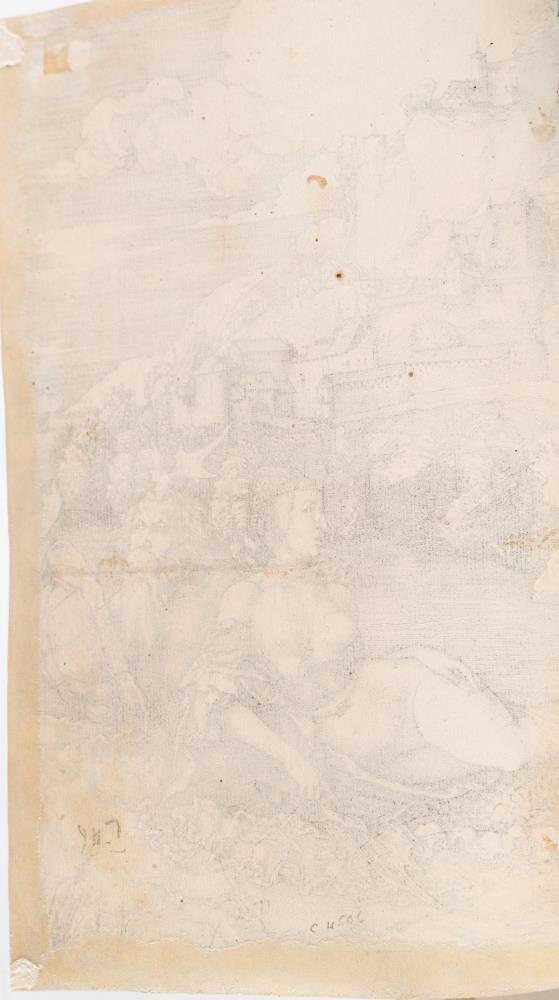
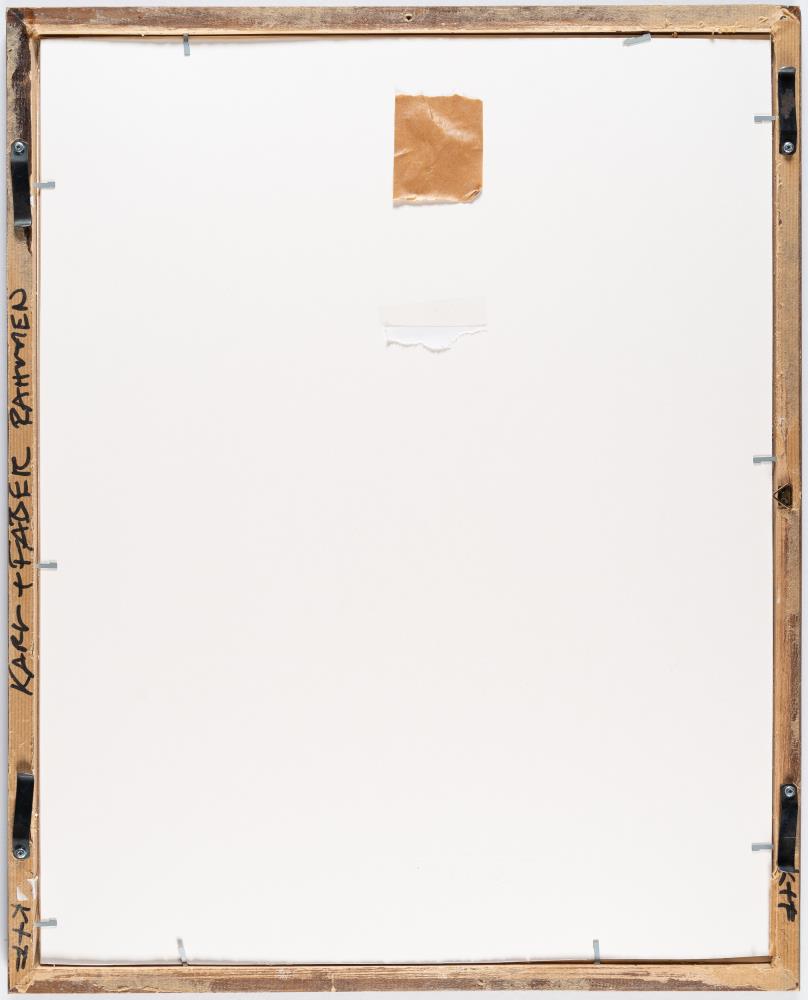
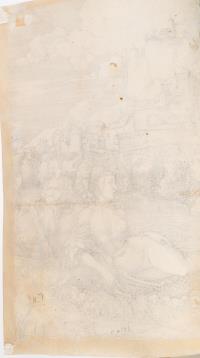
With Colnaghi’s, London, (with their stock number C. 4506 in pencil verso);
Buch- und Kunstantiquariat E + R Kistner, Nürnberg, Dezember 1973 (?).
Buch- und Kunstantiquariat E + R Kistner, Nürnberg, Dezember 1973 (?).
Teilen


Beschreibung
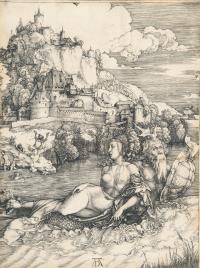
A very good, evenly-inked Meder a impression with fine contrasts, printing with good clarity. Trimmed just inside the platemark, in the lower right corner slightly within the image.
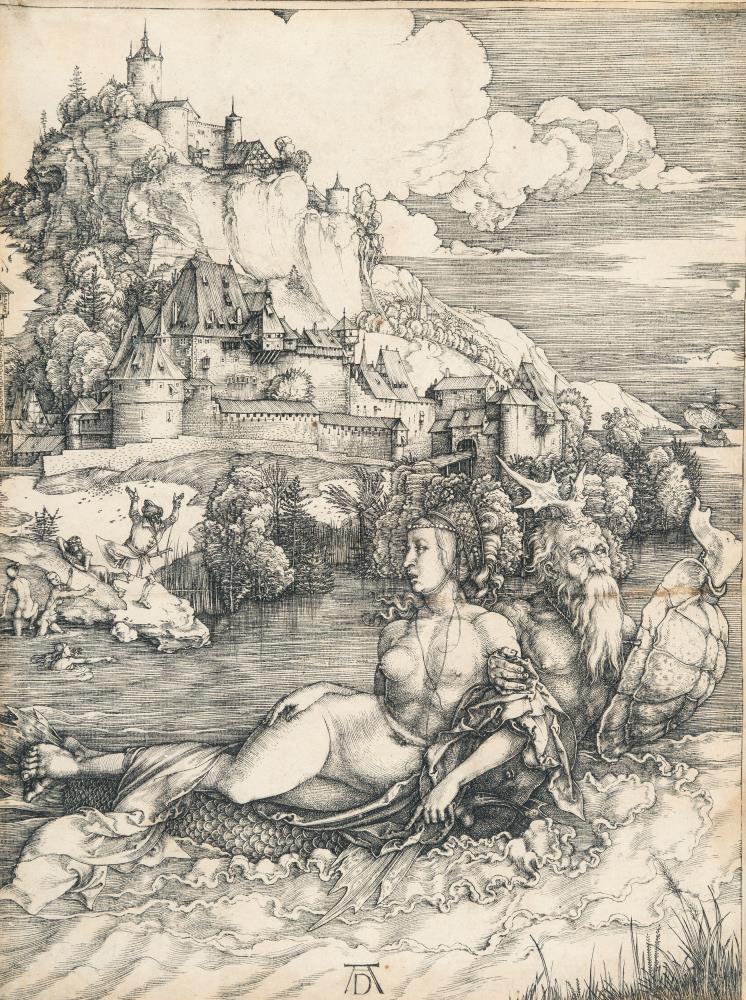
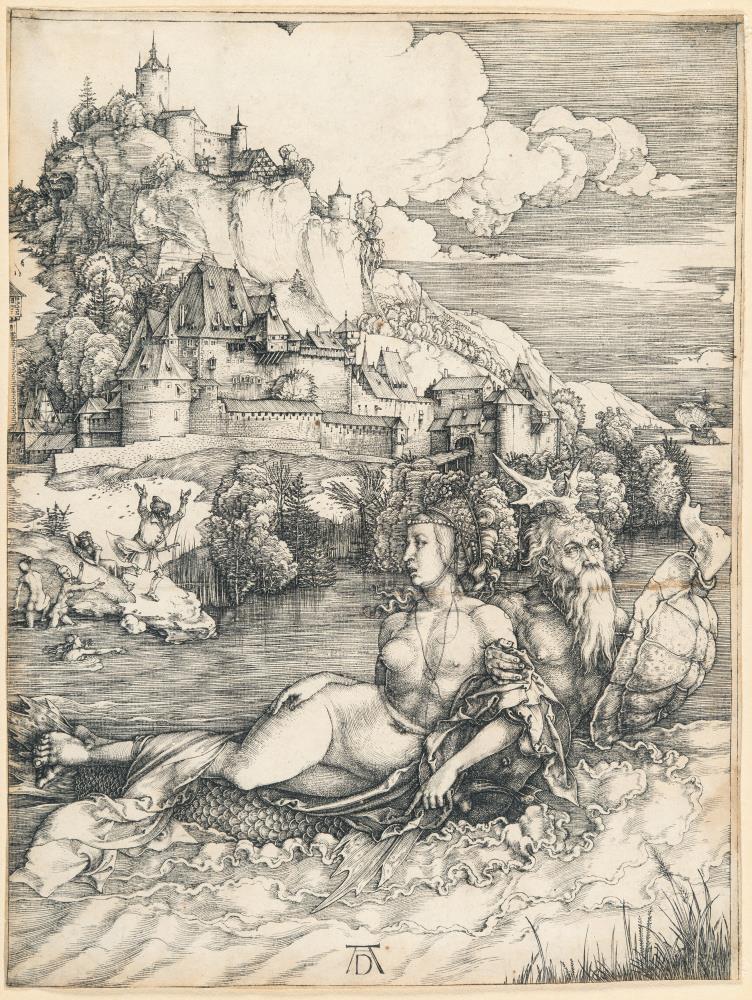
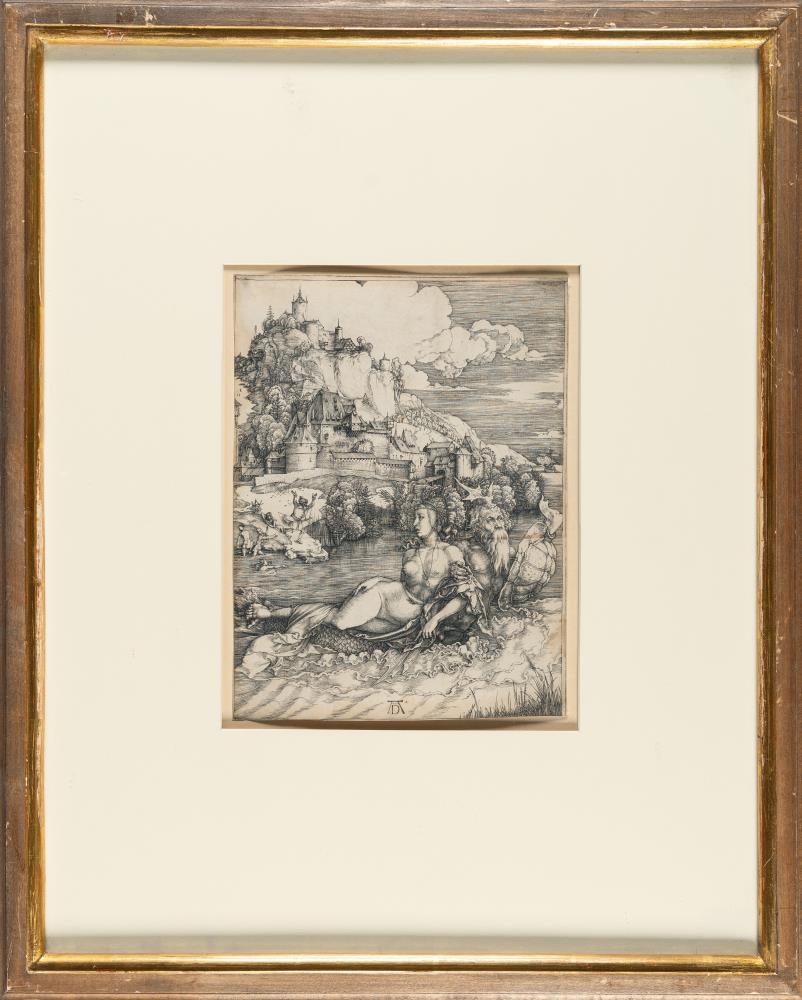
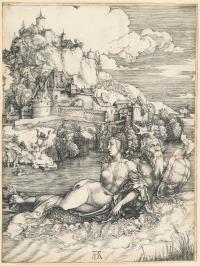
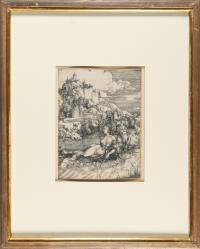
A bearded sea creature – half man, half fish – carries a young woman across the waves. In one hand, it wields a turtle shell pierced by a jawbone, used as a weapon. The abducted figure, scarcely covered by a cloth, appears curiously unfazed; her gaze is calm, almost detached. Her beauty stands in striking contrast to the bizarre and grotesque being that holds her tightly in its grasp.
The scene draws on a mythological subject that has yet to be conclusively identified in iconographic terms. Albrecht Dürer himself referred to the print in the diary of his journey to the Netherlands as "Meerwunder".
The female nude reflects Dürer’s engagement with a new ideal of beauty rooted in reason and measurability – a concept inspired by classical antiquity and central to the spirit of the Renaissance (cf. R. Schoch, p. 74). – A few isolated brown spots. A small restoration in the upper edge to the right. The lower right corner restored and traced with black ink. A closed tear extending from the right edge; here, the paper is slightly browned; along the edges on the reverse side, with remnants of a surrounding mount, otherwise in good condition.
A bearded sea creature – half man, half fish – carries a young woman across the waves. In one hand, it wields a turtle shell pierced by a jawbone, used as a weapon. The abducted figure, scarcely covered by a cloth, appears curiously unfazed; her gaze is calm, almost detached. Her beauty stands in striking contrast to the bizarre and grotesque being that holds her tightly in its grasp.
The scene draws on a mythological subject that has yet to be conclusively identified in iconographic terms. Albrecht Dürer himself referred to the print in the diary of his journey to the Netherlands as "Meerwunder".
The female nude reflects Dürer’s engagement with a new ideal of beauty rooted in reason and measurability – a concept inspired by classical antiquity and central to the spirit of the Renaissance (cf. R. Schoch, p. 74). – A few isolated brown spots. A small restoration in the upper edge to the right. The lower right corner restored and traced with black ink. A closed tear extending from the right edge; here, the paper is slightly browned; along the edges on the reverse side, with remnants of a surrounding mount, otherwise in good condition.